

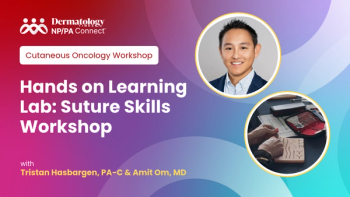
Attendees put technique into practice during an interactive suturing session led by Tristan Hasbargen, PA-C, using individual kits and real-world clinical examples.
Attendees put technique into practice during an interactive suturing session led by Tristan Hasbargen, PA-C, using individual kits and real-world clinical examples.
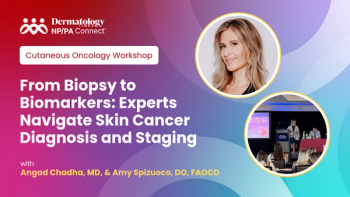
At the Cutaneous Oncology Workshop, faculty explored lesion recognition, surgical decision-making, risk stratification, and the evolving role of molecular testing.

Faculty at the Dermatology Times Cutaneous Oncology Workshop addressed real-world questions on mole mapping, biopsy decisions, oral photoprotection, and actinic keratosis treatment.
As chair of the new Dermatology Times NP/PA Connect Cutaneous Oncology Workshop, Tristan Hasbargen, PA-C, discusses the program's curriculum and goals live in Tampa, Florida.
Dermatology Times kicks off its first Cutaneous Oncology Workshop, bringing APPs and experts together for practical skin cancer education.

Advanced practice providers will gather September 12 for a full-day program covering skin cancer prevention, diagnosis, staging, treatment, and procedural skills.
Explore the top dermatology conferences and meetings happening this month and let us know which ones you'll be attending!

Physicians' Education Resource and Dermatology Times debut a dedicated NP/PA education platform and a new congress series, opening with Derm Nexus this November in Scottsdale, Arizona.
Lisa Weiss, PA, discussed timely immunodermatology education, standout sessions, and the collaborative community at Elevate-Derm.
Eileen Cheever, MPAS, PA-C, discussed patient advocacy, mentorship, and improving dermatologic care across different stages of life.
Daniel Butler, MD, discusses the 5Ms of geriatric care, shared decision-making, deprescribing, and emerging approaches to chronic itch.
Daniel Butler, MD, discussed how aging affects psoriasis presentation and the insurance challenges facing older patients in a recent Dermatology Times interview.
Oyetewa Asemba, MD, discussed common mistakes in hair loss and pigmentary disorder care, from scalp exams to treatment vehicle selection.
Eileen Cheever, PA, discussed family hesitancy toward systemic pediatric psoriasis treatment and age-related treatment gaps in dermatology.
Victoria Garcia-Albea, NP, discussed the learning curve dermatology NP fellows experience and the need for greater dermatology education for APPs.
Lisa Swanson, MD, FAAD, discussed expanding oral JAK inhibitor options for younger children with atopic dermatitis and alopecia areata.
Eileen Cheever, PA, discussed how understanding immunologic pathways can strengthen patient counseling and treatment confidence in dermatology.

Leon Kircik, MD, discusses the allosteric binding mechanism and safety profile data of zasocitinib in hard-to-treat psoriasis presented at the 2026 American Academy of Dermatology (AAD) Innovation Academy.

Leon Kircik, MD, outlines phase 3 zasocitinib data on palmoplantar psoriasis skin clearance presented at the 2026 American Academy of Dermatology (AAD) Innovation Academy.
Leon Kircik, MD, discusses zasocitinib scalp psoriasis clearance rates from the LATITUDE 1 and 2 trials presented at the 2026 American Academy of Dermatology (AAD) Innovation Academy.
Explore the top dermatology conferences and meetings happening this month and let us know which ones you'll be attending!
Catch up on the biggest clinical updates, expert insights, and exclusive interviews from Elevate-Derm Summer 2026 in San Diego, California.
Catch Up on Coverage From Day 5 of the 3rd Annual Elevate-Derm Summer Conference
Justin Love, PA-C, explains how multidisciplinary care and earlier targeted therapy can improve chronic inflammatory skin disease outcomes.
Catch Up on Coverage From Day 4 of the 3rd Annual Elevate-Derm Summer Conference
Catch Up on Coverage From Day 3 of the 3rd Annual Elevate-Derm Summer Conference

Faculty at Elevate-Derm Summer 2026 discussed the expanding role of oral JAK inhibitors in pediatric dermatology, emphasizing earlier intervention, individualized patient selection, safety monitoring, and family-centered counseling.
Advances in vitiligo, hidradenitis suppurativa, and hair loss were among the key trends Chantel Hillstead, APRN, said APPs should watch.
Lisa Swanson, MD, discussed strategies for counseling patients on JAK inhibitor safety and where she sees the drug class expanding next in a recent Dermatology Times interview.

At Elevate-Derm, Justin Love, PA-C, explains why planning is essential for successful and meaningful patient discussions.