


The panel discusses how to navigate treatment selection when patients have preferences and how to compare the available advanced therapies.
The panel discusses how to navigate treatment selection when patients have preferences and how to compare the available advanced therapies.

In this episode titled "The Future of Vitiligo Care: Patient Selection, Treatment Access, and the Road Ahead," moderator Nada Elbuluk, MD, MSc, FAAD and panelist Susan Taylor, MD, FAAD offer a forward-looking discussion on incorporating systemic JAK inhibitors into clinical practice, individualizing patient selection, and ensuring equitable access to emerging therapies.
Psoriatic arthritis often surfaces years after the skin diagnosis, making the dermatology visit a decisive checkpoint. This opening segment weighs risk markers and the structured questioning that surfaces joint disease before damage sets in.

Dr. Patel presents the program's first case: a 78-year-old woman with an enlarging, ulcerated lesion on the right temple and preauricular area, measuring close to five centimeters.
The panel provides a detailed breakdown of how a BTK inhibitor works in CSU and reviews key findings from the pivotal clinical trials
Linda Stein Gold, MD, presents tapinarof cream as a long-term, nonsteroidal option for pediatric atopic dermatitis based on data presented at the 2026 Society for Pediatric Dermatology Annual Meeting.

Systematic review highlights AI-supported triage, nursing education, and workforce strategies for underserved communities
Learn from Adnan Mir, MD, PhD, on how better biopsies and direct lab communication help APPs and dermatopathologists boost pediatric skin diagnoses and outcomes.
Lawrence Eichenfield, MD, presented phase 3 results showing lebrikizumab boosts skin clearance, eases itch, and looks safe for infants through teens with moderate to severe atopic dermatitis.

Pediatric vitiligo care now prioritizes comorbidity screening like thyroid checks and anemia evaluation, mental health support, and new therapies including JAK trials and phototherapy options.

Linda Stein Gold, MD, discusses pooled phase 3 tapinarof cream data across pediatric atopic dermatitis age groups presented at the 2026 Society for Pediatric Dermatology meeting.
Pediatric histiocytosis updates at SPD 2026 reveal BRAF/MEK targets as dermatopathology and biopsy genetics boost accuracy in complex childhood dermatoses.
Nanette Silverberg, MD, shares new pediatric vitiligo guidance, spotlighting facial-first goals, topicals, UVB, and steroid "rescue" strategies for widespread, fast-moving disease.

In the final episode, “Improving Access to Advanced Nonsteroidal Topical Therapies in Inflammatory Dermatoses,” the panelists explored practical strategies for overcoming barriers to advanced nonsteroidal topical therapies and discussed how these treatments are reshaping long-term disease management. Building on the consensus statement addressing affordable access, the expert faculty examine the challenges patients and clinicians face when attempting to obtain newer targeted topical treatments and review resources that may help improve treatment accessibility.
This episode, titled “The Evolving Role of Nonsteroidal Topicals in Inflammatory Dermatoses,” features panelists discussing the efficacy of advanced targeted topical therapies and their growing role in the long-term management of inflammatory skin diseases. Building on previous discussions of safety and tolerability, the expert faculty review evidence supporting both the short-term and long-term effectiveness of nonsteroidal topical treatments across multiple inflammatory dermatoses.

Derm Dispatch host Renata Block, DMSCc, MMS, PA-C, and Kelly Barta, president and executive director of the International Topical Steroid Awareness Network, discuss the new ICD-10 code for topical steroid withdrawal and ITSAN's international patient registry.

Despite advances in systemic and biologic therapy, topical agents remain the primary treatment for most patients with plaque psoriasis. Dr. Bhutani-Jacques reviews the steroidal and non-steroidal armamentarium and the risks associated with prolonged corticosteroid use.
In this episode titled "Systemic JAK Inhibitors for Vitiligo: Emerging Clinical Trial Data and Safety Considerations," moderator Nada Elbuluk, MD, MSc, FAAD and panelist Susan Taylor, MD, FAAD review the emerging pipeline of oral JAK inhibitors for vitiligo and discuss the safety considerations relevant to this therapeutic class.
As systemic therapy enters earlier in the disease course, coordinated care becomes essential. Dr. Carr and Dr. Patel examine the communication infrastructure, such as tumor boards, referral pathways, and cross-specialty literacy, that distinguishes academic centers from community practice.
The panel explores how to assess the full impact of CSU when the skin looks normal, and how to approach the transition to advanced targeted therapy.
In this episode titled "JAK Inhibitors in Vitiligo: Mechanism, Efficacy, and Durability," moderator Nada Elbuluk, MD, MSc, FAAD and panelist Susan Taylor, MD, FAAD explore the scientific rationale for JAK inhibitor therapy and review clinical evidence for the first FDA-approved topical agent in this class.
Over 15 years, advanced cutaneous squamous cell carcinoma has moved from limited chemotherapy and EGFR inhibition to checkpoint blockade. Dr. Chandra and Dr. Patel trace how the 2018 approvals restructured treatment sequencing and the timing of oncologic involvement.
The panel introduces Case 2—a more severe patient with daily CSU, recurrent angioedema, throat tightness, and prior emergency department visits.
Christopher Bunick, MD, PhD, discussed new data suggesting emergency departments continue to rely on outdated therapies for pediatric atopic dermatitis flares despite evolving dermatology guidelines.

Konika Patel Schallen, MD, discussed how nanofractional laser treatments may support regenerative skin health beyond cosmetic improvement and outlined the next research priorities in a recent Dermatology Times interview
Eugene R. Semenov, MD, MA, FAAD, discussed AI models that combine pathology and clinical data to better predict recurrence in early-stage melanoma

Konika Patel Schallen, MD, senior vice president and medical director of global clinical operations at Candela Medical, discussed epigenetic changes linked to laser skin resurfacing in a recent Dermatology Times interview.
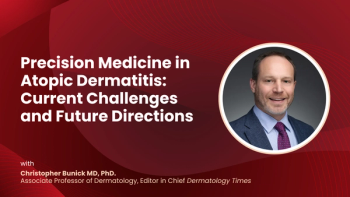
Christopher Bunick, MD, PhD, discussed the scientific advances still needed before precision medicine can guide individualized therapy selection in atopic dermatitis during a recent Dermatology Times interview.

Kathleen Suozzi, MD, details how she debunks sunscreen myths, explains absorption and SPF, urges year‑round UV habits, and previews new filter bemotrizinol, when counseling her own patients.
In “The Safety of Advanced Topical Therapies in Inflammatory Dermatoses,” our panel explores the consensus statements evaluating the short- and long-term safety of advanced targeted topical therapies for inflammatory skin diseases. The expert faculty review the growing body of clinical trial evidence supporting several nonsteroidal topical treatments, including roflumilast, tapinarof, ruxolitinib, crisaborole, and delgocitinib, and discuss how these therapies have expanded treatment options across multiple inflammatory dermatoses.