SYX-5219 improved disease severity and itch in a Phase 1b trial of adults with moderate to severe atopic dermatitis.
On this episode of Don’t Be Rash, host Andrew C. Krakowski, MD, welcomes Lawrence Eichenfield, MD, pediatric dermatologist, to discuss topical corticosteroid potency, dosing, and where they fit alongside nonsteroidal agents.
Lawrence Eichenfield, MD, dermatologist, professor of dermatology and pediatrics at the University of California, San Diego, and chief of pediatric dermatology at Rady Children’s Hospital, recently joined Don’t Be Rash host Andrew C. Krakowski, MD, pediatric dermatologist and Chair of Dermatology at St. Luke’s University Health Network in Bethlehem, Pennsylvania, to discuss the role of topical corticosteroids among pediatric patients as targeted nonsteroidal options multiply. Eichenfield and Krakowski also reviewed in-depth potency classification, dosing strategy, and anatomic considerations.
Disclosure: Don’t Be Rash is the official podcast of the Society for Pediatric Dermatology, hosted by Dermatology Times. This episode is supported in part by an unrestricted grant from Arcutis Biotherapeutics.
Eichenfield defined steroid phobia as excessive worry about steroid toxicity. Social media has intensified it, he said, citing more than 2 billion TikTok downloads of content on topical steroid withdrawal and addiction.
True withdrawal exists but is rare. Eichenfield has seen 2 patients with classic findings, both adults with prolonged class 1 steroid use.
“I have had innumerable number of patients and families who are concerned about topical steroid withdrawal when they use topical corticosteroids, usually even very modest quantities,” Eichenfield said.
The US classification runs from class 1 (strongest) to class 7 (weakest) and rests on the vasoconstrictor assay. Eichenfield said the assay remains predictive of potency and side effect risk. Percentages mislead, as clobetasol 0.05% is roughly 1,600 to 2,200 times stronger than hydrocortisone 1%.
Vehicle shifts class as well. Mometasone ointment is class 2, whereas the cream is class 4.
Eichenfield teaches trainees and families to master a few products. “One of the things Larry taught me when I was training under him was maybe pick three or four or five products, and get really comfortable with them,” Krakowski said.
Once-daily application performs comparably to twice daily in real-world use, Eichenfield said, though he often starts twice daily for a faster response before stepping down. Application beyond twice daily rarely makes sense.
He prescribes by volume, estimating the grams needed over 2 weeks from age and body surface area involved, and asks families to bring back the tube. Needing more than 2 or 3 weekly applications for maintenance points toward a nonsteroid.
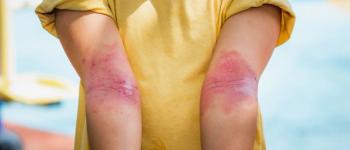
Atrophic skin is a reason to abandon steroids. Delicate sites such as the periocular region and body folds warrant short courses of mild steroids before a switch, while lichenified plaques, hands, and feet need stronger agents.
Lichen sclerosus remains the exception, managed with class 1 pulses. Follow-up studies of adults treated in childhood show persistent disease and anatomic and sexual complications, Eichenfield said, and 2 nonsteroidal agents, a JAK inhibitor and a pan-JAK inhibitor, are in development.
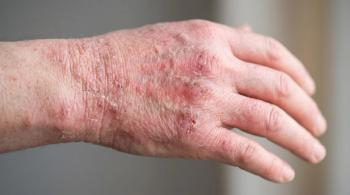
Roflumilast cream (Zoryve; Arcutis Biotherapeutics), a PDE4 inhibitor, is available at 0.05% for children aged 2 to 5 years. Tapinarof cream (Vtama; Organon), an aryl hydrocarbon receptor agonist, and ruxolitinib (Opzelura; Incyte), a Janus kinase (JAK) inhibitor, are approved down to age 2, with ruxolitinib capped at 20% body surface area. Delgocitinib (Anzupgo; LEO Pharma), a pan-JAK inhibitor, is labeled for chronic hand eczema in patients 18 and older.
Access still shapes prescribing. “Painfully, the insurance companies force you to jump through the hoops of having tried probably a topical steroid first,” Krakowski said.
“I still defend the use of topical corticosteroids, but with an acknowledgement of the concerns that patients have,” Eichenfield said. The goal remains minimal rash, itch, and sleep disturbance.