

Case-Based Roundtable
Latest News
Advertisement
Latest Videos
CME Content


Advertisement
More News
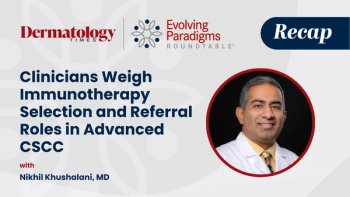
At a recent Dermatology Times Evolving Paradigms event, Nikhil Khushalani, MD, led dermatologists, Mohs surgeons, and oncologists in comparing systemic immunotherapy selection, referral practices, and adverse event management in advanced cutaneous squamous cell carcinoma.
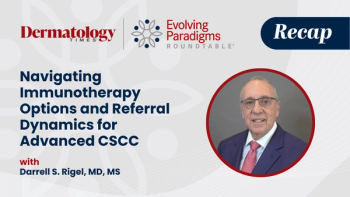
An Evolving Paradigms event led by Darrell S. Rigel, MD, MS, compared PD-1/PD-L1 immunotherapies for advanced cutaneous squamous cell carcinoma, with referral guidance and toxicity alerts.
Neal Bhatia, MD, led an Evolving Paradigms event on advancing multidisciplinary care in cutaneous squamous cell carcinoma to compare systemic immunotherapy data and referral practices.
Cosibelimab joins cemiplimab and pembrolizumab as a first-line option for advanced cSCC unsuitable for curative surgery or radiation.
Clinicians discuss how melanoma gene expression profiling guides sentinel node biopsy choices, refines early-stage risk, and shapes personalized surveillance and oncology referral.
Clinicians agreed that itch — not lesion count or BSA alone — is the most clinically meaningful driver of treatment escalation in patients with atopic dermatitis.
Experts discuss how clinicians translate clinical trial results into practical treatment decisions for alopecia areata.
Panelists discuss the role of communication, follow-up, and safety monitoring in optimizing long-term biologic therapy outcomes.
Panelists discuss the role of communication, follow-up, and safety monitoring in optimizing long-term biologic therapy outcomes.
Susan C. Taylor, MD, moderated a recent Case-Based Roundtable discussion on topical treatment options for vitiligo.
Experts discuss why alopecia areata should be viewed as a systemic condition with psychosocial consequences beyond visible hair loss.
Experts discuss how clinicians identify the right moment to transition from conventional therapy to biologic treatment in patients with hidradenitis suppurativa (HS).
The final case described a young woman with clinically mild hidradenitis suppurativa (HS) but significant emotional and social distress, prompting some of the most passionate discussion across the 3 roundtables.
This case involved a young patient with mild to moderate hidradenitis suppurativa (HS) of the axillae, characterized by intermittent, limited lesions without tunneling or scarring. Although seemingly routine, it prompted deeper reflection.
The first case involved a middle-aged patient with severe, long-standing hidradenitis suppurativa (HS) marked by years of active disease with extensive sinus tracts, dense scarring, chronic drainage, frequent flares, constant pain, limited mobility, and a daily life centered around symptom management.

Christopher Bunick, MD, PhD, led a vital discussion on innovative vitiligo treatments, emphasizing combination therapies and psychosocial support for effective management.
Firas G. Hougeir, MD, and clinician attendees discussed how to use real-world patient scenarios to determine optimal timing for biologic initiation for patients with moderate to severe HS.
Explore the complexities of managing hidradenitis suppurativa (HS) through real-world case studies moderated by Afsaneh Alavi, MD.
Experts discuss real-world applications of JAK inhibitors for alopecia areata, emphasizing patient selection, psychosocial impacts, and personalized treatment strategies.
Brad Glick, DO, MPH, and attendees discuss innovative treatments for atopic dermatitis, emphasizing the importance of patient comfort and modern nonsteroidal options.
Erik Domingues leads a vital discussion on innovative vitiligo management, addressing treatment challenges and psychosocial impacts in diverse patient populations.
At a recent Case-Based Roundtable event, Harrison Nguyen, MD, MBA, MPH, reviewed 2 HS patient cases and discussed the role of biologics.
Experts discuss real-world strategies for managing alopecia areata, emphasizing JAK inhibitors, psychosocial impacts, and personalized patient care approaches.
In part 3 of this Case-Based Roundtable supplement, experts discuss psoriatic therapies for hair-baring areas.
At a recent Case-Based Roundtable® event, Aaron Farberg, MD, moderated a discussion of challenging atopic dermatitis cases spanning adult, adolescent, and pediatric patients.
Advertisement
Advertisement
Trending on Dermatology Times
1
Clascoterone 5% Topical Solution Shows Long-Term Promise for Male Pattern Hair Loss
2
Neutrogena Launches New Sunscreens With Newly Permitted UV Filter Bemotrizinol
3
Dersimelagon NDA Accepted by FDA with Priority Review for EPP, XLP
4
Patidegib Gel Completes Phase 3 Follow-Up in Gorlin Syndrome
5