Shannon Trotter, DO, moderated a Dermatology Times Case-Based Roundtable event on how pharmacokinetics, adverse event timing, and trial response criteria should shape hedgehog pathway inhibitor selection in advanced BCC.
At a recent Dermatology Times Evolving Paradigms event led by Mark Nestor, MD, PhD, FAAD, dermatologists, Mohs surgeons, and oncologists compared immunotherapy mechanisms and referral thresholds for advanced CSCC.
Mark Nestor, MD, PhD, FAAD, led a Dermatology Times Evolving Paradigms
Nestor opened by noting a gap between how academic oncology defines high-risk CSCC and what dermatologists encounter in daily practice. Polling showed 81% of attendees see more than 20 CSCC cases per year, a volume Nestor said rarely lines up with the metastatic rates cited in national data. He also pointed to a shift he has observed toward more squamous cell diagnoses relative to basal cell ones, which he attributed in part to gaps in UVA protection from older sunscreens.
Cemiplimab (Libtayo; Regeneron), pembrolizumab (Keytruda; Merck), and cosibelimab (Unloxcyt; Sun Pharma) are each indicated for locally advanced or metastatic CSCC in patients who are not candidates for curative surgery or radiation. Cemiplimab also carries an adjuvant indication for high-risk disease after surgery and radiation. Nestor reviewed trial data showing similar objective response rates across the 3 agents, with no head-to-head trials available to compare them directly.
An oncologist in attendance walked through the mechanistic distinction between the drugs. "The first two, cemiplimab and pembrolizumab, are against the PD-1 protein, while cosibelimab is against the ligand," the attendee said. Nestor added that the more meaningful practical difference shows up in safety, pointing to lower rates of treatment discontinuation and severe immune-related adverse events reported with cosibelimab.
"Everybody who's on these drugs gets side effects. Let's be clear. Everybody gets side effects," Nestor said. He noted that the choice among agents is typically deferred to oncology once a patient is referred. Few dermatologists in the room reported prescribing checkpoint inhibitors directly in their own practices.
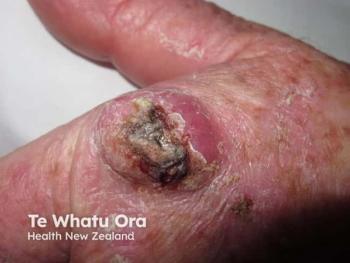
Nestor presented 2 patient cases from his practice. The first involved a 72-year-old man with a poorly differentiated, 5.7-mm scalp lesion with extensive perineural invasion that required Mohs surgery, parotidectomy, and adjuvant radiation after 1 of 18 lymph nodes tested positive. The second involved a 76-year-old man with a 3.8-cm, moderately differentiated lip lesion that cleared with Mohs and showed no nodal involvement.
Attendees agreed the first case clearly warranted systemic therapy, but the second generated disagreement over whether a gene-expression profile test was needed given the absence of major risk factors. Several attendees raised the test as a reflex step, with one saying, "Time to get a Castle test," and another describing it as a way to cover bases with the patient. Nestor pushed back, describing a retrospective 100-case study from his own practice that found no metastases among low-risk squamous cell carcinomas the assay had flagged for staging.
The group also debated national guidelines more broadly, with one attendee describing friction with local oncologists over sentinel lymph node biopsy. "I refused to refer to robots to follow the NCCN guidelines," the attendee said, adding they now work with an oncologist who monitors regional lymph nodes by ultrasound instead of biopsy.
When a case needs oncology, radiation oncology, or tumor board input, Nestor believes that dermatologists “are the gatekeepers when it comes to these patients with squamous cell carcinoma.”
Several attendees described frustration with losing visibility into a patient's care after referral. "How many of you guys in the room when you do send out, do you feel like a total loss of control?" 1 attendee asked, describing progress notes that arrive weeks later without direct communication. The group agreed that direct phone relationships with a small circle of trusted specialists, rather than a general referral pathway, kept patients from falling through communication gaps.
An attendee summarized the underlying principle guiding those relationships. "I will never steal a patient. I'm never worried about someone stealing a patient from me," the attendee said, encouraging younger clinicians to build ties with colleagues across specialties early in practice.
Nestor closed by thanking the group for what he called a collaborative exchange among specialties that do not always compare notes. "This proves that the issue why I really wanted to do this was this collaborative effort. We all learned something; we all learned about each other," he said.
This event recap has been produced independently by Dermatology Times and supported through an educational grant by Sun Pharmaceuticals.
Want to attend an upcoming Dermatology Times event?