Shannon Trotter, DO, moderated a Dermatology Times Case-Based Roundtable event on how pharmacokinetics, adverse event timing, and trial response criteria should shape hedgehog pathway inhibitor selection in advanced BCC.
Dermatologists and oncologists at a Dermatology Times Evolving Paradigms event in Dallas compared immunotherapy selection, adverse event management, and referral practices in advanced cutaneous squamous cell carcinoma.
Recently, Aaron Farberg, MD, led a Dermatology Times Evolving Paradigms
Farberg, a double board-certified dermatologist, fellowship-trained Mohs surgeon, chief medical officer at Bare Dermatology in Dallas, and Dermatology Times’ editor in chief emeritus (spring 2024), opened by asking the group whether mechanism of action meaningfully drives treatment choice among the 3 agents. Cemiplimab and pembrolizumab target the PD-1 receptor on T cells, while cosibelimab blocks the PD-L1 ligand on tumor cells and carries a secondary Fc region capable of recruiting natural killer cells.
"We use other PD-L1 inhibitors versus PD-1 inhibitors in clinical practice, and they tend to have a little bit of a different side effects profile," an attendee said, adding that effectiveness across the 2 classes appeared comparable in other tumor types.
Attendees cautioned single-institution trial results do not always hold up once replicated more broadly. "When you get into the real world and other people try to replicate those data, you end up with a 20% discount over the original data," an attendee said.
The group reviewed outcomes from CK-301-101, KEYNOTE-629, and EMPOWER-CSCC-1, noting that response rates looked roughly similar across cemiplimab, pembrolizumab, and cosibelimab without a head-to-head trial to confirm superiority. Several attendees pointed to the absence of grade 3 or 4 toxicities reported in the cosibelimab study.
"There were no grade 3 [or] grade 4 toxicities on the study with cosibelimab, which is, I think, impressive," an attendee said.
Attendees agreed there is no established data supporting a switch from a PD-1 to a PD-L1 inhibitor after progression, though retreatment can succeed if therapy was previously paused rather than truly failed. Discussion turned to grading immune-related adverse events, where one attendee described leaning on clinical impression over formal criteria.
"For me, it's just kind of does the patient look sick or not," the attendee said. "I like that you led with gestalt," another attendee added.
Several dermatologists described routine, informal communication with oncology colleagues to track referrals and confirm follow-up appointments were kept. "I text. I'll text the oncologist every single tumor," an attendee said, noting patients can slip through scheduling gaps in busy private practices.
Attendees also discussed the dermatologist's role as neoadjuvant and adjuvant immunotherapy becomes more common. One medical oncologist told the group that dermatologists function as gatekeepers who determine when a case needs oncology input.
"I think you're really almost a gatekeeper for this kind of stuff," an attendee said. "Let the brains at the end of the table make those decisions," once a case is referred.
Economics came up as a barrier to dermatologists infusing immunotherapy themselves. Attendees agreed the practice only makes financial sense at scale, given staffing needs and insurance reimbursement risk.
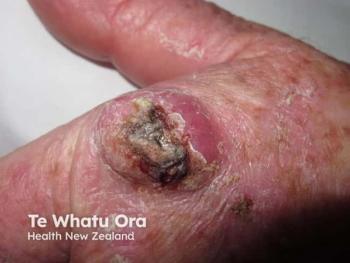
Farberg presented a case of a 72-year-old man with a scalp squamous cell carcinoma cleared by Mohs surgery to a 4.3 by 4.1 cm defect. Parotidectomy revealed 1 of 18 lymph nodes positive for metastatic disease, and pathology showed a poorly differentiated tumor 5.7 mm thick with extensive perineural invasion measuring 0.2 mm in caliber. The patient received adjuvant radiation of 5500 cGy over 20 fractions.
"There's a lot of high-risk features, right? You've got the perineural invasion, a big tumor, poorly differentiated, so these are things that I look for," Farberg said.
Attendees agreed the case met Brigham and Women's high-risk and C-POST criteria and supported a referral for systemic immunotherapy alongside surgery and radiation. "This is a perfect candidate for immunotherapy. I actually love that idea for this patient," an attendee said.
The group also weighed how comorbidities and patient preference shape these adjuvant decisions, since C-POST data reflect recurrence-free rather than overall survival benefit. One attendee noted older patients do not always choose less aggressive treatment.
"I've always been surprised with the 80-something-year-old that goes, no, no, no, I want to do everything full court press," an attendee said, contrasting a younger patient who preferred comfort over added treatment.
Farberg and the attendees agreed that a shared decision-making conversation, not a fixed algorithm, ultimately guides whether a high-risk patient pursues adjuvant immunotherapy.
Closing the evening, one attendee summarized the direction of the field. "I think this whole field is evolving rapidly, and I think we're going to be giving more immunotherapy, not less immunotherapy, and I, before tonight, hadn't heard of cosibelimab but if it has fewer side effects, it seems like the winner," the attendee said.
This event recap has been produced independently by Dermatology Times and supported through an educational grant by Sun Pharmaceuticals.
Want to attend an upcoming Dermatology Times event?