Dermatology clinicians at a Case-Based Roundtable in Austin, Texas, discussed real-world strategies for sequencing topical therapy, phototherapy, and ruxolitinib cream across pediatric and adult vitiligo cases.
Todd Schlesinger, MD, FAAD, FASMS, moderated an engaging discussion with colleagues to discuss complex vitiligo cases during a Dermatology Times Case-Based Roundtable event.
“The science behind vitiligo is fascinating. There’s a lot of interesting research in the mechanism of action surrounding the melanocyte and what’s going on with vitiligo, both nonsegmental and segmental,” Todd Schlesinger, MD, FAAD, FASMS, said during a recent
Schlesinger, founder and director of the Clinical Research Center of the Carolinas, a practicing physician at Epiphany Dermatology in Charleston, South Carolina, and a clinical assistant professor of dermatology at the George Washington University School of Medicine and Health Sciences in Washington, DC, moderated an engaging discussion with colleagues to discuss complex vitiligo cases.
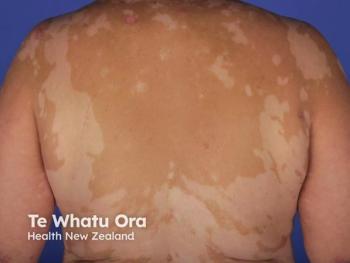
The first case included a 30-year-old African American man who first noticed small, depigmented patches on his cheeks 2 years ago. The depigmentation was initially stable and localized, but it has spread over the past 12 months. The patient reports new, larger depigmented patches on both cheeks, hands, and forearms.
The patient has no prior treatment history for his vitiligo, but he would like to try something now that there are more noticeable areas of depigmentation. The areas of depigmentation on his face are causing him significant distress, and he is uncomfortable in social situations.
Schlesinger first discussed the challenges of this case, which include the psychological impact of new, visible lesions; managing patient expectations; and the cosmetic burden of vitiligo in patients with higher Fitzpatrick skin types.
One clinician noted the relatively large surface area involved and suggested starting with a topical corticosteroid, acknowledging limitations and the need for additional therapeutic options. Another emphasized adherence challenges, particularly with regimens requiring twice-daily topical application (eg, betamethasone). Insurance and coverage issues were raised, especially when large surface areas require frequent refills that may be denied by payers.
A third clinician highlighted the need to clarify treatment goals. If vitiligo is spreading, details such as the rate of progression, presence of confetti-like depigmentation, erythema, or extent over the past 12 months are critical to determine whether the disease is active. If lesions are stable and the face is the main concern, a targeted approach (eg, topical calcineurin inhibitor, phototherapy, natural UV exposure) may suffice. If the patient’s goal is widespread repigmentation, management becomes more complex and requires broader therapeutic strategies.
In this specific case, the patient eventually started ruxolitinib cream, 1.5% (Opzelura; Incyte) for his vitiligo and was happy with the progress.
Schlesinger also reviewed with the attendees phase 3 data from the TRuE-V1 (
“About 30% of patients will achieve…the Facial Vitiligo Area and Severity Index improvement by week 24, which is consistent across the 2 studies,” Schlesinger said.
“It’s an easy conversation. Ruxolitinib is FDA approved. It’s the only FDA-approved topical for vitiligo. It’s a straightforward conversation that, for sensitive areas on the face, you don’t have to discuss which treatment to use in which area. You can use ruxolitinib all over sensitive areas, which makes it very convenient for you and the patient,” one of the attendees concluded.
The second case included a 28-year-old White woman with large areas of depigmentation on her back and elbows. The areas of depigmentation have rapidly spread over the past several months and now cover approximately 8% BSA. Her past medical history is notable for autoimmune thyroiditis. The patient has used topical corticosteroids infrequently in the past but stopped due to difficulties with application to her back and minimal repigmentation.
Regarding the patient’s presentation, one of the attendees remarked, “This is super active vitiligo—very erythematous. This is a patient I would consider [for] systemic therapies because it’s tough to treat. I would also push for light therapy.”
Another clinician added, “For both this case and the first one, for new-onset vitiligo in an adult, I always do a full-body check to make sure there’s not melanoma somewhere.”
Schlesinger prompted the group to consider other systemic treatments for vitiligo, even off-label, and what they have considered. One attendee mentioned upadacitinib (Rinvoq; AbbVie). Schlesinger provided the example of ritlecitinib (Litfulo; Pfizer Inc) being investigated for vitiligo and noted that there are many systemic treatments on the horizon for more difficult-to-treat vitiligo.
In this specific case, because of the location and extent of the patient’s vitiligo, the decision was made to start phototherapy with an excimer laser twice weekly.
Schlesinger noted that the group’s discussion focused on the benefits of combining narrowband UVB therapy with other management options, such as ruxolitinib, topical steroids, or calcineurin inhibitors.
The roundtable discussion highlighted the unique nature of vitiligo care, where treatment decisions depend not only on disease activity and lesion location, but also on patient goals, psychosocial impact, and practical considerations such as adherence and insurance coverage. Topical ruxolitinib was favored as a convenient first-line option for sensitive areas such as the face, whereas phototherapy and systemic agents remain important for more extensive or rapidly progressive disease.
“Not only do these discussions connect people with new information, but they also connect people with one another. In my experience, I tend to learn the most in settings like that, where I am able to participate in a focused discussion with various colleagues and come away with the feeling that I learned something new that I can take back and use in my patient care settings,” Schlesinger said.
12 months ago
Cosmetic Trends of Dermatologic Interest in 2025about 1 year ago
Sometimes a Dermatologist Also Has To Be a Psychiatristabout 1 year ago
Identifying Breast Issues Beyond the Skinabout 1 year ago
Dermatologists’ Role in Breast Cancer Awareness and Survivorship