


Opinion|Videos|August 5, 2026
HS Case Study: Recognizing Moderate Disease in an Adolescent
A 17-year-old with painful, recurrent nodules has quietly given up gym class, social events, and her school prom. The panel walks through what her case demands.
Advertisement
Episodes in this series
In "HS Case Study: Recognizing Moderate Disease in an Adolescent," the panel examines its first case: a 17-year-old with an 18-month history of painful nodules and abscesses.
The panel introduces its first case: a 17-year-old girl with an 18-month history of painful, recurrent nodules and abscesses in the axilla and groin, with flares that seem to worsen around her menstrual cycle. On exam she has inflammatory nodules and abscesses in both axillae, early scarring, and a limited tunnel on the left, placing her at Hurley Stage 2. She has stopped attending gym class, avoided her school prom, and told no one, including friends or teachers, about her condition. Her mother, frustrated that prior providers dismissed the lesions as acne, accompanies her; the patient rates her average pain at six out of ten, rising to nine during flares. Prior treatments, including antiseptic washes, topical and oral antibiotics, and a clindamycin-rifampin combination, brought minimal relief.
Cynthia Trickett says her first question with any HS patient is whether they are biologic-eligible, and this patient clearly is: two affected body areas, Hurley Stage 2 disease, and a significantly impaired quality of life after 18 months make her a textbook case for early, aggressive treatment. Trickett notes how often patients describe feeling dismissed, cycling through providers who repeat the same advice to lose weight or wash more before eventually losing hope. She stresses that establishing trust and empathy is the essential first step, since patients often need to feel heard before they can engage with treatment.
The panel discusses acting as detectives, asking patients when their first lesion appeared, how long flares last, and how heavily the disease weighs on daily life. They observe that simply naming the diagnosis and acknowledging its toll frequently brings patients to tears, a reaction they've all learned to expect and meet with reassurance that missed adolescent milestones, like this patient's prom, still deserve validation and a path forward.
The next episode in this series, "Approaching Sensitive Exams and Diagnostic Delay in Adolescent HS," has Dr. Tjahjono walking through how he approaches sensitive exams and diagnostic delay in teenage patients.
Advertisement
Related to this article

Phase 3 LATITUDE Atlas data presented at EADV 2026 showed higher rates of complete and near-complete skin clearance with zasocitinib compared with deucravacitinib.

Day 2 of EADV 2026 highlighted new findings involving GLP-1–associated nail changes, long-term atopic dermatitis control, emerging therapies, alopecia, and hidradenitis suppurativa.
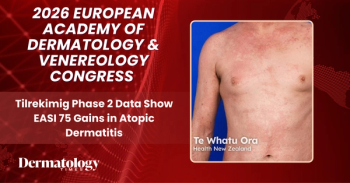
According to data presented at EADV, at week 16 of the phase 2 study, 47.8% to 62.5% of adults receiving tilrekimig achieved EASI 75 across doses, compared with 9.1% to 19.9% with placebo.

AbbVie reports F-VASI 75 of 55.1% in Viti-Up-1 and 47.4% in Viti-Up-2 at week 76 among patients continuing upadacitinib, with numerically higher responses alongside NB-UVB.
A new report from the National Eczema Association (NEA) found systemic corticosteroids were filled more often than dupilumab, and 13% of Americans live in counties without a dermatology or allergy/immunology practitioner.

Real-world EADV 2026 data suggest autonomous AI could increase dermatology capacity while maintaining high sensitivity for invasive skin cancers.
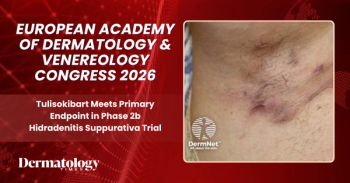
Up to 72% of tulisokibart-treated patients achieved HiSCR50 at week 16 vs 35% with placebo, the first positive phase 2 anti-TL1A data in dermatology.
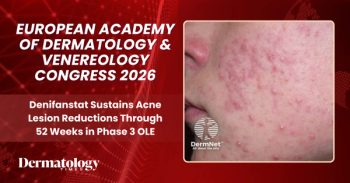
Treatment success reached 56.7% and total lesions fell 71.8% with up to 52 weeks of oral denifanstat, with no adverse event-related discontinuations.
Advertisement
Advertisement
Trending on Dermatology Times
1
NEA Report Highlights Atopic Dermatitis Care Access Gaps by State
2
EADV 2026 Day 1: Late-Breaking Data, Emerging Therapies, and New Directions in Dermatology
3
Nemolizumab Sustains Atopic Dermatitis Responses Through 3 Years in ARCADIA
4
Tulisokibart Meets Primary Endpoint in Phase 2b Hidradenitis Suppurativa Trial
5