


Opinion|Videos|August 12, 2026
Choosing First-Line Biologics and Follow-Up Strategies for HS
New IL-17 inhibitors are changing first-line choices for adolescent and adult HS alike. The panel weighs efficacy benchmarks against follow-up strategy and comorbidity screening.
Advertisement
Episodes in this series
In "Choosing First-Line Biologics and Follow-Up Strategies for HS," the panel returns to its adolescent case to discuss biologic selection now that newer agents are approved in younger patients.
With the patient's family history of multiple sclerosis in mind, Dr. Tjahjono explains that an IL-17A-specific monoclonal antibody becomes an appealing first choice, especially now that it is approved down to age 12, since comorbidities can make other biologic classes less favorable. He notes that adolescents often respond well to monthly dosing after an initial loading period, and that recent trials have pushed efficacy benchmarks higher, from clearing half of inflammatory lesions toward far more ambitious clearance targets, mirroring similar gains seen in psoriasis and atopic dermatitis treatment.
The panel discusses how much clinical trial data to share with patients, generally matching the conversation to each patient's comfort with numbers while still setting expectations that no therapy clears every patient completely. Dr. Cices notes that IL-17 inhibitors have become her first-line choice absent inflammatory bowel disease, given their efficacy and safety profile, though she reserves TNF-alpha inhibitors for patients managing both HS and IBD. The group weighs whether TNF-alpha and IL-17 inhibition represent parallel pathways or overlapping ones, agreeing that some patients respond better to one target than the other and that combination therapy is sometimes necessary given how the inflammatory pathways driving early nodules and later tunnel formation appear to differ.
The conversation closes on comorbidity screening, follow-up cadence, and access. Panelists screen for anxiety, depression, and family history of multiple sclerosis, while acknowledging comorbidity screening in HS lags behind psoriasis. Most see this patient back at four-to-eight-week intervals initially to build trust and confirm tolerability, and stress that patients should be able to reach their office directly during flares rather than seeking emergency care.
Our next episode, "HS Case Study: Closing Diagnostic Gaps in Adult Women," introduces the panel's second case: a 30-year-old nurse whose HS was mistaken for ingrown hairs for years.
Advertisement
Related to this article

Day 2 of EADV 2026 highlighted new findings involving GLP-1–associated nail changes, long-term atopic dermatitis control, emerging therapies, alopecia, and hidradenitis suppurativa.
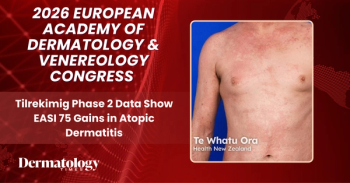
According to data presented at EADV, at week 16 of the phase 2 study, 47.8% to 62.5% of adults receiving tilrekimig achieved EASI 75 across doses, compared with 9.1% to 19.9% with placebo.

AbbVie reports F-VASI 75 of 55.1% in Viti-Up-1 and 47.4% in Viti-Up-2 at week 76 among patients continuing upadacitinib, with numerically higher responses alongside NB-UVB.
A new report from the National Eczema Association (NEA) found systemic corticosteroids were filled more often than dupilumab, and 13% of Americans live in counties without a dermatology or allergy/immunology practitioner.

Real-world EADV 2026 data suggest autonomous AI could increase dermatology capacity while maintaining high sensitivity for invasive skin cancers.
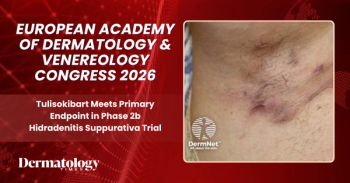
Up to 72% of tulisokibart-treated patients achieved HiSCR50 at week 16 vs 35% with placebo, the first positive phase 2 anti-TL1A data in dermatology.
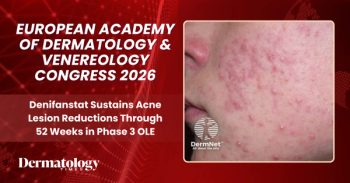
Treatment success reached 56.7% and total lesions fell 71.8% with up to 52 weeks of oral denifanstat, with no adverse event-related discontinuations.
Late-breaking EADV 2026 data showed significant improvements in skin clearance, itch, pain, and patient satisfaction among patients treated with lebrikizumab.
Advertisement
Advertisement
Trending on Dermatology Times
1
EADV 2026 Day 1: Late-Breaking Data, Emerging Therapies, and New Directions in Dermatology
2
NEA Report Highlights Atopic Dermatitis Care Access Gaps by State
3
Nemolizumab Sustains Atopic Dermatitis Responses Through 3 Years in ARCADIA
4
Tulisokibart Meets Primary Endpoint in Phase 2b Hidradenitis Suppurativa Trial
5