You’re busy. Between patients, prior authorizations, inbox messages, and everything else on your plate, keeping up with the literature is the first thing that slips. Dermatology Times NP/PA Connect is here to make sure it doesn’t. Each week, we pull the most clinically relevant news from across dermatology and bring it straight to your inbox — what’s new, what it means, and what’s worth watching. This week: an oral psoriasis therapy closing in on FDA review with phase 3 data to back it up, how to tell a treatable immunotherapy rash from one that demands you stop treatment, and why chasing individual actinic keratoses leaves the cancer field around them untouched.
The FDA has granted priority review to zasocitinib, Takeda's investigational once-daily oral TYK2 inhibitor, for moderate to severe plaque psoriasis in adults, with a PDUFA target action date in the first quarter of 2027.1 The selective TYK2 inhibition is designed to modulate IL-23/IL-17 and type I interferon signaling while largely sparing JAK1/2/3, and in vitro testing showed more than 1 million-fold selectivity for TYK2 over other JAK enzymes.
The filing rests on phase 3 data from LATITUDE PsO 3001 (693 patients) and LATITUDE PsO 3002 (1108 patients), both of which met all co-primary end points at week 16. PASI 75 was reached by 76% and 71% of patients on zasocitinib across the 2 trials, compared with 12% on placebo and 33% to 37% on apremilast; PASI 90 rates reached 61% and 52%. Clearance extended to hard-to-treat sites, with scalp PGA 0/1 rates of 74% to 77% and palmoplantar PGA 0/1 rates of 69% to 71%. The most common adverse events, each occurring in at least 5% of patients, were upper respiratory tract infection, acne, and nasopharyngitis, with no new safety signals identified. Zasocitinib remains investigational and is not approved by the FDA or any other regulatory authority.
Our phase 3 data demonstrated rapid and durable skin clearance across various patient types and in high-impact and hard-to-treat areas.— Andy Plump, MD, PhD, President of Research and Development, Takeda
▶ Why it matters: If zasocitinib clears the FDA on schedule, it adds an oral option that outperformed apremilast and approached biologic-range PASI 90 rates, including at the scalp and palmoplantar sites your patients care about most.
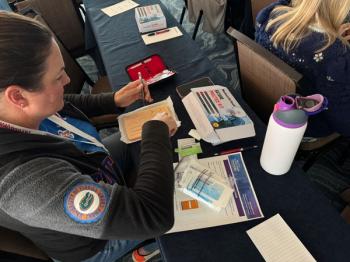
Combination immune checkpoint inhibitor therapy improves response rates and durability over monotherapy but raises the risk of cutaneous immune-related adverse events, especially in patients with preexisting autoimmune disease, solid organ transplants, poor performance status, or chronic viral infection, said Angad Chadha, MD, speaking at the Dermatology Times NP/PA Connect Cutaneous Oncology Workshop in Tampa, Florida.2 Most reactions, eczematous eruptions, pruritus, bullous pemphigoid, and lichenoid dermatitis among them, are manageable without stopping cancer therapy.
The quicker you get their condition under control, the longer and more likely they are to be able to stay on immunotherapy, which is always our goal.— Angad Chadha, MD
Stevens-Johnson syndrome and toxic epidermal necrolysis are the exception, occurring in fewer than 1% of patients on checkpoint inhibitors but requiring permanent discontinuation and inpatient multidisciplinary care. “This is not something you can treat through,” Chadha said. A related mimic, progressive immunotherapy-related mucocutaneous eruption, typically spares the ocular mucosa and responds to systemic corticosteroids. For patients who need definitive local treatment, radiation remains a strong option for basal cell carcinoma, cutaneous squamous cell carcinoma, and especially the highly radiosensitive Merkel cell carcinoma, said Amit Om, MD, FACMS, a Mohs surgeon at Dermatology Group of the Carolinas; melanoma responds poorly to radiation. Older patients, those on anticoagulation, and those with poor wound healing are often good radiation candidates, though multiple treatment visits can create transportation and financial burdens.
▶ Why it matters: Early, effective management of cutaneous irAEs can keep patients on lifesaving immunotherapy, but recognizing SJS/TEN and stopping treatment immediately when you see it is what prevents a fatal outcome.
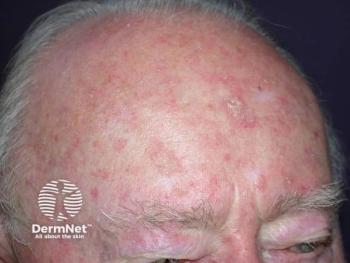
Individual actinic keratoses carry a malignant transformation risk ranging from 0.025% to 16% annually, averaging about 8% in immunocompetent patients, and more than 60% of squamous cell carcinomas show an adjacent, contiguous AK on histologic exam, said Amit Om, MD, FACMS, at the same Tampa workshop.3 Visible lesions are “only the most advanced portion of a much larger field of sun-damaged skin,” Om said, since chronic UV exposure drives genetic and epigenetic change across the whole exposed area, not just at clinically apparent spots. Spontaneously regressed AKs recur at rates up to 50% within a year.
The 2021 American Academy of Dermatology guidance favors treating the entire cancerization field over isolated lesions when feasible. Field options discussed across the workshop and a related NP/PA Connect panel4 include standard topical 5-fluorouracil, typically for about 2 weeks; compounded 5-fluorouracil plus calcipotriene for a shorter course in patients who need less downtime; tirbanibulin, dosed once daily for 5 days; imiquimod; diclofenac 3%; and photodynamic therapy. “I still like good old-fashioned 5-fluorouracil. Typically, I use it for about 2 weeks. But it depends on the patient,” Om said. Setting expectations with photos of anticipated erythema and crusting, and framing treatment as cancer prevention rather than cosmetic care, improves adherence, which Om called the biggest determinant of success.
▶ Why it matters: A patient with 1 or 2 visible AKs likely has subclinical disease across the whole sun-exposed field, so counsel and treat accordingly rather than letting a light lesion count talk you out of field-directed therapy.
Thorough clinical context materially changes how a pathologist reads a biopsy, said Amy Spizuoco, DO, FAOCD, on the same NP/PA Connect panel.4 “Tell your dermatopathologist everything that you can, because the point of it is to communicate,” Spizuoco said, noting that details as simple as how many similar-appearing lesions were biopsied help contextualize borderline findings. For atypical nevi, Tristan Hasbargen, PA-C, recommended trusting clinical gestalt on first assessment, then photographing and measuring lesions for longitudinal comparison; a very high nevus burden may warrant full-body mole mapping. “Go with your first instinct and the clinical gestalt,” Hasbargen said.
On hereditary melanoma screening, the panel noted that a single melanoma diagnosis alone doesn't warrant a GI referral; concern rises with multiple melanomas plus a family history. For oral photoprotection, Om recommends over-the-counter Polypodium leucotomos and nicotinamide, not niacin, for patients with multiple skin cancers or heavy outdoor exposure. “These aren't replacements for sunscreen or protective behavior,” Om said. “They're another tool.”
▶ Why it matters: A few extra lines on your biopsy requisition, and a few extra minutes counseling on oral photoprotection, cost you almost nothing and can meaningfully change what comes back on the path report.
MORE ON SKIN CANCER
Get Involved With Dermatology Times
For APPs across all stages of their dermatology careers, opportunities to connect, learn, and share experiences can be an important part of professional growth. Dermatology Times invites nurse practitioners and physician assistants to share their perspectives through NP/PA Connect. APPs can contribute clinical insights, career experiences, advocacy efforts, lessons learned, and perspectives on emerging treatments while connecting with colleagues across the dermatology community.
Interested in getting involved? Contact editor Shannon Heaning at [email protected] to contribute.
References
- Heaning S. FDA grants priority review to zasocitinib for moderate to severe plaque psoriasis. Dermatology Times. September 14, 2026. Accessed September 14, 2026. https://www.dermatologytimes.com/view/fda-grants-priority-review-to-zasocitinib-for-moderate-to-severe-plaque-psoriasis
- Heaning S. From immunotherapy to radiation: experts navigate treatment and toxicity in cutaneous oncology. Dermatology Times. September 14, 2026. Accessed September 14, 2026. https://www.dermatologytimes.com/view/from-immunotherapy-to-radiation-experts-navigate-treatment-and-toxicity-in-cutaneous-oncology
- Bader K. Field-directed therapy favored for actinic keratosis management. Dermatology Times. September 13, 2026. Accessed September 14, 2026. https://www.dermatologytimes.com/view/field-directed-therapy-favored-for-actinic-keratosis-management
- Heaning S. Q&A: practical pearls on atypical nevi, photoprotection, and field cancerization. Dermatology Times. September 12, 2026. Accessed September 14, 2026. https://www.dermatologytimes.com/view/q-a-practical-pearls-on-atypical-nevi-photoprotection-and-field-cancerization
Dermatology Times NP/PA Connect | The Breakout Bulletin