Faculty from the Cutaneous Oncology Workshop answer practical questions spanning skin cancer prevention, diagnosis, treatment, and follow-up.
New data show that nearly two-thirds of Sun Bus participants had never visited a dermatologist, highlighting persistent gaps in access to skin cancer care.
As UV Awareness Month arrives each July, the dermatology community turns its attention once again to a familiar challenge: reaching the patients who are least likely to show up. For Karen Babcock Nern, MD, MBA, FAAD, a board-certified dermatologist and Mohs surgeon practicing in Colorado, that challenge has driven more than a decade of outreach work—and 2 innovations that are quietly changing how skin cancer screening and education reach underserved communities.1,2
“It’s the only mobile clinic that we know of that’s run by clinicians and scientists,” said Nern. The program—which she cofounded and serves as medical director for—operates at the intersection of screening, education, and public health research, with Tamara Terzian, PhD, MS, a biomedical engineer and former University of Colorado faculty member, now leading day-to-day operations as executive director.
The Sun Bus meets patients where they are—literally. The program has screened participants at NASCAR events, ski communities, and other venues far removed from a traditional clinic setting. That accessibility is by design. In 2025, survey data from Sun Bus participants revealed that 65.6% had never visited a dermatology clinic.1 “Here you are, we are introducing in a more informal way to dermatology, so they’re not scared of the specialized care,” Terzian said.
Approximately one-third of participants are referred for follow-up after their screening. Rather than adding to clinic burden, the Sun Bus is positioned to reduce it by triaging those with concerning findings for earlier appointments while allowing lower-risk individuals to be monitored over time. “If we reduce the wait time, the burden on clinics, and we act as a triage center—and we just pull the ones that need to be seen immediately—that’s a benefit for the dermatology clinics and at the same time the patient or the community,” Terzian explained.
The program has also become a training ground of sorts. Medical, physician assistant, and nursing students volunteer regularly, contributing to a referenced newsletter and gaining early exposure to both research and clinical communication. The Sun Bus has recently established a formal research relationship with Lubbock Christian University, with 5 Independent Review Board–approved study proposals now pending.
The second initiative to emerge from the Sun Bus ecosystem addresses a gap that Nern and Terzian encountered repeatedly in the field: the limitations of existing patient education materials when applied to the full spectrum of skin cancer presentations. “The ABCDE standard really is incomplete and misses 95% of skin cancers,” Nern said, “and it’s also written in language that’s really complicated.”
Rather than discarding ABCDE [asymmetry, border, color, diameter, evolution], the team set out to build on it.
The methodology behind ODD-SPOT was rigorous. A 7-member team conducted a literature review across 5 major dermatology journals, 5 public-facing patient websites, and 5 core dermatology textbooks, including Bologna, Fitzpatrick, and Andrews, clustering and scoring descriptive language used to characterize skin cancer across all sources. That was followed by 2 rounds of patient-facing surveys, including a live survey at a women in leadership conference and a distribution to nearly 1800 Sun Bus participants, asking respondents to select which terms resonated most when viewing clinical photographs of basal cell carcinoma, squamous cell carcinoma, and melanoma.
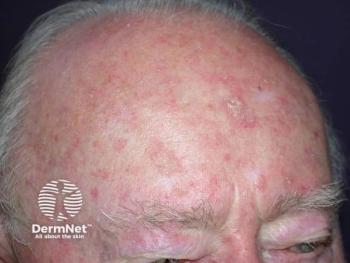
The final tool pairs the ODD-SPOT descriptors with clinical photographs licensed from DermNet and is written at a sixth-grade reading level, meeting American Medical Association, CDC, and National Institutes of Health standards for clear health communication. It scored 100% on the CDC’s Clear Communication Index.
For clinicians, the practical impact has been tangible. “There is no direct educational material—easy, one place to go for it—to give them one handout about it with the images,” Terzian noted, describing feedback from providers on the Sun Bus. “It reduced the time for that explanation.” Nern conducted her own informal time study, having a medical student track the difference between a standard ABCDE counseling session and a brief ODD-SPOT walkthrough with the take-home card. The result: a savings of approximately 1 minute per patient—which, across 20 skin cancer screenings a day, adds up to 20 minutes, a meaningful gain in a packed schedule.
A Spanish-language adaptation, written in common usage rather than direct translation, has recently been completed, and a dedicated ODD-SPOT educational website is available now. As the dermatology community marks UV Awareness Month, both the Sun Bus and ODD-SPOT offer a practical model for what community-centered skin cancer outreach can look like—one that meets patients at NASCAR, at the pharmacy counter, and everywhere in between.
References
3 months ago
Dermatology Times June 2026 Print Recap3 months ago
Preservatives: The Villain in the Bottle