





Atopic Dermatitis
Latest News
Advertisement
Latest Videos






CME Content

Advertisement
More News

Drs Alexandra Golant and Brett King discuss the role that atopic disease severity and treatment resistance play in the selection of oral vs systemic treatment for their patients.
Brett King, M.D, Ph.D and Alexandra Golant M.D comment on their considerations on the management of patients suffering from atopic dermatitis, highlighting the importance of body surface area and patient preference in treatment selection.
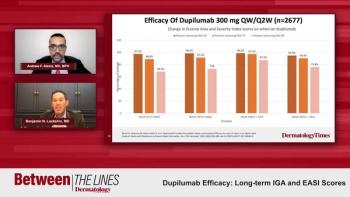
Andrew F. Alexis, MD, MPH, and Benjamin N. Lockshin, MD, discuss the relevance of the 4-year efficacy data for dupilumab in adults with moderate to severe atopic dermatitis, with a focus on IGA and EASI scores.

Continuing their discussion about safety, Andrew F. Alexis, MD, MPH, and Benjamin N. Lockshin, MD, take a closer look at conjunctivitis data from the long-term use of dupilumab

Andrew F. Alexis, MD, MPH, and Benjamin N. Lockshin, MD, review the design of the LIBERTY-AD open-label extension trial and share clinical context regarding safety findings.

Thought leaders share strategies for talking to patients about the importance of treatment adherence in the long-term management of atopic dermatitis.

Recommendations were made for patients to help relieve inflammation, itching and infections.

JAK inhibitors may cause less adverse events compared with traditional systemic therapies.

In part 5 of this Frontline Forum, Raj Chovatiya, MD, PhD; Neal D. Bhatia, MD; Alexandra K. Golant, MD; and Brett King, MD, PhD, discuss the rapidly changing use for JAK inhibitors and other agents for atopic dermatitis.

Andrew F. Alexis, MD, MPH, and Benjamin N. Lockshin, MD, evaluate the effect of the rapidly changing therapeutic landscape in atopic dermatitis.

Results from the test reveal that high levels of the immune biomarker Thymus and Activation-Regulated Chemokine (TARC) in babies increases their chances of developing atopic dermatitis.

Andrew F. Alexis, MD, MPH, and Benjamin N. Lockshin, MD, review the burden of atopic dermatitis and discuss how they talk to patients about the impact their disease has on their lives.
In part 4 of this Frontline Forum, Raj Chovatiya, MD, PhD; Neal D. Bhatia, MD; Alexandra K. Golant, MD; and Brett King, MD, PhD, discuss the rapidly changing use for JAK inhibitors and other agents for atopic dermatitis.
In part 3 of this Frontline Forum, Raj Chovatiya, MD, PhD; Neal D. Bhatia, MD; Alexandra K. Golant, MD; and Brett King, MD, PhD, discuss the rapidly changing use for JAK inhibitors and other agents for atopic dermatitis.
In part 2 of this Frontline Forum, Raj Chovatiya, MD, PhD; Neal D. Bhatia, MD; Alexandra K. Golant, MD; and Brett King, MD, PhD, discuss the rapidly changing use for JAK inhibitors and other agents for atopic dermatitis.

In this DermView series recap, Raj Chovatiya, MD, PhD, and Lisa Swanson, MD, FAAD, review the changing landscape of atopic dermatitis treatment options and what is on the horizon.
In part 1 of this Frontline Forum, Raj Chovatiya, MD, PhD; Neal D. Bhatia, MD; Alexandra K. Golant, MD; and Brett King, MD, PhD, discuss the rapidly changing use for JAK inhibitors and other agents for atopic dermatitis.

Patients are finding relief in alternative therapy for the chronic skin disease.

Catch up on coverage from the 2022 Revolutionizing Atopic Dermatitis Conference.

In this episode, Christopher Bunick, MD, PhD, discusses a paper he recently co-authored, which explores JAK inhibitor safety compared to traditional systemic therapies for atopic dermatitis.

Drs Raj Chovatiya and Neal Bhatia summarize their final thoughts on the available treatment options for the management of atopic dermatitis.
Raj Chovatiya, M.D., Ph.D. and Neal Bhatia, MD comment on the importance of assessing a treatment’s available clinical trial data, ability to control disease severity, and QoL impacts when assessing atopic dermatitis treatment options.
Experts in dermatology discuss the use of oral and topical JAK inhibitors in clinical practice and their reflection of overarching treatment guidelines and indications.

At the RAD 2022 Conference, Keri Kelley, Senior Outreach and Community Manager at Global Parents for Eczema Research discussed a program aimed at providing support for eczema caregivers.
Drs Raj Chovatiya and Neal Bhatia highlight the biological targets of current and emerging treatments for the management of atopic dermatitis and discuss the importance of safety and long-term data.
Advertisement
Advertisement
Trending on Dermatology Times
1
Beyond the Skin: How Inflammation Connects Dermatologic Disease
2
DermNexus 2026 Day 1 Recap: Emerging Therapies and Clinical Insights
3
Guselkumab in Axial Psoriatic Arthritis: Phase 4 STAR Trial Results
4
Skin Findings May Reveal Hidden Gastrointestinal Disease
5