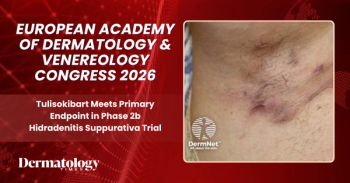
Up to 72% of tulisokibart-treated patients achieved HiSCR50 at week 16 vs 35% with placebo, the first positive phase 2 anti-TL1A data in dermatology.
The growing success of IL-17–targeted therapies suggests that remission may become a realistic future goal for many patients living with hidradenitis suppurativa.
The therapeutic landscape for hidradenitis suppurativa (HS) is rapidly evolving, with data presented at the
Among the most mature data sets presented were new analyses from the phase 3 BE HEARD program (
"Bimekizumab does work well for HS, and it seems to work better with time," Steven Daveluy, MD, board-certified dermatologist and program director at Wayne State University in Detroit, Michigan, told Dermatology Times. "We always do our primary outcomes at week 12 or 16, but we know that’s not how long it takes HS to get better. When bimekizumab works for a patient, it’s going to continue working for them.”
Beyond response rates, bimekizumab demonstrated meaningful disease modification. Data from long-term analyses showed a marked shift in disease severity, with a substantial proportion of patients transitioning from severe disease at baseline to mild or inactive disease by year 3.2 Flare rates also declined over time, approaching 0 among patients remaining on therapy, further supporting the concept of sustained disease control.3
Complementing these long-term data, newer investigational IL-17–targeted agents also demonstrated compelling efficacy. Sonelokimab, a next-generation nanobody targeting IL-17A and IL-17F, showed strong and improving responses through week 40 in the phase 3 VELA-1 and VELA-2 trials (
“If you don’t get the inflammatory lesions under control early on, they progress to irreversible tissue damage. We should be maximally motivated to get the inflammation under control as early as possible,” Kristian Reich, MD, PhD, dermatologist and the founder and chief scientific officer of MoonLake Immunotherapeutics, said in conversation with Christopher Bunick, MD, PhD, associate professor of dermatology at Yale School of Medicine and editor in chief of Dermatology Times.
Similarly, izokibep, a small protein IL-17A inhibitor, demonstrated sustained efficacy in data from phase 3 studies, with rapid onset of action and continued improvements in HiSCR responses and pain reduction in both biologic-naive and biologic-experienced patients.5 Although longer-term data are still emerging, the consistency of response across patient populations suggests that IL-17 inhibition as a class may offer robust and versatile disease control.
Collectively, these data reflect a paradigm shift in HS management from modest symptom reduction toward sustained, high-level response and even remission. Increasingly, higher response thresholds such as HiSCR75, HiSCR90, and HiSCR100 are being used to differentiate therapies and set new expectations for clinical outcomes. This evolution mirrors trends seen in other inflammatory diseases, such as psoriasis, where treatment goals have progressively advanced toward near-complete or complete clearance.
“This is not a disease that we resolve in 14 or 16 or 12 weeks. So [it’s] great to see continued improvement on all of those measures over time,” Alexa Kimball, MD, MPH, professor of dermatology at Harvard Medical School in Boston, Massachusetts, said to Dermatology Times in a recent interview.
Ultimately, the data presented at AAD 2026 signal a turning point in HS care. With multiple IL-17–targeted therapies demonstrating durable, high-level responses across diverse patient populations, clinicians are now better equipped than ever to achieve meaningful, sustained disease control. As ongoing trials continue to report longer-term outcomes and as more pipeline agents become available, the field is moving closer to a future in which remission—not just improvement—becomes a realistic goal for patients living with HS.
References
1. Sayed CJ, Porter ML, Molina-Leyva A, et al. Bimekizumab efficacy by patient subgroups in moderate to severe hidradenitis suppurativa: 3-year phase 3 results from BE HEARD EXT. Poster presented at: 2026 AAD Annual Meeting; March 27-31, 2026; Denver, CO. https://eposters.aad.org/s3/AM2026/poster/73230/Bimekizumab+efficacy+by+patient+subgroups+in+moderate+to+severe+hidradenitis+suppurativa+3-year+phase+3+results+from+BE+HEARD+EXT.pdf
2. Chovatiya R, Alavi A, Shi VY, et al. Bimekizumab efficacy by disease duration and severity in moderate to severe hidradenitis suppurativa: 3-year phase 3 results from BE HEARD EXT. Poster presented at: 2026 AAD Annual Meeting; March 27-31, 2026; Denver, CO. https://eposters.aad.org/s3/AM2026/poster/73498/Bimekizumab+efficacy+by+disease+duration+and+severity+in+moderate+to+severe+hidradenitis+suppurativa+3-year+phase+3+results+from+BE+HEARD+EXT.pdf
3. Daveluy S, Naik HB, Reguiai Z, et al. Bimekizumab leads to sustained flare-free status in moderate to severe hidradenitis suppurativa: 3-year data from BE HEARD EXT. Poster presented at: 2026 AAD Annual Meeting; March 27-31, 2026; Denver, CO. https://eposters.aad.org/s3/AM2026/poster/73493/Bimekizumab+leads+to+sustained+flare-free+status+in+moderate+to+severe+hidradenitis+suppurativa+3-year+data+from+BE+HEARD+EXT.pdf
4. Kimball A. Sonelokimab in moderate-to-severe HS: long-term results through week 40 of two phase 3 trials. Presented at: 2026 American Academy of Dermatology Annual Meeting; March 27-31, 2026; Denver, CO.
5. Papp K, Bechara F, Porter M, et al. Efficacy of izokibep, a novel interleukin-17A inhibitor, in moderate to severe hidradenitis suppurativa: week 32 results from a randomized, double-blind, placebo-controlled, multicenter, phase 3 study. Poster presented at:2026 AAD Annual Meeting; March 27-31, 2026; Denver, CO.
4 months ago
Dermatology Times May 2026 Print Recap5 months ago
Phages in Dermatology: What Is Their Role?