



Vitiligo
Latest News
Advertisement
Latest Videos





Advertisement
More News

Lesional stability is a necessary requirement for determining the course of treatment for vitiligo.

A poster presented at the 2023 ReV Virtual Conference explored the association between the 2 conditions.

Raj Chovatiya, MD, PhD, reviews a case of an adolescent patient with rapid changes in existing vitiligo.

The promising data on upadacitinib was presented at the 2023 Revolutionizing Vitiligo Virtual Conference.

Jordan Bui and Bernard A. Cohen, MD, review a case of a young patient with vitiligo.

Benjamin Lockshin, MD, FAAD, summarizes the panel's best practices for improving patient education on the risks and benefits of vitiligo treatment. He underscores the importance of establishing and managing expectations for treatment response.
An expert in dermatology discusses the case of an active 71-year-old female who spends considerable time outdoors. The expert summarizes the panel's recommendations for counseling the patient on the benefits of treatment compliance and the use of sun-sparing products to enhance her quality of life and treatment response.
Benjamin Lockshin, MD, FAAD, summarizes key points from a panel discussion on the utilization of topical treatments in vitiligo. The first case revolves a 31-year-old woman with distressing depigmentation and highlights the panel's treatment approach to the management of this condition in difficult to treat areas.

An expert in dermatology discusses the case of an active 62-year-old female, who is self-conscious about her condition, and explores how the panel would advise her to maintain her outdoor lifestyle while discussing effective topical treatments.
Heather C Woolery-Lloyd, MD, discusses a 23-year-old woman with vitiligo vulgaris affecting 75% of her face, including complete depigmentation. She explores the panel’s response to managing progressive disease and its impact on the patient's quality of life.

Recently, a significant breakthrough was achieved when 42 international vitiligo experts and 4 patient representatives collaborated and developed a consensus management strategy for vitiligo.

Experts Heather Woolery-Lloyd, MD; Chesahna Kindred, MD, MBA, FAAD; Gary M. Owens, MD; and Renata Block, MMS, PA-C, discuss the evolving landscape of vitiligo, particularly from an economic lens.
Susan C. Taylor, MD, FAAD, and George Han, MD, PhD, share insights on vitiligo awareness, demographics, treatment approaches, and the impact of the condition on patients’ quality of life.

Incorporating vitamin D may mitigate adverse effects of corticosteroids, though more research is needed to discover the best methods for topical administration in vitiligo.

Meta-Analysis Finds Chinese Patent Medicines May Be Efficacious, Suitable Interventions for Vitiligo
Combined with routine treatments for vitiligo, certain CPMs proved efficacious in patients with vitiligo, with few adverse effects.

Investigators believe different circulating inflammatory phenotypes in patients with vitiligo may influence their responses to treatment with ruxolitinib cream.
Experts in dermatological conditions provide insight on challenges patients and clinicians may face in accessing vitiligo medications, especially for newer therapies, and the future of vitiligo treatment.
Susan C. Taylor, MD, and George Han, MD, PhD, discuss how to measure treatment response in patients with vitiligo and share advice for counseling patients about long-term use and compliance of treatment.
Dr Susan C. Taylor leads a discussion on newly approved agent, ruxolitinib, and its use in clinical practice as a targeted treatment option for patients with vitiligo.
Experts in dermatology comment on treatment approaches to vitiligo, including home phototherapy devices and recent autologous cell-harvesting technology for burn victims.
Drs Susan C. Taylor and George Han highlight the importance of setting goals, managing patient expectations, and shared-decision making for vitiligo treatment.
Susan C. Taylor, MD, leads a discussion on approaching patient conversations on vitiligo including understanding patient lifestyle, cultural impact, and the impact on QoL.

Overall, acne events were mild or moderate and did not cause patients to discontinue ruxolitinib cream treatment.

AbbVie announced the 24- and 52-week data at EADV 2023.
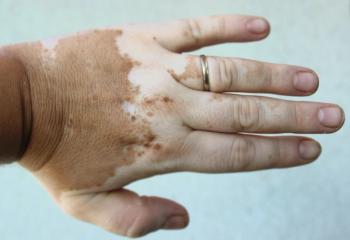
Longer-term use of povorcitinib demonstrated further improvement in total body and facial repigmentation.
Advertisement
Advertisement
Trending on Dermatology Times
1
From Mechanism to Management: Navigating Male Pattern Hair Loss and New Topical Therapies
2
FDA Approves Baricitinib for Adolescents With Severe Alopecia Areata
3
Tremfya Meets Primary, Major Secondary Endpoints in Phase 4 STAR Study of Axial PsA
4
Dr. Charrow Highlights Earlier Biologic Use and Deroofing in Hidradenitis Suppurativa
5