

Opinion|Videos|September 22, 2026
Biologic Mechanisms and When to Escalate Therapy in HS
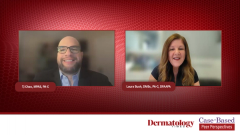
Three FDA-approved biologics now intercept the inflammatory cascade at different points, yet Dr. Laura Bush argues a calm exam can understate real disease burden. The panel discusses when history should outweigh appearance.
Advertisement
Episodes in this series
This episode, "Biologic Mechanisms and When to Escalate Therapy in HS," features the panel unpacking today's treatment landscape for HS.
Dr. Bush walks through the current standard of care for HS, describing three FDA-approved biologics: adalimumab, secukinumab, and bimekizumab, layered alongside oral and topical antibiotics, intralesional steroid injections, medicated washes, metformin, and spironolactone. Treatments are often stacked depending on the individual patient. Chao argues the standard of care should mean treating patients earlier rather than waiting, since delayed escalation historically allowed scarring to develop before advanced options were used. Dr. Bush agrees clinicians once knew far less and treated conservatively by default, but now understand what untreated HS becomes, prompting faster action. She notes therapies can start simultaneously rather than sequentially, combining an antibiotic, a biologic, and a surgical referral for the same patient without waiting. Turning to mechanisms, Dr. Bush explains that TNF inhibitors block inflammation furthest upstream, right after follicular rupture activates the innate immune system. Secukinumab blocks IL-17A more specifically downstream, preventing it from binding its receptor. Bimekizumab is unique because it blocks IL-17A and IL-17F simultaneously, interrupting the feedback loop that perpetuates inflammation. Chao notes today's therapies are far more targeted than those available twenty years ago, with less collateral damage elsewhere in the body. On escalation triggers, Dr. Bush shares a patient who appeared mild on exam, with just one nodule and one abscess, but had missed six workdays that month and five the previous month. She placed him on a biologic despite the modest exam findings, reasoning that flare history and functional impact matter more than what is visible on a given day. Chao adds that he proactively reassures patients that frightening internet photos reflect a pre-biologic era, and that building trust matters as much as clinical reasoning when recommending escalation. Dr. Bush agrees that earning a patient's buy-in, reading the room, comes before introducing the idea of a biologic.
Our next episode, "Case 1: Assessing Severity and Barriers to Biologics in HS," applies these decisions to a real patient facing years of unresolved axillary and groin disease.
Advertisement
Related to this article
The designation marks the first FDA Fast Track status granted to a therapy for peeling skin syndrome, which currently has no approved treatment.

The merger, backed by an oversubscribed $180 million private placement, will fund development of NOR-101, an IL-13 x IL-18 bispecific antibody entering phase 1 trials in atopic dermatitis in early 2027.

Maui Derm NP+PA Fall 2026 brought APPs together for updates spanning inflammatory disease, oncology, emerging therapies, and diagnostic challenges.

LEO Pharma has closed its acquisition of dersimelagon from Tanabe Pharma after the FDA accepted the drug's NDA for filing and granted Priority Review, with a PDUFA date expected by the end of February 2027.
Sol-Gel Technologies has completed patient follow-up in its pivotal phase 3 trial of SGT-610 (patidegib gel, 2%) for Gorlin syndrome, with top-line results expected in late November 2026.

Two small clinical studies evaluated skincare and dermabrasion for changes in skin quality among individuals taking medical weight loss medications.

Two-year POETYK PsA-2 data showed sustained ACR and minimal disease activity responses with deucravacitinib and no new safety signals.

Faculty from the Cutaneous Oncology Workshop answer practical questions spanning skin cancer prevention, diagnosis, treatment, and follow-up.
Advertisement
Advertisement
Trending on Dermatology Times
1
Clascoterone 5% Topical Solution Shows Long-Term Promise for Male Pattern Hair Loss
2
Dersimelagon NDA Accepted by FDA with Priority Review for EPP, XLP
3
North Immunology, Aethlon Merge to Advance NOR-101 for AD
4
Maui Derm NP+PA Fall 2026: Key Clinical Takeaways From 4 Days of Dermatology Education
5