Shannon Trotter, DO, moderated a Dermatology Times Case-Based Roundtable event on how pharmacokinetics, adverse event timing, and trial response criteria should shape hedgehog pathway inhibitor selection in advanced BCC.
Gaurav Singh, MD, explains how pharmacokinetics, trial design, and real-world tolerability set sonidegib apart from vismodegib in locally advanced basal cell carcinoma and when to start systemic therapy earlier.
“Sometimes a smaller tumor on a cosmetically sensitive site, or perhaps a patient who’s already had surgery multiple times and has already had radiation, may benefit from hedgehog inhibitor therapy, especially prior to surgery,” said Gaurav Singh, MD.
Singh, a dermatologist and Mohs surgeon at City of Hope Comprehensive Cancer Center in Chicago, led a
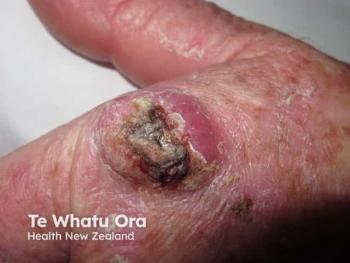
Singh placed the size threshold at more than 2 cm, or more than 4 cm by some standards, but said location shifts the definition. A 3-cm lesion on the back may not qualify, while a 5-mm lesion on the eyelid margin could. Because BCC lacks a uniform staging system, he borrows risk factors from AJCC systems for other cancers.
Invasion beyond subcutaneous fat, morpheaform and micronodular subtypes, recurrence, scarred sites, prior radiation, and a history of leukemia, lymphoma, or transplant all raise concern. He cautioned the pathology report can understate risk, noting about a third of superficial BCCs are upstaged on final pathology.
Patient preference drives his decision to introduce systemic therapy. “Hedgehog inhibitors are likely underutilized, and systemic therapy should be considered earlier than it currently is for a lot of patients,” Singh said.
He often starts an HHI before surgery despite the label, aiming for a smaller defect and scar. In a multidisciplinary setting, he combines oral therapy with surgery and adjuvant radiation where indicated.
Both drugs are dosed once daily, at 200 mg for sonidegib and 150 mg for vismodegib, and no head-to-head trials exist. Singh contrasted a sonidegib half-life of 1 month and volume of distribution above 9000 L with a vismodegib half-life of 4 to 12 days and volume of distribution near 30 L. Steady state takes up to 4 months with sonidegib and about 3 weeks with vismodegib.
“Sonidegib tends to go to the scene of the crime, which is the basal cell carcinoma in the skin, and that’s because of the very high volume of distribution for the medication, and then it tends to stay there,” Singh said.
The 42-month BOLT analysis reported objective response rates of 56% in laBCC and 8% in metastatic disease with sonidegib 200 mg.¹ In ERIVANCE, vismodegib produced an investigator-assessed rate of 60.3% in laBCC with a median duration of response of 26.2 months.² STEVIE reported 68.5% in laBCC, with 98% of patients experiencing at least 1 treatment-emergent adverse event.³
Singh stressed the trials cannot be compared directly. BOLT required a reduction of more than 50% in the bidimensional sum for partial response, while the other trial required 30% in 1 dimension. Applying RECIST-like criteria to sonidegib would put its complete response rate near 21%, he said.
“We know from clinical practice that tumors don’t grow in one dimension, and to a patient, all three dimensions, and at minimum two dimensions, the length and the width of the tumor, are very clinically relevant and significantly affect surgical morbidity,” Singh said.
A claims analysis found sonidegib-treated patients stayed on therapy longer and were 33% less likely to have gastrointestinal conditions, 71% less likely to have taste or smell conditions, and 52% less likely to have muscle spasms than those on vismodegib.⁴ “I do not consider sonidegib and vismodegib to be interchangeable in clinical practice,” Singh said.
He uses sonidegib first for laBCC. For metastatic disease, he usually chooses a PD-1 inhibitor such as cemiplimab (Libtayo; Regeneron Pharmaceuticals), and he moves to one after HHI failure rather than switching within the class.
Singh checks creatine kinase, creatinine, complete blood count, and comprehensive metabolic panel at baseline, weekly for 2 months, then every 4 weeks. Fatigue, spasms, nausea, and dysgeusia typically emerge before month 4, alopecia around month 5, and weight loss after month 6. He gives L-carnitine 400 mg 3 times daily for spasms and uses oral minoxidil, finasteride, or spironolactone for alopecia.
“I like to stick to how the trials were actually done to help my patients derive a benefit,” Singh said. He allows drug holidays of up to 21 days but avoids altered dosing.
Response usually appears around month 4. Absent response by month 6, he typically moves to a different class such as a PD-1 inhibitor and expects tumor reduction in 2 dimensions.
Singh urged colleagues to widen referral. “When patients have a history of surgery and a history of radiation, I would implore all of us to please consider systemic options,” he said.
References