Cosibelimab-ipdl is now an NCCN Category 2A option for locally advanced CSCC in patients ineligible for curative surgery or radiation.
Shannon Trotter, DO, moderated a Dermatology Times Case-Based Roundtable event on how pharmacokinetics, adverse event timing, and trial response criteria should shape hedgehog pathway inhibitor selection in advanced BCC.
Shannon Trotter, DO, a dermatologist with DOCS Dermatology in Central Ohio and a clinical assistant professor at Ohio University, led a recent
An opening poll showed more than half of attendees do not currently use HHIs in practice. Trotter framed the evening around the pharmacology of sonidegib (Odomzo; Sun Pharmaceutical Industries) and vismodegib (Erivedge; Genentech), tolerability, and individualized selection.
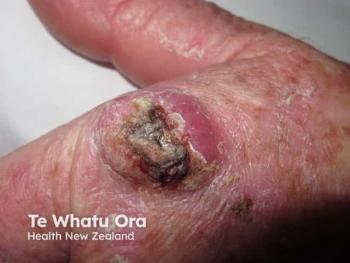
The first case involved a 68-year-old man with a 3.5-cm ulcerated, infiltrative BCC at the left medial canthus. Oculoplastic surgery advised against resection and radiation was deferred, with no nodal or distant disease on imaging.
Attendees questioned whether radiation offered a realistic alternative. “If oculoplastics isn’t going to touch it, do you think radiation is going to do him some favors?” an attendee said.
Trotter noted there is no consensus definition of locally advanced BCC and prefers the term difficult-to-treat BCC.
Trotter said labeling for both agents calls for baseline and periodic creatine kinase and creatinine testing. In her own practice, she checks at baseline and repeats only for symptomatic patients.
Dosing and interactions also factored into selection. Sonidegib is taken on an empty stomach and requires caution with CYP3A inhibitors, while vismodegib can be taken with or without food and carries no major interactions.
She also reviewed pharmacokinetic differences. Sonidegib has a markedly larger volume of distribution, with skin concentrations about 6 times higher than plasma, and adverse events tend to appear later. Median onset of alopecia was 5.5 months with sonidegib and 2.9 months with vismodegib.
For supportive care, Trotter starts L-carnitine about 2 weeks before therapy, often near 1500 mg nightly. “Stay well hydrated to avoid muscle spasms,” an attendee said.
Trotter said NCCN guidelines include neoadjuvant therapy for locally advanced BCC. Attendees who use HHIs before surgery reported mixed results. “Usually they shrink and then they stop shrinking,” an attendee said.
Another attendee raised the risk of missed skip areas after tumor contraction. “That’s the problem with all neoadjuvant therapies,” an attendee said.
Trotter said response assessment remains unsettled. “The imaging modalities aren’t there yet for full standard,” Trotter said.
The second case featured a 45-year-old man with a 2.5-cm ulcerated nasal tip nodule involving cartilage. He had stage 2 chronic kidney disease, simvastatin use, leg cramps, and creatine kinase at the upper limit of normal. Vismodegib 150 mg was chosen for his irregular meals, and at week 6 he developed grade 2 muscle spasms with creatine kinase twice the upper limit of normal.
A poll asked which adverse event most often ends therapy. Alopecia ranked first, followed by a tie between dysgeusia and weight loss, with muscle spasms last.
“It’s amazing how powerful hair loss is,” Trotter said. She described patients who paused therapy to preserve taste, including one who wanted to enjoy wedding cake at her daughter’s wedding.
Given the elevated creatine kinase, Trotter said she would pause therapy and recheck laboratory values.
Trotter outlined options after a side effect, including supportive care, interruption, and dose modification. She cited a Cleveland Clinic regimen of vismodegib Monday through Friday with weekends off, which she said offered better tolerability with the same efficacy. She also moved one patient from vismodegib to sonidegib for tolerability.
The third case involved a 72-year-old woman with recurrent infiltrative BCC of the left temple after 3 Mohs surgeries and radiation. She declined further surgery and started sonidegib 200 mg on an empty stomach.
Trotter explained BOLT (
“I usually tell people to focus on the complete response,” Trotter said. Median time to response was about 4 months for both agents. One attendee found the durability data disappointing, noting patients often stop responding.
Trotter also noted case reports of adjunctive imiquimod in resistant disease. Attendees were mixed on managing HHIs themselves versus referring to colleagues.
In a closing poll, setting adverse event expectations before the first dose ranked as the top planned change. Selecting an HHI by tumor characteristics and using planned interruptions tied for second. “If you’re using it as primary treatment, I think it’s very well within the dermatologist’s wheelhouse to be doing it,” Trotter said.
Reference