LEO Pharma has closed its acquisition of dersimelagon from Tanabe Pharma after the FDA accepted the drug's NDA for filing and granted Priority Review, with a PDUFA date expected by the end of February 2027.
Delgocitinib showed consistent efficacy in atopic, irritant, allergic, and hyperkeratotic forms of chronic hand eczema in pooled trial data.
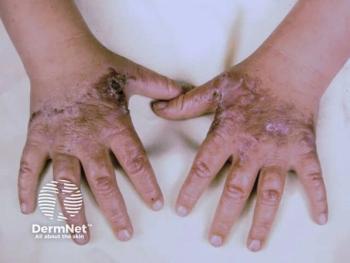
Chronic hand eczema (CHE) remains one of the most challenging inflammatory dermatoses to manage in clinical practice. Affecting up to 10% of the general population, CHE is a multifactorial, relapsing condition characterized by erythema, scaling, fissuring, and pruritus that can significantly impair hand function and quality of life. Although corticosteroids have been the mainstay of therapy, long-term control often remains inadequate due to variable efficacy, safety concerns, and patient nonadherence.1
Recent data presented in an article by Issa et al have positioned delgocitinib 2% cream, a topical pan–Janus kinase (JAK) inhibitor, as a promising nonsteroidal therapeutic option for adults with moderate to severe CHE.2
"Patients with CHE have suffered without a dedicated FDA-approved therapy for a long time. CHE disrupts the skin barrier and alters the skin appearance, but importantly also causes prominent symptoms of itch and pain in many patients, plus issues of self-confidence and social anxiety," author Christopher Bunick, MD, PhD, associate professor of dermatology at the Yale School of Medicine and editor in chief of Dermatology Times said. "Delgocitinib offers a potent, safe, non-steroidal treatment approach to managing CHE of all subtypes, ensuring the underlying inflammatory pathways driving any particular patient's disease are optimally managed. In this article, my co-authors and I describe the clinician-friendly and patient-friendly use of delgocitinib for CHE management."
CHE affects both sexes but shows higher prevalence in women, likely reflecting differences in occupational and domestic exposures. The disease is often long-standing, with a median duration of 11 to 16 years and recurrent inflammatory flares associated with pain, fissures, and pruritus. Itch affects up to 78% of patients and correlates closely with disease severity, contributing to significant sleep disturbance and psychological distress. Pain, reported in 36–53% of cases, is an underrecognized symptom that correlates with Investigator Global Assessment (IGA) and Hand Eczema Severity Index (HECSI) scores.
Occupational hand eczema represents a major subset, particularly in health care, food service, and cleaning industries. CHE’s chronicity and localization lead to substantial socioeconomic costs; European studies estimate annual societal expenses of €1,813–€7,738 per patient, largely due to absenteeism and job loss.
The immunopathogenesis of CHE is complex, involving both barrier dysfunction and immune dysregulation. Distinct cytokine patterns characterize its subtypes: Th2/Th22-related cytokines (IL-4, IL-13, IL-31, IL-22) predominate in atopic forms, whereas Th1/Th17 cytokines (IFN-γ, IL-17A) dominate in irritant and hyperkeratotic subtypes. Despite heterogeneity, these inflammatory pathways converge on the JAK-STAT signaling cascade, a shared intracellular route for multiple cytokine receptors.
By targeting all 4 JAK isoforms (JAK1, JAK2, JAK3, TYK2), delgocitinib broadly inhibits downstream signaling of proinflammatory cytokines implicated in CHE pathogenesis. This mechanistic breadth provides a scientific basis for its efficacy across CHE phenotypes, including mixed and unclassifiable forms frequently encountered in practice.
The pivotal DELTA-1 and DELTA-2 phase 3 trials were randomized, double-blind, vehicle-controlled studies enrolling adults with moderate-to-severe CHE (IGA-CHE 3–4) unresponsive or intolerant to topical corticosteroids. Participants applied delgocitinib 2% cream or vehicle twice daily for 16 weeks.
At week 16, 24.3% of delgocitinib-treated patients achieved IGA-CHE treatment success (clear or almost clear with ≥2-grade improvement) compared with 8.4% on vehicle. HECSI-75 and HECSI-90 responses were achieved in 49.4% and 30.3% of delgocitinib users, versus 20.9% and 10.6% with vehicle, respectively. Improvements in itch and pain were observed as early as week 1, with statistically significant mean reductions by day 3 for pain and day 1 for pruritus.
A post-hoc analysis indicated a “deep response” (clear/almost clear skin with minimal itch or pain and DLQI ≤1) in 19% of delgocitinib-treated patients compared to 4% on vehicle.
The DELTA-3 open-label extension evaluated up to 52 weeks of treatment using twice-daily, as-needed dosing. Among 801 participants, 42% achieved IGA-CHE success at least once by week 16, increasing to 60% by week 52. HECSI-75 was reached by 66.5% at week 16 and 83.5% at week 52. Approximately one-third of patients who achieved complete clearance maintained remission for up to 8 weeks after stopping therapy, supporting a potential for intermittent or “flare-based” treatment schedules.
In the DELTA FORCE head-to-head phase 3 trial, delgocitinib 2% cream was compared with oral alitretinoin 30 mg, the only approved systemic agent for severe CHE in Europe. At week 12, delgocitinib produced a significantly greater reduction in HECSI score (–67.6 vs –51.5; P<0.0001), with fewer adverse events (49% vs 76%) and discontinuations. Headache and nausea were notably less frequent in the topical arm.
A matching-adjusted indirect comparison between delgocitinib and dupilumab in atopic hand eczema demonstrated comparable efficacy at 16 weeks, suggesting delgocitinib may offer a non-systemic alternative for atopic-predominant cases.
Systemic absorption of delgocitinib following topical administration was minimal. Plasma concentrations after twice-daily application remained below 0.25 ng/mL—orders of magnitude beneath the IC50 threshold for systemic JAK inhibition. Common adverse events included mild application-site reactions and nasopharyngitis; no systemic laboratory abnormalities or treatment-related serious adverse events were observed. Notably, delgocitinib carries no boxed warning, differentiating it from oral JAK inhibitors and improving its suitability for chronic use.
A phase 2a molecular analysis demonstrated that delgocitinib normalized expression of inflammatory genes associated with Th1, Th2, and Th17 signaling, while upregulating barrier-related genes such as filaggrin-2 and loricrin. These results provide mechanistic support for its dual anti-inflammatory and barrier-restorative activity, aligning with observed clinical improvement.
For clinicians, delgocitinib cream represents a novel steroid-sparing, non-systemic therapy capable of addressing the multifactorial pathophysiology of CHE. Its rapid onset, durable efficacy, and favorable tolerability profile suggest potential for both induction and maintenance phases of care, including in patients with occupational or recalcitrant disease.
Ongoing pediatric trials (DELTA Kids and DELTA Teens) are expected to assess safety and efficacy in children and adolescents, potentially expanding its therapeutic reach to younger age groups.
Recent clinical evidence supports delgocitinib 2% cream as an effective, well-tolerated topical treatment for CHE, providing broad efficacy across subtypes with negligible systemic risk. Through pan-JAK inhibition, delgocitinib modulates multiple inflammatory pathways while promoting barrier restoration. For clinicians managing refractory CHE, these data establish delgocitinib as a meaningful advancement in a condition long underserved by available topical therapies.
References