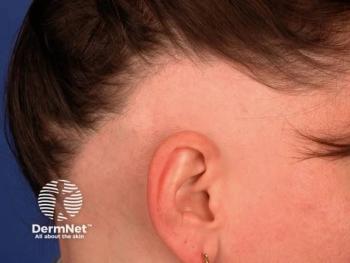
The FDA approval, based on 36-week data from the phase 3 BRAVE-AA-PEDS trial, extends baricitinib access to patients as young as 12 years old with severe alopecia areata.
Combination therapy may be particularly beneficial for frontal hairline regrowth, a traditionally difficult area to treat.
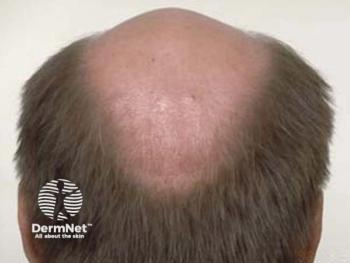
Androgenetic alopecia (AGA) remains one of the most common reasons men seek dermatologic care. In China alone, it affects an estimated 1 in 5 men, and similar patterns are seen globally. While the condition is medically benign, its psychological impact is anything but. Increasingly, clinicians recognize that hair loss, particularly frontal recession, can affect self-image, confidence, and even social functioning in younger patients.1
At the core of AGA is a well-described process: genetically susceptible hair follicles gradually shrink over time, producing thinner, shorter hairs until they eventually stop producing visible hair altogether. The frontal hairline is often where this becomes most noticeable, especially in M-pattern (M-type) hair loss, the most common subtype.2
For years, treatment has centered on 2 FDA-approved options: topical minoxidil and oral finasteride. Both can be effective, but neither is perfect. Minoxidil requires long-term daily use and can take 6 months or more before meaningful improvement is seen. Finasteride, meanwhile, is sometimes avoided due to concerns about potential sexual adverse effects, even if the absolute risk is low in most studies. As a result, adherence in real-world practice is often inconsistent.
This has created growing interest in combination strategies that can enhance drug delivery and improve response—particularly in areas like the frontal scalp, which tends to respond less robustly than the vertex.
A
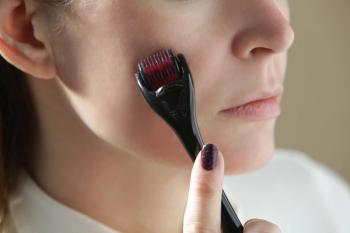
The concept behind the approach is relatively straightforward. Fractional CO₂ lasers create microscopic channels in the skin. These micro-injuries are not destructive in the traditional sense, but instead act as temporary pathways that may enhance the penetration of topical medications into deeper layers of the scalp where hair follicles reside.
In this study, 178 men with M-type AGA were randomly assigned to either standard topical minoxidil alone or minoxidil combined with monthly fractional CO₂ laser sessions over 24 weeks.
Both groups improved over time, which is expected with consistent minoxidil use. But the combination group consistently outperformed minoxidil alone across multiple measures.
By week 24, patients receiving laser-assisted therapy showed a larger increase in terminal hair density in the frontal scalp region—the primary area of concern in M-pattern hair loss. On average, the combination group gained about 16.8 hairs/cm² versus 9.6 hairs/cm² in the minoxidil-only group. This difference was statistically significant and, more importantly, visually noticeable in standardized photographs.
Improvements weren’t just limited to hair counts. Hair shaft thickness also increased more in the combination group, suggesting not only more hairs, but stronger, more mature ones. This is clinically relevant because early AGA is characterized not just by hair loss, but by progressive miniaturization—thinning of the hair shaft before complete loss occurs.
Interestingly, improvements appeared earlier in the combination group, with measurable differences already evident at 12 weeks. This faster onset may be particularly meaningful for patients who struggle with the long waiting period typically associated with topical therapies.
Trichoscopic imaging—essentially high-magnification scalp photography—provided a closer look at what was changing beneath the surface.
Markers of AGA such as hair diameter variability, yellow dots (often representing follicular miniaturization), and perifollicular pigmentation improved more in the laser group. These findings suggest that the benefit may go beyond improved drug delivery alone. The authors propose that fractional CO₂ laser may also influence local inflammation and microcirculation, both of which are thought to play a role in follicular health.
In simpler terms, the scalp environment itself may become more “hair-friendly” after laser treatment, not just more permeable to medication.
Interestingly, quality-of-life scores (DLQI) did not differ significantly between groups at 24 weeks. This may seem surprising given the clinical improvements. However, patient satisfaction scores told a slightly different story: men in the combination group reported higher satisfaction with their frontal hairline appearance.
This highlights an important clinical reality. Standardized questionnaires don’t always fully capture how patients perceive cosmetic change—especially in early stages. Even modest visible improvement in the frontal hairline can carry disproportionate psychological value.
One of the most important findings from a practical standpoint is safety. Both treatments were well tolerated. The most common adverse effects were mild scalp irritation, temporary redness, or itching. These occurred at low rates in both groups and did not lead to treatment discontinuation. No serious adverse events were reported.
For a procedure-based adjunct therapy, this safety profile is reassuring, particularly given that treatments like finasteride and systemic therapies often raise more complex risk-benefit discussions.
The results support a growing trend in dermatology: combination approaches that enhance existing therapies rather than replacing them. Fractional CO₂ laser-assisted delivery appears to meaningfully improve both the speed and magnitude of response to topical minoxidil in M-type AGA.
However, this is not a replacement for standard therapy. Minoxidil remains the foundation. Instead, laser-assisted treatment may represent an add-on option for selected patients—particularly those with:
While promising, the study also has limitations. It was conducted at a single center, followed patients for only 24 weeks, and used fixed laser settings. Longer-term durability of results remains unknown, as does the optimal treatment protocol.
Still, the findings add to a growing body of evidence suggesting that physical methods like fractional laser therapy may enhance topical drug performance in AGA.
This study reinforces a simple but important idea: in androgenetic alopecia, improving drug delivery may be just as important as the drug itself.
For clinicians, fractional CO₂ laser-assisted minoxidil delivery is emerging as a well-tolerated and potentially more effective option than topical therapy alone—particularly for frontal scalp regrowth, where traditional treatments often fall short.
For patients, it represents another step toward more personalized, multi-modal hair restoration strategies that move beyond 1-size-fits-all treatment.
References