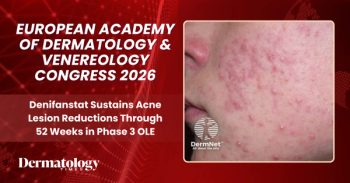
Treatment success reached 56.7% and total lesions fell 71.8% with up to 52 weeks of oral denifanstat, with no adverse event-related discontinuations.
As 2024 comes to a close, Dermatology Times is taking a look back at the studies, therapies, and advances in acne this year.
The pilot study explored the use of double-conjugated retinoid serum used in combination with exfoliating peel pads.
Researchers found that high levels of AST and ALT in patients with acne taking oral isotretinoin was low in incidence.
This article discusses insights from research studies and offers specialized guidance aimed at dermatologists in hopes of fostering patient adherence in acne management.
The guidelines update the American Academy of Dermatology’s 2016 recommendations for acne management in adults, adolescents, and children aged 9 and older.
There’s nothing worse than having OTC products fight back against the progress we make with our prescription therapies.
Barbieri spoke with Dermatology Times to discuss the new guidelines and the recommendations and good practice statements included.
Despite its black box warning, isotretinoin does not appear to increase the risk of suicide in acne patients, a finding investigators say is reassuring in their research.
Tween skin care has become a rising trend across social media platforms such as TikTok, and dermatology clinicians are becoming increasingly concerned about misinformation.
On March 6, 2024, Valisure, an independent testing laboratory, found high levels of benzene when BPO products were incubated at 37°C, 50°C, and 70°C.
Over 50% of women in their 20s and over 35% of women aged 30 to 39 years struggle with adult female cystic acne.
Mona Gohara, MD, explained the importance of the products' impact on the skin barrier.
Take an in-depth look at the basis of Valisure's benzene testing methods and practical recommendations for clinicians from Christopher Bunick, MD, PhD.
Acinonyx Bio's topical cream, ACX, targets Propionibacterium acnes.
Am acne-specific HRQoL questionnaire developed in Europe could help to create more comprehensive, individualized treatment plans.
Supplementation with RGLE led to clinically significant improvements in patients with acne vulgaris, according to a study.
Although acne is common for most people to experience in their lifetime, it is important to individualize treatment and provide appropriate care when working with a diverse patient base.
Patients with acne scarring who received concurrent therapy with isotretinoin and fractional radiofrequency achieved significant reductions in acne scar volume.
Researchers found that the hemp derivative addressed multiple facets of acne pathophysiology and improved acne scarring overall.
Some patients may be looking for alternatives to BPO, questioning its safety.
A study found that pharmacy professionals had an increased level of capability, opportunity, and motivation after accessing the resource.
Social media misinformation related to acne vulgaris may require clinician intervention when discussing treatment with patients.
The lotion effectively rebalanced the microbiota, reduced erythema and desquamation, and improved acne severity.
Patients with acne also had higher rates of abnormal zinc and vitamin D levels, especially in severe cases.
A study revealed that CO2 fractional laser was significantly more effective than microneedling for acne treatment with ALA-PDT.
Although EBDs provided improvements over controls, they did not match the sebum reduction levels achieved by isotretinoin or hormonal therapies.
Acne vulgaris has been reported as an adverse effect of GLP-1 receptor agonists by some patients.
Shanna Miranti, MMS, PA-C, reviews 2 patient cases of pseudo acne fulminans, offering perspectives on treatment and management strategies.
This new indication adds to existing clearance of a non-drug treatment for mild to severe inflammatory acne vulgaris.
The meta-analysis revealed comparable efficacy in treating acne vulgaris and was presented at Fall Clinical 2024.
The clinical trial showed promising results for patients who used probiotics as an accompanying treatment.
The study demonstrated significant reductions in inflammatory and non-inflammatory lesions for Hispanic patients using CAB gel.
A poster presented at the 2024 SDPA Fall Conference demonstrated that clascoterone cream remains stable when paired with commonly prescribed acne topicals, supporting its role in multimodal therapy.
Research suggested acne is primarily inflammatory, occurring even in unaffected skin, redefining its pathophysiology.
These findings further suggest the implications of acne vulgaris treatment on the skin barrier.
Researchers stated that therapy represents a “valuable nonpharmacological intervention that offers an innovative therapeutic alternative” for acne treatment.
Researchers noted higher correlations in those who are prone to severe acne and post acne erythema (PAE).
Don’t miss a moment of Dermatology Times by signing up for our eNewsletters and subscribing to receive the free print issue and supplements each month.