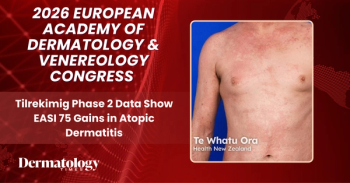
According to data presented at EADV, at week 16 of the phase 2 study, 47.8% to 62.5% of adults receiving tilrekimig achieved EASI 75 across doses, compared with 9.1% to 19.9% with placebo.
Roman Bronfenbrener, MD, discusses how AI-generated patient diagnoses are reshaping dermatology visits and creating new challenges.
As artificial intelligence (AI) becomes increasingly integrated into dermatology, clinicians are beginning to see its effects extend beyond practice operations and into patient encounters.
In an
Bronfenbrenner recently described a patient who arrived with a printed report from Gemini AI identifying an itchy rash as eczema and recommending topical corticosteroids. After evaluation, however, the correct diagnosis was shingles.
"I had a patient come in a couple of weeks ago with a whole printout from Gemini saying you have eczema, you need topical steroids, and they have shingles," Bronfenbrenner
He attributed the misdiagnosis in part to the limited information submitted to the chatbot. The patient had uploaded close-up photographs and described the rash as itchy, leading the AI to incorrectly classify the eruption.
Rather than topical steroids, the patient ultimately left with a prescription for valacyclovir (Valtrex).
"He left with Valtrex, but at the end of the day he got the correct diagnosis, which is important," Bronfenbrenner said.
Although Bronfenbrenner has not yet encountered a patient whose AI-generated advice prevented them from seeking care for a dangerous lesion, he believes those cases are likely on the horizon.
He explained that AI systems are particularly vulnerable to anchoring bias, relying heavily on the history patients provide. When that information is incomplete or inaccurate, AI can reinforce an incorrect diagnosis rather than challenge it.
"The patient gives the incorrect history to the AI, and it has this anchoring bias...and it turns out to be like a melanoma," Bronfenbrenner said.
Despite these concerns, Bronfenbrenner believes AI can play a positive role if it encourages patients to seek professional evaluation instead of offering false reassurance.
"If AI kind of breeds more awareness...and instead says, 'I'm not really sure, you need to go get checked out by a doctor,' which is what I think AI is currently doing, there might be some benefit to it,"
He also noted that patients increasingly use AI after appointments to better understand their diagnoses or interpret progress notes.
"I'm not opposed. I think that's a savvy patient that does that," Bronfenbrenner said.
While Bronfenbrenner acknowledged that current AI systems can still hallucinate or generate inaccurate information, he expects their accuracy to improve over time. He emphasized, however, that AI is more likely to reshape workflows than replace physicians.
"I firmly believe AI is not going to replace us today or tomorrow or in the next few years," he said.
Instead, he believes dermatologists who fail to adopt AI for administrative tasks may find themselves at a competitive disadvantage.
"If you're a dermatologist and you don't use AI, you're going to get swept behind, because you're going to spend a ton of time on administrative tasks...that you could easily delegate to AI," Bronfenbrenner said.
As AI adoption continues to expand among both clinicians and patients—a trend reflected in the 2026 State of Dermatology Report—Bronfenbrenner believes dermatologists will increasingly find themselves balancing two responsibilities: leveraging AI to improve practice efficiency while helping patients navigate its limitations.
References