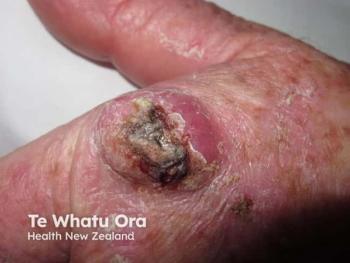
Cosibelimab-ipdl is now an NCCN Category 2A option for locally advanced CSCC in patients ineligible for curative surgery or radiation.
New guidelines for treating vitiligo cite phototherapy and combination therapy as the most effective management techniques.
Bordeaux, France - New guidelines for treating vitiligo cite phototherapy and combination therapy as the most effective management techniques.
The
For segmental vitiligo or limited nonsegmental vitiligo, the task force recommended avoiding triggering factors and using local agents such as corticosteroids or calcineurin inhibitors as first-line treatments. Second-line treatments should involve localized narrowband ultraviolet B radiation (311 nm), preferably with an excimer monochromatic lamp or laser, the guidelines state. For third-line therapy on patients with cosmetically unsatisfactory repigmentation even after first- and second-line treatments, the task force suggested considering surgical techniques.
“Vitiligo is a disease lacking definitive and completely effective therapies,” wrote A. Taïeb, M.D., of Service de Dermatologie, in Bordeaux. “Phototherapy and combined treatments are the most effective treatments. Therapy should stop the progression of the lesions and provide complete or almost complete repigmentation to be satisfactory for the patient.”
The guidelines were published online Aug. 3 in the