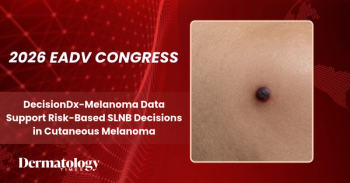
Prospective data suggest DecisionDx-Melanoma may help refine SLNB decisions and identify recurrence risk beyond conventional staging.
Kavita Mariwalla, MD, FAAD, explains why melanoma is rising in young women, how tanning trends and sunscreen myths spread online, and what prevention steps work best in younger patients.
As
In this Q&A, Kavita Mariwalla, MD, FAAD, a double board-certified dermatologist, Mohs surgeon, and current president of the American Society for Dermatologic Surgery (ASDS), discusses the evolving epidemiology of skin cancer, the cultural and behavioral factors contributing to rising melanoma rates in younger patients, and the critical role dermatologists must play in education, advocacy, and prevention efforts.
Dermatology Times: In your opinion, what do you think is contributing to the rise of skin cancer/melanoma rates, especially in young women? What social media trends and behaviors are adding to this?
Mariwalla: I'm treating younger patients more now than ever before. In my practice, I'm not just seeing more skin cancer, but also abnormal moles that are happening in younger and younger populations, and I think that's been a shift in the last decade. I don't know if there's another uptick in tanning bed use, because I do see on social media that a bronze glow seems to be back on trend. Prom season is coming up, and I see girls posting videos or pictures of themselves in strapless gowns but having tan lines, which is interesting. In fact, I saw that most recently at the Met Gala, where Blue Ivy, Beyoncé’s daughter, had tan lines. Isn't that interesting? If Beyoncé can't explain it to her child, then what about the rest of us mere mortals? It almost seems like that's a trend; how visible is your tan line? And obviously, as physicians, that's really concerning, if what seems cool is so dangerous to overall health.
And I think what's troubling also is that such a doubt has been raised as to the validity of physician advice. It's almost like, "Well, how do you know?" There seems to be this resurgence of questioning science and being unwilling to look at data critically or believe it, coupled with the FDA kind of abandoning indoor tanning bans. Some people are saying, "Oh, the FDA doesn't think it's that bad, so what's the big deal?" or "Oh, how do you know that? " I find patients are almost more willing to do beef tallow than they are sunscreen; one thing that's clearly studied well, and the other that's just on social media.
Dermatology Times: How do you counsel your younger patients on skin cancer prevention and sun safety, especially those who may not perceive themselves as "at risk” and are resistant to prevention?
Mariwalla: The thing I always tell my patients is the skin remembers everything. Every blistering sunburn, every tanning bed session. All those cumulative years don't come out right away, and that's the bummer is that they come out later. It's just like with any habits that we have when we’re young. You think youth is on your side, and it's only later on that you realize, "Oh gosh, I made some mistakes." And that's what makes it so difficult to educate young people, because they don't see it.
With younger patients, what's hard is that you almost have to convince them, and they still don't necessarily believe you. Because it seems to me that authority or degrees seem to matter less than your social media following. Once you start getting older and seeing a few lines and wrinkles, suddenly you're like, "Yep, I believe it." Because you notice the changes yourself as they're happening, and that's when it catches up with you.
My dad always jokes with me; youth is wasted on the young. When you're young and you have all this energy in the world ahead of you, you don't listen to anybody who's gone through it and the consequences. You're young, what could go wrong? But that damage is cumulative, and that's what's difficult. I try to almost appeal to patients' vanity when they're younger to say, telling them it's going to make pores look bigger. It's going to make scars worse. It's going to really be something that later on, will make you look older than you are. And I'll often point to things like the hands and chest rather than the face. It's interesting. Most people will protect their faces. They'll just forget about everything else.
Dermatology Times: What role should Mohs surgeons and dermatologists play in advocacy or public health to increase skin cancer awareness and education?
Mariwalla: Prevention matters, early detection matters. But for our ASDS members, especially, we encourage them. Even though the federal government has stepped back from weighing into tanning bed legislation, that's where it becomes super important for our members to take up the call on a local level and state level for tanning bed regulation. That's why it's really important that even though the federal government may not be acting on it, that doesn't mean that the state government does not have jurisdiction. And also continuing to advocate for new and interesting sunscreen ingredients is really important.
[Transcript has been edited for clarity]