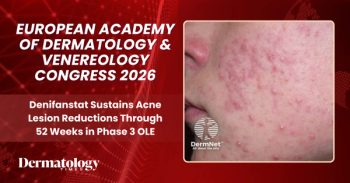
Treatment success reached 56.7% and total lesions fell 71.8% with up to 52 weeks of oral denifanstat, with no adverse event-related discontinuations.
Kord Honda, MD, provides his first-line and adjunct treatment strategies for acne in recognition of Acne Awareness Month.
Kord Honda, MD, a dermatologist and dermatopathologist at University Hospitals Cleveland Medical Center and professor of dermatology at Case Western Reserve University School of Medicine in Ohio, recently outlined a stepwise approach to acne management in recognition of
Honda said the most important step is treating the initiating factor in acne, with topical retinoids serving as the base treatment for most patients. He starts many patients on over-the-counter adapalene (Differin), topical tretinoin, or topical tazarotene. Benzoyl peroxide is often added as a wash, gel, or cream, and topical antibiotics may be introduced for patients with an inflammatory component.
"The most important thing is to try to treat the initiating factor in acne, so really the base treatment for a lot of acne is going to be topical retinoids," Honda said.
Honda cautioned that benzoyl peroxide can bleach clothing and pillowcases, and he prefers a wash formulation for easier removal. He advises patients to wait 30 minutes after washing with benzoyl peroxide before applying tretinoin or a topical antibiotic. Treatment should cover the entire face rather than function as spot therapy, since preventing new lesions works better than treating existing ones. Honda said results take about 2 months to appear, and patients should not abandon a regimen before then.
"It's not spot treatment. You want to treat the whole face and not just individual pimples as they pop up, because we have a much better track record of preventing new pimples than treating the pimples that are already there," Honda said.
For girls and women, Honda recommends asking about a hormonal component, since hormonal acne may not always respond to topicals alone. Oral contraceptives or spironolactone, which addresses the male hormone contributing to acne, are additional options. For severe cases, Honda described isotretinoin as highly effective, though it requires patient registration through the iPledge system due to potential side effects, including birth anomalies in pregnancy.
"Isotretinoin is quite effective, but it does carry more side effects," Honda said.
Honda noted topical androgen inhibitors, a relatively new drug class, may help address oil production contributing to acne for select patients. He said microbiome-targeted therapy could prove helpful down the road, though nothing is currently FDA-approved specifically for it. Interest in red light therapy has also declined; Honda said patients asked about it more often approximately 5 years ago than they do now.
"If we can control the microbiome of the skin, that may prove to be helpful down the road, but nothing's currently newly FDA-approved for that treatment," Honda said.
According to Honda, most patients can be managed with a scale of these products, titrated according to severity at presentation.
How do you approach severe acne cases in your practice? Email