This review of the latest dermatological studies includes insights on stem cell therapies for skin rejuvenation, smoke exposure in HS, hair loss in pediatric IBD, and more.
In the Chair puts you in the hot spot, challenging you to navigate complex, real-world cases.
This patient saw 12 dermatologists before receiving a working diagnosis of rosacea. Prior treatments included therapies directed at acne, eczema, psoriasis, and allergic disease, none of which produced sustained improvement. The eventual diagnosis was supported by clinical pattern recognition and histopathologic findings after biopsy was obtained at the family’s request.
This case presents 3 clinical decision points in the evaluation and management of a chronic pediatric papulopustular eruption. At each stage, the distinguishing features are subtle but clinically decisive.
An 8-year-old boy presented with a 3-year history of recurrent facial eruption localized to the central face, involving the cheeks, nose, and chin. Lesions began as small erythematous papules and evolved into multiple inflamed pustules with intermittent flares and partial remissions, though never complete resolution.
There was no truncal involvement and no clinically evident telangiectasia. The eruption was associated with a burning sensation rather than pruritus. Symptoms worsened with heat exposure and swimming. Topical corticosteroids provided transient improvement, while benzoyl peroxide and isotretinoin were ineffective.
The patient also reported intermittent cough with mucus production, which was evaluated separately and managed symptomatically.
The child was otherwise healthy, with no systemic symptoms. There was no relevant exposure history. Family history was notable for a father diagnosed with rosacea beginning in childhood.
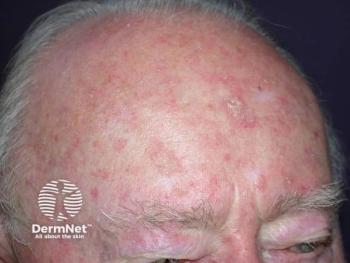
On examination, erythematous papules and pustules were present on the central face without comedones, crusting, ulceration, or scarring. The remainder of the physical examination was normal.
An 8-year-old with a chronic centrofacial papulopustular eruption, burning sensation, heat-triggered flares, absence of comedones, and partial response to topical corticosteroids presents a diagnostic challenge.
📋 WHAT WOULD YOU DO?
Which diagnosis best fits this presentation?
Diagnosis
Distribution
Comedones
Pustules
Key Differentiator
Papulopustular Rosacea
Cheeks, nose, chin
No
Yes
No — key distinguisher
Acne Vulgaris
Face, trunk
Yes — hallmark
Yes
Common in adolescents
Seborrheic Dermatitis
Nasolabial folds, scalp
No
No — greasy scale
Hair-bearing distribution
Keratosis Pilaris Rubra
Lateral cheeks, neck
No
No
Neck/lateral involvement
Acute Cutaneous Lupus
Malar (spares nasolabial folds)
No
No
Spares nasolabial folds
Drug-Induced Acneiform
Face and trunk
Yes
Yes
Sudden onset; drug history
After multiple evaluations without a definitive diagnosis, a skin biopsy was performed at the family’s request.
📋 WHAT WOULD YOU EXPECT TO SEE?
A clinical diagnosis of papulopustular rosacea was made based on morphology, distribution, chronicity, and supportive biopsy findings.
📋 WHAT WOULD YOU DO NEXT?
This patient developed symptoms at age 5 and spent 3 years undergoing multiple evaluations and treatments before a unifying diagnosis was made. The distinguishing clinical features were present early: centrofacial distribution, papulopustular morphology without comedones, burning sensation, heat sensitivity, and a relevant family history.
The delay in diagnosis reflects not a lack of data, but a low index of suspicion for pediatric rosacea.
When papulopustular facial eruptions persist despite acne-directed therapy, the key question is not which acne regimen to escalate — but whether acne is the correct diagnosis at all.
References