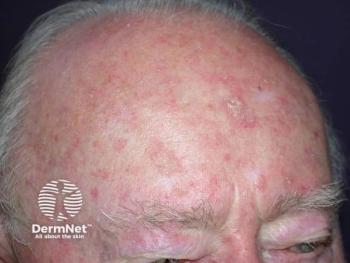
Faculty from the Cutaneous Oncology Workshop answer practical questions spanning skin cancer prevention, diagnosis, treatment, and follow-up.
At Fall Clinical 2025, Harrison Nguyen, MD, MBA, MPH, outlined how gene expression profile testing complements traditional staging systems by helping clinicians better identify melanoma and cSCC patients at the highest risk for recurrence.
“There's some really exciting emerging data for prospectively studying the risk of a positive sentinel lymph node biopsy using the GEP test,” said Harrison Nguyen, MD, MBA, MPH, in an interview at the
Nguyen, managing director and chief investigator at Harrison Dermatology and Research Group in Houston, Texas, discussed the evolving clinical role of gene expression profile (GEP) testing in skin cancers related to his session, “Leveraging Gene Expression Profiling to Optimize Management and Empower Patients With Skin Cancers.”1
As both a clinician and researcher, Nguyen noted that while pathologic and clinical staging remain foundational, GEP testing helps fill prognostic gaps and, therefore, identifies high-risk patients who might otherwise be missed by standard criteria.
According to Nguyen, GEP assays such as the 31-GEP for invasive melanoma and 40-GEP for high-risk cutaneous squamous cell carcinoma (cSCC) provide independent prognostic information that can refine clinical decision-making. In melanoma, he recommends ordering the 31-GEP test immediately after biopsy to inform sentinel lymph node biopsy (SLNB) discussions. Preliminary data from ongoing prospective studies indicate that patients stratified as low risk (with <5% likelihood of SLNB positivity) have thus far shown 0% SLN positivity, suggesting strong predictive potential for guiding surgical decisions.2
Even when SLNB results are negative, particularly in stage I and II melanomas, GEP results can help identify patients at elevated recurrence risk. Nguyen highlighted that patients with Class 2B GEP results, despite negative SLNB findings, warrant closer follow-up and may benefit from routine imaging beyond guideline-based skin and nodal exams. “These tests help identify which patients need more diligent monitoring,” he explained, emphasizing that GEP classification represents an independent prognostic factor, distinct from histologic or clinical parameters. Discordance between GEP results and traditional factors, he added, should prompt further discussion and potential escalation of care.
For high-risk cSCC, Nguyen typically employs the 40-GEP test following biopsy confirmation, though in some cases it may be performed postoperatively, such as after Mohs surgery or wide local excision, if high-risk histologic features are identified intraoperatively. Regardless of timing, he emphasized that “it’s better to use it later than never,” as these results can meaningfully guide postoperative surveillance intensity.
Looking ahead, Nguyen expressed optimism about ongoing innovation in dermatologic therapeutics, including novel oral psoriasis agents with biologic-level efficacy and emerging treatments for hidradenitis suppurativa. However, he reiterated that tools like GEP testing already represent a significant stride toward personalized, risk-adapted management in dermatologic oncology.