A 30-year retrospective cohort study of 316 adults aged 18 to 44 years found that how a melanoma is found, and by whom, predicts prognosis. Self-detection was the most common pathway, accounting for 58.9% of cases, but self-detected melanomas were more likely to be thicker than lesions found by a relative, friend, or clinician. Male sex and self-detection were each independently associated with Breslow thickness greater than 2 mm, and among self-detected lesions, nodularity and bleeding were the strongest predictors of advanced disease.5
Men fared worse across the board, with higher rates of metastatic progression (33.1% vs 18.1%) and melanoma-related mortality (18.7% vs 11.3%) than women. Among patients who died from melanoma, the median years of life lost exceeded 29.
▶ Why it matters: Counsel young men in particular to seek prompt evaluation of any changing, bleeding, or nodular lesion rather than watching and waiting.
MotherToBaby opened a new observational pregnancy study for lebrikizumab-lbkz (Ebglyss; Eli Lilly and Company) on August 13, 2026, enrolling participants with moderate to severe atopic dermatitis across the United States and Canada. Christina D. Chambers, PhD, MPH, professor of pediatrics at UC San Diego School of Medicine, is leading the effort to address a real gap: current prescribing information states that available case-report data are insufficient to evaluate a drug-associated risk of major birth defects, miscarriage, or other adverse maternal or fetal outcomes, and that IgG antibodies like lebrikizumab are known to cross the placenta.6,7
The study will compare outcomes in women exposed to lebrikizumab with 2 comparison groups, those on other systemic therapy or phototherapy and those on no systemic treatment, to help separate drug-associated effects from disease-related risk. It is observational, so no participant is asked to change her treatment plan, and enrollment is expected to run through 2033.
Every participant who shares their experience helps expand the evidence available to support informed eczema treatment decisions during pregnancy. — Christina D. Chambers, PhD, MPH, professor of pediatrics, UC San Diego School of Medicine
▶ Why it matters: Patients on lebrikizumab who are pregnant or planning pregnancy are candidates for enrollment. The registry is worth mentioning at the point of prescribing so eligible patients know it exists.
Infertility affects an estimated 24% to 33% of female providers, roughly double the rate in the nonmedical professional population, and many turn to ovulation-inducing pharmacotherapy that carries its own dermatologic burden.8 Gonadotropins, including human chorionic gonadotropin, and clomiphene raise estrogen and progesterone, which increases sebum production, follicular plugging, and Cutibacterium acnes activity, driving acnegenesis. The same hormonal surge can stimulate melanin-producing pathways, raising melasma and hyperpigmentation risk, particularly with UV exposure, while the rapid hormone drop after IVF egg retrieval or during downregulation can trigger telogen effluvium and sometimes androgenic alopecia.
Steven Ory, MD, an obstetrician-gynecologist in Coconut Creek, Florida, noted that the most common skin reaction his patients experience is urticaria tied to progesterone supplementation ahead of embryo transfer, affecting as many as a quarter of patients and usually resolving with a different oil vehicle. He added that androgen effects like acne and hirsutism can occur with gonadotropins and clomiphene, agents that raise LH. Topical steroids are not a concern before pregnancy is established, since teratogenic risk begins after embryogenesis starts around 5 weeks post last menstrual period, but isotretinoin, spironolactone, and tetracyclines must be stopped once a patient transitions to pregnancy.9
▶ Why it matters: Coordinate with the reproductive endocrinology team before starting or continuing systemic acne or pigment therapy in a patient actively pursuing fertility treatment.
Anogenital Psoriasis Carries the Heaviest Burden and Gets the Least Biologic Therapy
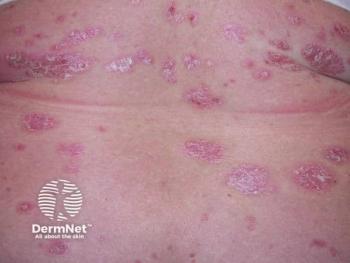
The case-control PsoGen study of 294 adults with psoriasis found that 159 patients (54.1%) had current anogenital involvement, and this group carried a substantially heavier disease burden than patients without it.9 They had higher psoriasis severity, more comorbidities, and more intense itching, pain, and burning, yet were less likely to receive biologic therapy. They also reported greater quality-of-life impairment, poorer mental health, and more difficulty with sexual activity and intimate relationships.
Patients defined their own treatment priorities around reducing physical symptoms and restoring sexual and relationship functioning, not simply clearing visible plaques. Higher disease severity, greater itching or burning, and limitations in sexual activity were all associated with worse patient-reported outcomes.
▶ Why it matters: Ask directly about anogenital involvement and sexual health at every visit, and let patient-reported burden, not just PASI, guide the decision to escalate to biologic therapy.
Get Involved With Dermatology Times
For APPs across all stages of their dermatology careers, opportunities to connect, learn, and share experiences can be an important part of professional growth. Dermatology Times invites nurse practitioners and physician assistants to share their perspectives through NP/PA Connect. APPs can contribute clinical insights, career experiences, advocacy efforts, lessons learned, and perspectives on emerging treatments while connecting with colleagues across the dermatology community.
Interested in getting involved? Contact editor Shannon Heaning at sheaning@mjhlifesciences.com to contribute.
References
- Merck and Moderna announce phase 3 INTerpath-001 trial of intismeran autogene plus KEYTRUDA met endpoints of recurrence-free survival (RFS) and distant metastasis-free survival (DMFS) in patients with completely resected stage IIB-IV melanoma. News release. Merck & Co., Inc.; Moderna, Inc. August 19, 2026. Accessed August 20, 2026. https://www.merck.com/news/merck-and-moderna-announce-phase-3-interpath-001-trial-of-intismeran-autogene-plus-keytruda-met-endpoints-of-recurrence-free-survival-rfs-and-distant-metastasis-free-survival-dmfs-in-patient/
- Weber JS, Carlino MS, Khattak A, et al. Individualised neoantigen therapy mRNA-4157 (V940) plus pembrolizumab versus pembrolizumab monotherapy in resected melanoma (KEYNOTE-942): a randomised, phase 2b study. Lancet. 2024;403(10427):632-644. doi:10.1016/S0140-6736(23)02268-7
- Moderna and Merck present 5-year data for intismeran autogene in combination with KEYTRUDA (pembrolizumab) in patients with high-risk stage III/IV melanoma following complete resection at the 2026 ASCO Annual Meeting. News release. Moderna, Inc.; Merck & Co., Inc. June 1, 2026. Accessed August 20, 2026. https://www.merck.com/news/moderna-and-merck-present-5-year-data-for-intismeran-autogene-in-combination-with-keytruda-pembrolizumab-in-patients-with-high-risk-stage-iii-iv-melanoma-following-complete-resection-at-the-20/
- Armstrong AW, Strober BE, Liu CM, Cather JC, Merola JF, Lebwohl MG. Effectiveness of brodalumab in biologic-experienced adults with moderate to severe plaque psoriasis: a focused narrative review. J Dermatolog Treat. 2026;37(1):2694924. doi:10.1080/09546634.2026.2694924
- Rodríguez-Sánchez B, Avilés-Izquierdo JA, Martín-Nieto-González J, et al. Prognostic impact of detection patterns, reasons for consultation, and sex differences in melanoma among young adults: a 30-year retrospective cohort study. Int J Dermatol. Published online August 13, 2026. doi:10.1111/ijd.70615
- New MotherToBaby study targets pregnancy data gap for newer eczema treatment. News release. MotherToBaby. August 13, 2026. Accessed August 18, 2026. https://mothertobaby.org/ongoing-study/ebglyss-lebrikizumab-lbkz/
- EBGLYSS (lebrikizumab-lbkz) injection, for subcutaneous use. Prescribing information. Eli Lilly and Company; 2024. Accessed August 18, 2026. https://ebglyss.lilly.com/
- Kassab JG, Garcia Keeme-Sayre A, Lipshultz LI. Physician infertility: a structured literature review. J Assist Reprod Genet. 2024;41(9):2227-2235. doi:10.1007/s10815-024-03216-4
- da Silva Burger N, Augustin M, Wilsmann-Theis D, et al. Disclosing the overall and sex-related disease burden and treatment needs of patients with anogenital psoriasis: results from the case-control PsoGen study. Dermatology Research and Practice. 2026;7159192. doi:10.1155/drp/7159192
Dermatology Times NP/PA Connect | The Breakout Bulletin