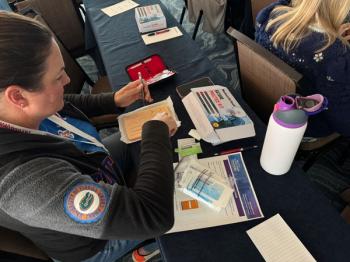
An HS toolbox with wound care, symptom relief, and personal care supplies can help patients stay prepared for unexpected flares.
At EADV 2025, UCB presented new long-term data demonstrating bimekizumab’s durable efficacy and a consistent safety profile over extended treatment.
At the
"HS involves scarring, so there is a need to have effective medical therapy early in the disease course to prevent disease progression and scarring," said John Ingram, MA, MSc, DM, FRCP, FAcadMEd, professor of dermatology at Cardiff University, during the late-breaking presentation at EADV.2
At 3 years, Hidradenitis Suppurativa Clinical Response (HiSCR) scores remained high, with 90.2% of patients maintaining HiSCR50, 81.2% maintaining HiSCR75, 64.3% maintaining HiSCR90, and 50.1% maintaining HiSCR100. Improvements in quality of life were also sustained: 38.1% of patients achieved a Dermatology Life Quality Index (DLQI) score of 0/1, indicating no impact of HS on daily life.
"If we look at DLQI scores at baseline, you'll see their score of 11. So, that reflects severe impacts on quality of life," Ingram said at EADV.
Ingram also noted that HiSCR75 is becoming the "new normal" in terms of an efficacy measurement that patients want to reach.
Disease duration influenced outcomes. Patients diagnosed within 2.4 years prior to study entry demonstrated superior responses compared with those with disease lasting ≥10.7 years. At week 96, International HS Severity Score System (IHS4) responses of 100 were achieved in 46.1% of patients in the shortest duration quartile, versus 22.8% in the longest duration group—highlighting the potential benefit of early biologic intervention.
“A crucial goal for treating people with hidradenitis suppurativa is achieving and maintaining long term disease control at the most stringent levels,” Ingram stated in the UCB news release. “These data for bimekizumab – including HiSCR100 and IHS4-100 – showed disease control can be maintained long-term. Importantly, the resolution of inflammatory lesions highlights the potential to prevent long-term structural damage commonly associated with this disease.”1
Long-term treatment also reduced structural and symptomatic burden. Over 2 years, bimekizumab decreased the number of draining tunnels in most patients, while improvements in skin pain translated into measurable gains in health-related quality of life.
"We know that HiSCR isn't counting draining tunnels, so we have the baseline level of about 3.8 draining tunnels, average per patients. That's down at the end of year 2 to 1.1 draining tunnels, and decreased a little bit further to 0.9 at the end of year 3," Ingram said at EADV.
Safety findings were consistent with earlier years of study. Bimekizumab was generally well tolerated, with no new safety signals identified up to 3 years. The most common treatment-emergent adverse events included hidradenitis (19.6/100 patient years), coronavirus infection (14.1/100 PY), and oral candidiasis (9.3/100 PY).
“The three-year data on bimekizumab presented at EADV demonstrated deep and sustained responses across stringent efficacy endpoints, as well as long-term improvements in health-related quality of life – raising the treatment bar for people living with hidradenitis suppurativa,” said Donatello Crocetta, Head of Medical and Chief Medical Officer at UCB, in the news release. “Long-term efficacy and safety data are vital for advancing understanding of chronic inflammatory conditions like hidradenitis suppurativa, and these findings underscore UCB’s commitment to advancing science-led insights and providing transformative treatment options to improve outcomes for patients.”
Ingram echoed a similar sentiment at EADV, concluding his presentation with: "These data are highlighting both the depth of response that we need in HS, but also the duration, the durability of response to bimekizumab. But we need to treat moderate to severe HS, typically onset in early stages. We need, of course, to be able to effectively treat patients with this chronic, long-term condition."
The full results will be presented at EADV, alongside additional UCB data in psoriasis, psoriatic arthritis, axial spondyloarthritis, and investigational galvokimig in atopic dermatitis.
Also today at EADV, UCB announced new long-term data on
References