From “Botox in a bottle” to castor oil and face taping, Dermatology Times reviews the evidence behind 3 viral dermatology trends from October.
Dermatology PAs unpack 4 frightening skin care myths and trends, from sunscreen misinformation and citrus DIYs to overusing actives and beef tallow.
From skipping
Halloween may be the season for scares, but some of the most frightening things dermatology clinicians hear do not involve ghosts or monsters. Instead, they are coming from patients’ skin care routines, and increasingly, from
From claims that sunscreen causes cancer to DIY citrus treatments and overloaded skin care routines, viral advice can sometimes steer patients away from evidence-based care or leave them with irritation, breakouts, and other preventable skin concerns.
In the spirit of Halloween, Dermatology Times asked dermatology PAs to share some of the “scariest” skin care myths and trends they are encountering in practice, and what they want patients and clinicians to know instead.
For Donna Lam Cahill, PA-C, one particularly concerning myth is not about what patients are putting on their skin, but what they are leaving off.
“One of the scariest dermatology myths I’ve been hearing lately is that sunscreen causes skin cancer,” Cahill told Dermatology Times. “I’ve had patients bring this up during visits, and it’s concerning how much misinformation is spreading on social media.”
The scientific evidence points in the opposite direction. Exposure to ultraviolet radiation is a well-established risk factor for skin cancer, and photoprotection, including sunscreen use, is an important strategy for reducing UV-induced skin damage.1,2
The danger of sunscreen misinformation, Cahill noted, is that it can influence patients to abandon a protective behavior because of claims they encounter online.
“As a dermatology PA, I always remind my patients that daily SPF is one of the simplest and most important things they can do for their skin,” Cahill said. “The scary part is that people are skipping sunscreen because of something they saw online.”
For clinicians, these conversations offer an opportunity to ask patients where they are getting their skin care information, address concerns without dismissing them, and reinforce the established relationship between UV exposure and skin cancer risk.
The scary part is that people are skipping sunscreen because of something they saw online. — Donna Lam Cahill, PA-C
Another seemingly harmless trend can leave behind a much more visible reminder.
Patients may turn to raw lemon or lime juice as an inexpensive, “natural” alternative for brightening skin or treating hyperpigmentation. According to Jamie Restivo, PA-C, however, the practice can produce precisely the outcome patients are trying to avoid.
“Patients dabbing raw lemon or lime juice onto dark spots think they’ve unlocked an ‘all-natural’ vitamin C hack, but they’re actually courting a phototoxic nightmare,” Restivo told Dermatology Times.
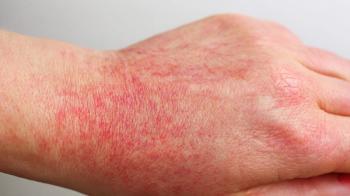
Citrus fruits contain furanocoumarins, which can produce a phototoxic reaction when skin exposed to the compounds is subsequently exposed to UVA radiation. The resulting phytophotodermatitis may cause erythema, edema, vesicles, or bullae, followed by postinflammatory hyperpigmentation.3,4
Its unusual presentation can provide an important clue. Lesions may develop in linear, irregular, handprint, or drip-like configurations reflecting where the photosensitizing substance contacted the skin.
“Instead of fading discoloration, this kitchen table remedy creates the very dark spots they were trying to banish,” Restivo said.
When patients present with unusual hyperpigmentation or blistering after outdoor exposure, asking about citrus, plants, DIY skin care, and recent social media-inspired treatments may help uncover the cause.
If one active ingredient works, several must work even better—at least according to another trend Cahill frequently encounters.
“One skincare trend that scares me is seeing patients use way too many products at once,” she said. “I often have patients come in with irritated skin after trying multiple products they saw trending on social media.”
The expanding availability of over-the-counter retinoids, exfoliating acids, vitamin C products, and other active ingredients has given consumers more options than ever. But
“They’re layering
Her advice is to bring patients back to the basics.
“I always remind my patients that skincare doesn’t have to be complicated or expensive to be effective,” she said.
Cahill described a simple routine she commonly uses as a starting point: a gentle cleanser, vitamin C, and tinted sunscreen in the morning, followed by a gentle cleanser and retinol at night. Importantly, routines should be individualized according to the patient's skin type, condition, treatment goals, and tolerance.
“Sometimes less really is more, and consistency is key,” Cahill said.
Few ingredients fit a Halloween skin care story quite as literally as rendered animal fat.
Restivo cautioned against treating those claims as established dermatologic evidence.
“The viral trend of swapping formulated moisturizers for rendered beef fat claims to mimic human sebum,” she said.
Although beef tallow contains fatty acids that may have emollient properties, clinical evidence supporting its use in routine skin care remains limited. Its heavy, occlusive nature may also be poorly suited to some patients, including those with oily or acne-prone skin.
Restivo noted that another potential problem may be hiding elsewhere in the ingredient list.
“Because these concoctions carry a distinctly savory barnyard scent, many DIY formulations or unstandardized artisanal brands overload the mix with essential oils and masking fragrances to make it palatable,” she said.
For patients seeking additional moisturization or barrier support, clinicians can instead direct them toward appropriately formulated products with established ingredients selected for their individual skin needs.
Although the 4 examples range from potentially dangerous misinformation to questionable DIY experiments, they share a common source: patients now have access to an enormous volume of skin care advice without an equally reliable way to determine which claims are supported by evidence.
That makes the clinician-patient conversation increasingly important.
Rather than simply telling patients that a viral trend is wrong, clinicians can ask what they are using, where they heard about it, and what they are hoping to accomplish. Explaining why a trend may be ineffective or potentially harmful, and offering an evidence-based alternative that addresses the same goal, can make those conversations more productive.
This Halloween, the message from dermatology clinicians is simple: Skin care does not have to be scary. But some of the advice haunting patients’ social media feeds deserves a closer look.
References