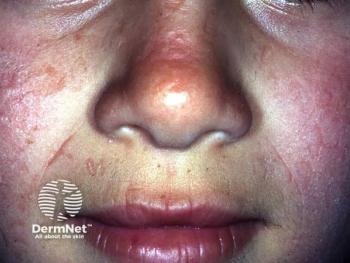
Lutikizumab significantly improved HiSCR75 response, pain, and disease flares in adults and adolescents with moderate to severe HS.
The US Food and Drug Administration (FDA) has approved remibrutinib, Novartis' oral, highly selective Bruton's tyrosine kinase inhibitor (BTKi), as the first treatment in the US for adults with symptomatic dermographism (SD) whose disease is inadequately controlled by H1 antihistamines, the company announced on October 7, 2026.
The decision, which comes just over a year after the agent's first FDA approval in
Remibrutinib is indicated for adults with SD inadequately controlled by H1 antihistamines, with the SD indication announced October 7, 2026. It is also approved for adults with CSU inadequately controlled by H1 antihistamines, making it the only prescription treatment with approved uses in both conditions when antihistamines alone do not control symptoms.1
Remibrutinib is a highly selective BTKi. It blocks the BTK pathway involved in histamine release, a key driver of hives (wheals) and swelling. Its activity in mast cells underlies its use across urticarial diseases.1
Remibrutinib is an oral therapy. According to Novartis, no routine laboratory monitoring is required.1
The approval is based on the SD cohort of the phase 3 RemIND trial (NCT05976243), which enrolled patients who remained symptomatic on second-generation H1 antihistamines. Remibrutinib was compared with placebo, and the primary efficacy measure was complete response from hives as assessed by the TotalFric score. RemIND also evaluated remibrutinib in other forms of chronic inducible urticaria, including cold urticaria and cholinergic urticaria.1
At week 12, 29.3% of patients with SD treated with remibrutinib achieved complete response from hives vs 14.0% with placebo (P = .0229). Novartis reported that responses were observed as early as week 2.1
Novartis identifies SD as the most prevalent type of chronic inducible urticaria and reports that more than 50% of patients with SD remain symptomatic despite H1 antihistamines. Because more than 90% of adults with chronic hives have either CSU or SD, remibrutinib is now the only treatment indicated for both of the 2 most common forms.1 Before this approval, treatment for SD had largely been limited to topical corticosteroids or oral antihistamines.
Through week 24 of clinical trials, remibrutinib showed a consistent safety profile across SD and CSU. The most common adverse events (incidence ≥3%) were nasopharyngitis (nasal congestion, sore throat, and runny nose), bleeding, headache, nausea, and abdominal pain.1
Novartis reported no liver safety signals in the phase 3 REMODEL-1 (NCT05147220) and REMODEL-2 (NCT05156281) trials of remibrutinib in relapsing multiple sclerosis, consistent with the CSU experience. In those trials, which compared remibrutinib with teriflunomide, the company reported clinically meaningful reductions in annualized relapse rate and delays in disability progression, with a favorable safety profile.1
In the phase 3 REMIX-1 (NCT05030311) and REMIX-2 (NCT05032157) trials in patients with CSU, remibrutinib reduced the weekly urticaria activity score (UAS7) vs placebo at week 12, with least squares mean changes of −20.0 vs −13.8 in REMIX-1 and −19.4 vs −11.7 in REMIX-2 (P < .001 for both).2
Beyond the US, remibrutinib is approved for CSU in the EU, UK, and China. Novartis plans to submit the full RemIND data set, including the cold and cholinergic urticaria cohorts, to health authorities globally where appropriate. Remibrutinib is also being studied in hidradenitis suppurativa and food allergy.1
Remibrutinib is manufactured by Novartis and marketed as Rhapsido.1