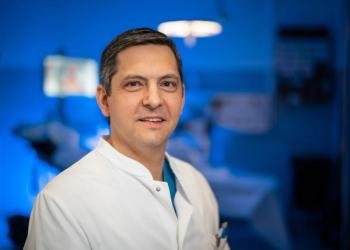
Falk G. Bechara, MD, discusses long-term tunnel control, structural damage, and the evolving role of biologics and surgery in HS care.
Lisa Weiss, MMSc, PA-C, and Justin Love, PA-C, discuss the importance of broad differentials, repeat biopsies, and national networking to strengthen diagnostic accuracy and provider support at Elevate-Derm Fall.
“It's really interesting when you talk with colleagues about different cases that different differential diagnoses come up. There are some things that you don't always think about, that somebody else may bring up, or you may not think to do a specific test that may link different diagnoses to each other,” said Lisa Weiss, MMSc, PA-C, in an interview at the
Weiss, a physician assistant at Goodman Dermatology in Georgia, was joined by her colleague and co-presenter, Justin Love, PA-C, a physician assistant at Loma Linda University in California, to discuss complex patient cases and differential diagnoses.
In their joint conversation, Weiss and Love emphasized the value of maintaining a wide diagnostic lens and building strong networks across the dermatology community. Both speakers mentioned that accurate diagnosis often hinges on the willingness to question initial assumptions and revisit earlier conclusions—even those made by previous clinicians.
Love highlighted the need to continually broaden the differential diagnosis, especially when clinical and histopathologic findings diverge. He noted that repeat biopsies remain an essential part of care when pathology reports do not align with the patient’s presentation. Providing additional tissue or more contextual clinical information to the dermatopathologist, he said, can be the key to unlocking elusive diagnoses. Weiss echoed that sentiment, stressing the importance of approaching each case independently rather than relying on a patient’s report of a prior diagnosis. Fresh clinical scrutiny, she noted, frequently uncovers details that redirect evaluation.
Both clinicians emphasized how case discussions with colleagues can open diagnostic pathways that may not surface in isolation. Weiss pointed out that peer dialogue often introduces alternative diagnoses or testing strategies that shift clinical thinking in meaningful ways. She described this cross-pollination of ideas as especially valuable when working through complex, multi-layered presentations.
Beyond clinical reasoning, the 2 PAs spoke extensively about the value of professional connection. In an increasingly digital practice landscape, Love noted that conferences help clinicians form relationships that support ongoing learning and shared problem-solving, particularly for those working in smaller or rural settings. Weiss described these networks as indispensable, explaining that she regularly consults colleagues across the country for difficult cases. Both clinicians highlighted the practical benefit of having trusted contacts nationwide, especially as patients frequently relocate.