

Opinion|Videos|October 20, 2026
JAK Inhibitors for Alopecia Areata: Selectivity and Pivotal Trial Efficacy
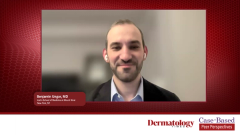
Author(s)Benjamin Ungar, MD
All three approved JAK inhibitors for severe alopecia areata achieve meaningful regrowth. Dr. Ungar reviews their selectivity and pivotal trial results while cautioning against cross-trial comparisons.
Advertisement
Episodes in this series
In "JAK Inhibitors for Alopecia Areata: Selectivity and Pivotal Trial Efficacy," our expert reviews how the three approved agents differ and what their pivotal trials showed.
Dr. Ungar begins by reading the Case 1 follow-up: given the patient's time-sensitive goal, a JAK inhibitor is started. He then reviews the three FDA-approved treatments for severe alopecia areata, which are deuruxolitinib, ritlecitinib, and baricitinib. Their selectivity differs. Deuruxolitinib and baricitinib are JAK1 and JAK2 inhibitors, while ritlecitinib inhibits JAK3 and TEC. He notes that the clinical implications of these differences are still being worked out.
Before reviewing data, Dr. Ungar cautions against comparing results across trials. Designs, patient populations, investigators, and locations differ, and none of these agents has been tested head to head. The primary endpoint in these trials is typically a SALT score of 20 or less, meaning patients regrew the vast majority of their scalp hair.
In THRIVE-AA1 and THRIVE-AA2, about 30 percent and 33 percent of patients taking deuruxolitinib 8 mg twice daily reached this endpoint at week 24, versus less than 1 percent on placebo. In the ALLEGRO trial, 23 percent of patients on ritlecitinib 50 mg once daily reached it at week 24, compared with 2 percent on placebo.
The BRAVE-AA1 and BRAVE-AA2 trials of baricitinib are more complex. They tested two doses and assessed the endpoint at week 36. At 2 mg, about 23 percent responded in BRAVE-AA1 and roughly 20 percent in BRAVE-AA2, versus about 6 percent and 3 percent on placebo. At 4 mg, Dr. Ungar recalls responses of roughly 30 to 35 percent against 6 to 8 percent on placebo. He concludes that all three are very effective and offer real potential for regrowth.
In "Starting JAK Inhibitors for Alopecia Areata: Safety Counseling and Choosing an Agent," Dr. Ungar will share his clinical experience and explain how he approaches access, safety, and drug selection.
Advertisement
Related to this article
The joint AAD-HSF guideline issues 37 recommendations, including strong support for adalimumab, bimekizumab, infliximab, and secukinumab.
Two-year oral IL-23 data, GLP-1 biomarker findings, and a nonsurgical option for superficial basal cell carcinoma headline the sessions covered in Las Vegas.
Dermatology’s growing focus on skin longevity demands clear definitions, validated outcomes, and rigorous evidence beyond anti-aging claims.

A retrospective claims analysis of 2897 matched pairs found hazard ratios of 0.48 to 0.67 for new atopic disease with dupilumab vs systemic corticosteroids in children.
Disc Medicine reports the phase 3 APOLLO trial met all primary and secondary end points, with whole-blood PPIX reduced 41.4% vs placebo and an NDA resubmission planned by end of 2026.
Castor oil has become a popular social media remedy for thicker, longer hair, but evidence supporting its ability to stimulate hair growth remains limited.
The FDA clearance allows Edesa to expand an ongoing placebo-controlled study of the CXCL10 antibody EB06 to US sites, with topline data expected in the fourth quarter of 2027.

The novel oral helicase-primase inhibitor demonstrated significantly higher rates of complete lesion healing compared with investigator’s choice treatment in the phase 3 PRIOH-1 trial.
Advertisement
Advertisement
Trending on Dermatology Times
1
Dupilumab Associated With Lower Atopic March Risk in Pediatric Atopic Dermatitis
2
Bitopertin Meets All End Points in Phase 3 APOLLO Trial for EPP
3
GLP-1 Candidacy and Prescribing Considerations in Psoriasis
4
Anti-Inflammatory Effects of GLP-1 Medications in Psoriasis and Obesity
5