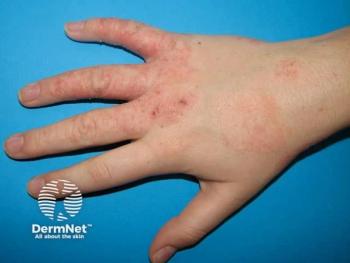
Chronic hand eczema (CHE) creeps into parts of a patient’s day they rarely thought about before. Imagine pouring a morning cup of coffee only to feel a major sting, wiping a counter and flinching at a sharp pinch, or hesitating before a simple handshake out of self-consciousness. The ordinary turns into challenges, fraught with pain and embarrassment, which forces our patients to plan, pause, and protect their hands before any action. CHE keeps them vigilant about their hands, reshaping how they act and what they do or say. With no cure and unpredictable flare-ups, the path to stability is long and often frustrating for both the patient and the provider. Managing this relentless skin condition is never a one-size-fits-all; it requires ongoing attention, tailored treatment, and consistent follow-ups with a clinician.
The impact of CHE is particularly profound in patients whose daily responsibilities require constant hand use. An elementary school teacher whom I manage exemplified this reality. Fissures across her palms caused persistent discomfort, intensified by handwashing required in a classroom setting. She often mentioned that she is worried her students’ parents may misinterpret the appearance of her hands as contagious, a fear exacerbated by her students commenting on her skin. Outside of her job, the burden continued. As a mother to an infant, her routine tasks, such as bathing her baby, washing bottles, and cleaning, became painful reminders of her disease. Her experience underscores how CHE extends beyond visible inflammation, affecting confidence, emotional well-being, and the ability to fully engage in daily roles.
Practical Strategies for Managing Chronic Hand Eczema
- Functional support: Ask about daily activities, hand use, and exposure to irritants, and adjust treatment to the patient’s routine. This helps patients maintain independence, continue their work and hobbies, and reduce frustration from limitations.
- Treatment planning: Consider combination therapy (topical + systemic) or advanced options like delgocitinib early and tailor choice to severity and the patient's lifestyle. This reduces flares and the severity of flares, prevents long-term skin damage, and improves overall disease control.
- Monitoring and tracking: Encourage patients to keep symptom diaries, take photos, and note possible triggers. This provides better insight into flare patterns, guides therapy adjustments, and empowers patients to actively participate in their care.
- Patient support: Provide education on hand hygiene, barrier protection, and flare prevention strategies while discussing realistic expectations for improvement. This improves patient confidence, adherence to treatment, and overall quality of life while reducing anxiety about daily hand function
Although CHE is a difficult condition to live with, it can be just as challenging to treat. Its heterogeneous nature, whether irritant, allergic, atopic, or mixed, means that sometimes, neither the patient nor the provider can pinpoint exactly what is driving the inflammation.1 A symptom journal can help solve the problem by connecting the dots between exposures and flares. Yet, even when a trigger is identified, avoiding it can be unrealistic. A hairdresser cannot stop washing hair; a cook cannot avoid wet work or washing their hands; a parent cannot hit a pause button on bathing their child or cleaning up a spill. These everyday exposures can create a cycle of improvement and relapse that wears down both the patient and the provider. This is why effective care requires a personalized plan that considers the patient’s current stage of life rather than following a protocol that tells the provider what to prescribe.
There are many treatment options currently available, and ongoing research continues to expand the possibilities for patients struggling with this chronic condition. Topical corticosteroids (TCs) are typically the mainstay treatment for flare-ups, whereas topical calcineurin inhibitors are reserved for patients who need a steroid-free option for longer-term use.1 For patients with an atopic subtype, there are several nonsteroidal topicals, including roflumilast (Zoryve; Arcutis Biotherapeutics), tapinarof (Vtama; Organon), and ruxolitinib (Opzelura; Incyte). These topicals control inflammation and minimize the adverse effects associated with prolonged TC use, such as skin atrophy. Beyond topicals, biologic injection therapies, such as tralokinumab (Adbry; LEO Pharma), lebrikizumab (Ebglyss; Eli Lilly and Company), dupilumab (Dupixent; Regeneron Pharmaceuticals), and nemolizumab (Nemluvio; Galderma), are used to address type-2–driven inflammation, which reduces flare frequency, restores the skin barrier, and improves barrier function in an atopic subtype.2 For patients who seek systemic therapy in oral form, Janus kinase (JAK) inhibitors, like upadacitinib (Rinvoq; AbbVie) and abrocitinib (Cibinqo; Pfizer Inc), indirectly reduce type 2 inflammation by blocking the intracellular JAK-STAT signaling pathway that cytokines, like IL-4 and IL-13, use.2 Management often requires combining topical and systemic options, and recent advances, including a newly approved nonsteroidal topical for CHE, are providing clinicians with more tools to help patients achieve symptom control and improved quality of life.
The most recent advancement in CHE treatment is delgocitinib (Anzupgo; LEO Pharma), the first and only topical specifically indicated for CHE in adults.3 Clinical trials, including DELTA 1 (NCT04871711) and DELTA 2 (NCT04872101), showed significant reductions in disease severity, itch, and pain. Its pan-JAK inhibition targets skin inflammation and minimizes systemic exposure, making it a valuable tool for the long-term management of CHE. In fact, in October 2025, I was the second-highest prescriber of delgocitinib in the northeast.
CHE remains a frustrating condition for both the patient and the clinician, but these recent advances in treatment are providing renewed hope.4 Having tools, such as TCs, calcineurin inhibitors, nonsteroidal topicals, biologic injections, oral JAK inhibitors, and now delgocitinib cream, clinicians are better equipped to support patients by fitting therapy into their lives that is just right. Although CHE may never be fully curable, these evolving treatment options are helping patients and providers regain control and treat effectively.
Izabela Horzempa, PA-C, is a certified dermatology physician assistant practicing at Integrated Dermatology in Trumbull, Connecticut. She is also a member of the Society of Dermatology Physician Associates' Emerging DermPAs Scholars Program.
References
1. Silverberg JI, Guttman-Yassky E, Agner T, et al. Chronic hand eczema guidelines from an expert panel of the International Eczema Council. Dermatitis. 2021;32(5):319-326. doi:10.1097/DER.0000000000000659
2. Haddad EB, Cyr SL, Arima K, McDonald RA, Levit NA, Nestle FO. Current and emerging strategies to inhibit type 2 inflammation in atopic dermatitis. Dermatol Ther (Heidelb). 2022;12(7):1501-1533. doi:10.1007/s13555-022-00737-7
3. Bissonnette R, Warren RB, Pinter A, et al. Efficacy and safety of delgocitinib cream in adults with moderate to severe chronic hand eczema (DELTA 1 and DELTA 2): results from multicentre, randomised, controlled, double-blind, phase 3 trials. Lancet. 2024;404(10451):461-473. doi:10.1016/S0140-6736(24)01027-4
4. Alvarenga JM, Bieber T, Torres T. Emerging biologic therapies for the treatment of atopic dermatitis. Drugs. 2024;84(11):1379-1394. doi:10.1007/s40265-024-02095-4