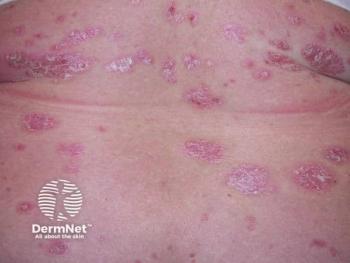
At 12 weeks she was clear, BSA down to roughly 3% with an 85% EASI improvement, and sleeping normally. But her repeat lipid panel told a different story: LDL had climbed from 108 to 192 mg/dL, with a 10-year ASCVD risk of 5.9%. The case asks whether that's reason enough to stop the drug.
The care team didn't discontinue. They looped in her primary care provider, started rosuvastatin 10 mg, and continued upadacitinib. At 3-month follow-up her atopic dermatitis remained controlled, she tolerated the statin without issue, and her cholesterol had stabilized.
▶ Why it matters: Lipid elevation on JAK inhibitors is a predictable, manageable finding, not an automatic reason to discontinue an otherwise effective treatment. Baseline labs, interval monitoring, and PCP collaboration keep patients on therapy safely.
Verrica Pharmaceuticals has completed enrollment in COVE-2, the first pivotal phase 3 trial evaluating YCANTH (cantharidin) for common warts, after an independent statistician's interim power analysis found no additional patients were needed. The companion trial, COVE-3, has passed 50% of its target enrollment. Topline data from COVE-2 are expected in the first quarter of 2027, with the rest of the phase 3 program reading out by mid-2027.4
Common warts affect an estimated 22 million people in the US, and there is currently no FDA-approved prescription drug for the condition. YCANTH is already approved for molluscum contagiosum in patients 2 years and older; a positive phase 3 program could make it the first approved prescription option for warts as well.4
If the Phase 3 program is successful, YCANTH has the potential to become the first FDA-approved prescription drug treatment for common warts.— Noah L. Rosenberg, MD, Chief Medical Officer, Verrica Pharmaceuticals
For now, this is an enrollment milestone, not efficacy or safety data. COVE-2 remains fully blinded, and the announcement doesn't include any results.
▶ Why it matters: Nothing changes in how you counsel or treat common warts today. Enrollment completion means a phase 3 readout is on the horizon in 2027, not that a new option exists yet.
NPs and PAs delivered 27.4% of dermatology office visits in 2020, up from 15.5% in 2013, and they account for 55.6% of dermatology providers in micropolitan areas and 87.8% in rural areas.2 Despite that footprint, specialty certification isn't required to practice, and a 2024 workforce survey of 10,275 NPs found that only 0.3% reported a dermatology specialty certification.
The DCNP exam for NPs requires 3,000 hours of dermatology practice within 3 years, APRN licensure, and passing 175 questions weighted toward assessment, diagnosis, prescribing, and procedures. It costs $400 and renews every 3 years. As of July 2025, only 588 NPs nationwide held it. CAQ-Derm, the newer PA credential launched in 2023, requires 4,000 hours over 6 years plus 75 category 1 dermatology CME credits.2
Neither credential has outcomes data linking it to better diagnostic accuracy or patient outcomes yet. What CAQ-Derm holders do report is professional payoff: more than 40% pursued a promotion, about half saw a pay increase, and roughly two-thirds said patients treated them with more respect. The review's authors point to cardiology, where the American College of Cardiology published formal NP and PA competencies in 2020, as a possible model for dermatology.2
▶ Why it matters: Certification remains optional and unproven on outcomes, but for PAs weighing CAQ-Derm, the career benefits reported so far may be reason enough to pursue it.
Tudriqev (vusolimogene oderparepvec-wtpg), combined with nivolumab, received FDA accelerated approval for adults with unresectable or metastatic cutaneous melanoma that progressed on anti-PD-1 therapy, based on objective response rate and duration of response.5 This week's quiz, built around an interview with Joan Levy, PhD, chief science officer at the Melanoma Research Alliance, tests whether you can explain the drug's abscopal effect (immune responses in uninjected lesions), when an interventional radiologist should be involved for visceral injections, and which end points the confirmatory IGNYTE-3 trial is tracking (overall survival and progression-free survival).
▶ Why it matters: If you have PD-1-refractory melanoma patients, understanding how this oncolytic immunotherapy works, and how it's delivered, prepares you to have an informed conversation about it as an option.
Get Involved With Dermatology Times
For APPs across all stages of their dermatology careers, opportunities to connect, learn, and share experiences can be an important part of professional growth. Dermatology Times invites nurse practitioners and physician assistants to share their perspectives through NP/PA Connect. APPs can contribute clinical insights, career experiences, advocacy efforts, lessons learned, and perspectives on emerging treatments while connecting with colleagues across the dermatology community.
Interested in getting involved? Contact editor Shannon Heaning at sheaning@mjhlifesciences.com to contribute.
References
- Gaumond SI, Andrade LF, Warp PV, et al. Vitiligo and skin cancer risk: a systematic review and meta-analysis with subtype and phototherapy stratification. JEADV Clin Pract. Published online 2026. doi:10.1002/jvc2.70418
- Smith L, Horzempa I. Advancing standards: the role of specialty certification in advanced practice practitioners in dermatology practice. J Clin Aesthet Dermatol. 2026;19(7-8 Suppl 1). https://jcadonline.com/advancing-standards-the-role-of-specialty-certification-in-advanced-practice-practitioners-in-dermatology-practice/
- Duerr H. JAK Workshop: Case-Based Roundtable Discussion. Presented at: 2026 Elevate-Derm Summer Conference; July 29-August 2, 2026; San Diego, CA. https://www.dermatologytimes.com/view/jaks-in-practice-panel-discusses-case-pearls-at-elevate-derm-conference
- Verrica Pharmaceuticals announces completion of enrollment in first pivotal phase 3 trial (COVE-2) evaluating YCANTH for the treatment of common warts, with topline data expected Q1 2027. News release. Verrica Pharmaceuticals Inc. August 27, 2026. Accessed August 27, 2026. https://www.biospace.com/press-releases/verrica-pharmaceuticals-announces-completion-of-enrollment-in-first-pivotal-phase-3-trial-cove-2-evaluating-ycanth-for-the-treatment-of-common-warts-with-topline-data-expected-q1-2027
- FDA approves new engineered viral immunotherapy for patients with treatment-resistant advanced melanoma. News release. FDA. November 25, 2025. Accessed August 21, 2026. https://www.fda.gov/news-events/press-announcements/fda-approves-new-engineered-viral-immunotherapy-patients-treatment-resistant-advanced-melanoma
Dermatology Times NP/PA Connect | The Breakout Bulletin