
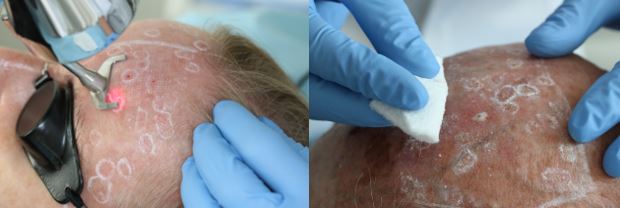








Is it just a “spot” or precancerous lesion? Two physicians debate how best to treat actinic keratosis in a talk given at EADV last week.
Is it just a “spot” or precancerous lesion? Two physicians debate how best to treat actinic keratosis in a talk given at EADV last week.
There are many non-surgical treatments for basal cell carcinomas, but a physician reporting at EADV last week said new treatments should be compared against surgery, which has the highest cure rate and lowest rate of recurrence.
A pregnancy-associated melanoma (PAM) prognosis does not appear to be worse than melanoma in non-pregnant controls, researchers reported at EADV. Nonetheless, measures should be taken to protect the fetus in the treatment and imaging of PAM.
Potential new treatment with targeted monoclonal antibodies offers new hope for cutaneous lymphoma patients.

With immunotherapy as a key treatment for melanoma, dermatologists should be prepared to treat its cutaneous side effects and refer for adrenal sufficiency, uveitis, thyroid disease and other non-cutaneous side effects.
Checkpoint inhibitors have clearly changed the prognosis of melanoma, yet the search for evidence-based answers to these and other questions regarding their use continues, experts report at EADV this week.
It is only recently that continued research has led to significant advances in numerous immune-based drugs that can successfully be used in patients with advanced melanoma (stage III and IV).
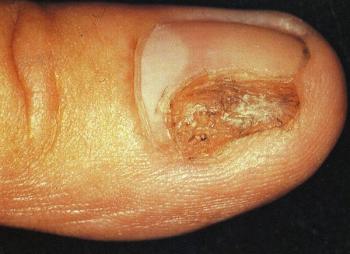
Helping a dermatopathologist diagnose neoplasms and infections of the foot requires not only taking adequate samples, but in many cases, sending clinical photographs with them.
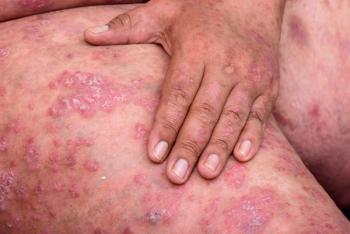
As dermatologists become increasingly aware of comorbidities associated with psoriasis, questions of associated malignancy risk remain. Dr. Megan Noe emphasizes the need for skin cancer checks.
In this article, we review the American Academy of Dermatology treatment guidelines for cutaneous squamous cell carcinoma.
Solid organ transplant recipients experience an average of two cutaneous squamous cell carcinomas following their transplant.

People who use indoor tanners may be putting themselves at greater risk for skin cancer because they use low SPF sunscreen.

Combination that extends survival in BRAF-mutant metastatic melanoma gains FDA approval.

Two to three months of neoadjuvant topical imiquimod, 5%, cream prior to conservatively staged excisions for lentigo maligna (LM) is associated with a low rate of recurrence.

Chance of metastasis for cutaneous squamous cell carcinomas of vermillion lip is five times greater than on the cutaneous lip, study shows.

Monitoring changes in patients with melanoma can be tricky. Some changes present slowly and in tiny ways. Using imaging technologies to track these changes can help achieve an accurate diagnosis.
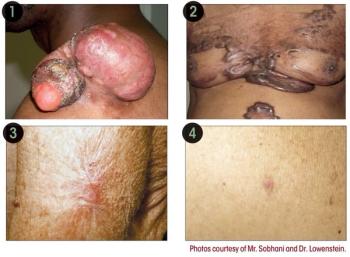
Dermatofibrosarcoma protuberans (DFSP), dermatofibromas, keloids and hypertrophic scars are four separate conditions requiring assessment, but only one requires a biopsy.

In this review article, Kaivon Sobhani, B.S., and, Eve Lowenstein, M.D., Ph.D., examine fibrotic skin lesions, including the cutaneous tumor dermatofibrosarcoma protuberan (DFSP).

Nearly half of patients at an outpatient primary care clinic elected to learn about genomic testing to assess their risk of melanoma.

The cost of skin cancer treatments continue to increase in the United States where a large proportion of expenditures stem from the cost of systemic agents for melanoma.

Some melanoma patients prefer fewer follow-up visits, but only if self-skin examinations were utilized at home or teledermatology implemented for a quick assessment.
Changing the schedule of targeted therapies has been shown to improve the response rate in a mouse model of melanoma.
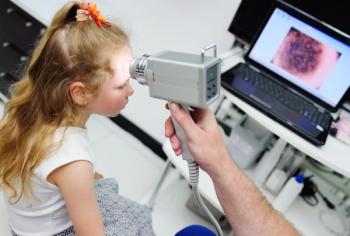
Pediatric melanomas are often misdiagnosed by physicians. Adolescents have a more aggressive disease course than children and are treated with adult protocols leading to chronic morbidity.
The combination of encorafenib plus binimetinib significantly improved overall survival versus vemurafenib in patients with BRAF-mutant melanoma, updated results of the randomized, phase three COLUMBUS trial show.
Researchers reporting at the American Society of Clinical Oncology annual meeting on June 4 presented a study in which they compared the seventh and eighth editions of the American Joint Committee on Cancer melanoma staging systems. The eighth edition differentiates melanoma survival slightly worse than the previous edition.