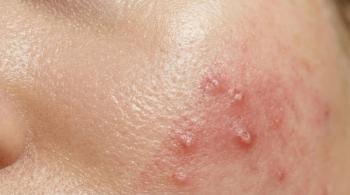
Aaron Farberg, MD, a board-certified dermatologist based in Dallas, Texas, outlined a three-phase topical isotretinoin regimen designed to guide patients from active acne treatment through long-term skin maintenance under the Isoclear program.1 Farberg said patients typically notice reduced oil production and calmer skin within the first several weeks, with the full therapeutic effect occurring by 6 to 8 weeks.1 The regimen combines topical isotretinoin with additional active ingredients as patients progress from active inflammatory acne to post-inflammatory hyperpigmentation (PIH) and long-term maintenance.1
MORE ON ACNE
Interest in compounded topical isotretinoin has grown as clinicians explore alternatives to oral isotretinoin, which requires enrollment in the iPLEDGE Risk Evaluation and Mitigation Strategy (REMS) program.3 Farberg said the staged regimen is intended to transition patients from treating active inflammatory lesions to addressing PIH and maintaining long-term skin quality. No comparative efficacy or safety data versus standard topical therapies or oral isotretinoin were presented during the interview.
Three-phase treatment framework
Farberg described the regimen as three sequential phases built around topical isotretinoin as the consistent foundation.1
- During the Clear phase, topical isotretinoin is paired with short-term topical clindamycin to reduce active acne, bacterial burden, and acute inflammation.1
- The Fade phase, spanning approximately months 4 through 6, continues topical isotretinoin while adding tranexamic acid and niacinamide to address PIH, improve skin tone, and support the skin barrier.1
- Beginning around month 6, the Renew phase incorporates GHK copper peptide alongside topical isotretinoin to support tissue repair, firmness, texture, and long-term skin quality maintenance.
Farberg said patients move between phases as their skin's clinical presentation evolves, transitioning from active inflammatory acne to PIH and ultimately long-term maintenance. No specific criteria for advancing between phases, patient sample size, or clinical outcome data were disclosed in the interview. Farberg described the overall strategy as "precision-prescription grade dermatology" that can be adapted to individual patient needs.
Expected treatment timeline
According to Farberg, reduced oil production and overall calming of the skin may become noticeable within the first several weeks of treatment, while the full therapeutic effect is generally observed by 6 to 8 weeks.1 He said the staged approach is intended to continue beyond initial lesion clearance by incorporating ingredients that address residual pigmentation and support long-term skin health as patients transition through each phase.
Antibiotic stewardship considerations
Farberg said clindamycin is intentionally limited to the Clear phase and short-term use to rapidly reduce active inflammation and bacterial burden without contributing to prolonged topical antibiotic exposure. He said the approach aligns with American Academy of Dermatology guidance supporting antibiotic stewardship in acne management.2 No specific guideline citation or recommended treatment duration was provided during the interview.
Compounded formulation and pharmacy oversight
Farberg also addressed the safety of compounded medications, stating that misinformation has circulated from parties he described as having financial conflicts with other companies.1
He said Isoclear is compounded under Section 503A of the Federal Food, Drug, and Cosmetic Act, which governs pharmacy compounding for individually identified patients by licensed pharmacies and physicians.3 According to Farberg, the formulation uses active pharmaceutical ingredients sourced from FDA-registered and inspected facilities through a partnership with a licensed US compounding pharmacy.
Farberg noted that millions of compounded prescriptions are dispensed annually in the United States, describing the practice as safe and well established. No Isoclear-specific safety data or adverse event findings were presented during the interview.2
Message to dermatology clinicians
Farberg encouraged dermatologists to consider the regimen as an additional topical treatment option.
My message to my peers would be that this is acne care that is precision prescription grade dermatology, and you now have another topical option that you can utilize to treat your patients with acne, and I hope you try it," — Aaron Farberg, MD, FAAD
Although comparative clinical data have not yet been published, the three-phase framework presents a structured compounded topical isotretinoin protocol that extends beyond treatment of active acne to include PIH management and long-term maintenance. Independent clinical studies will be needed to determine how the regimen compares with established topical and oral acne therapies.
REFERENCES:
- Clear Health launches Isoclear™, the first prescription topical isotretinoin system for acne treatment in the US. News release. Published June 17, 2026. Accessed June 17, 2026. https://www.businesswire.com/news/home/20260617471674/en/Clear-Health-Launches-Isoclear-the-First-Prescription-Topical-Isotretinoin-System-for-Acne-Treatment-in-the-U.S.
- Bagatin E, Costa CS. The use of isotretinoin for acne - an update on optimal dosing, surveillance, and adverse effects. Expert Rev Clin Pharmacol. 2020;13(8):885-897. doi:10.1080/17512433.2020.1796637
- Section 503A of the Federal Food, Drug, and Cosmetic Act. US Food and Drug Administration. Accessed July 23, 2026. https://www.fda.gov/drugs/human-drug-compounding/section-503a-federal-food-drug-and-cosmetic-act