The coexistence of AD and psoriasis in the same patient has been considered uncommon because of their differing T-cell lineages. AD is a chronic inflammatory skin disease affecting up to 10% of adults and 30% of children globally. It is primarily driven by Th2-mediated cytokines such as IL-4, IL-13, and IL-31.1,2 In contrast to AD, psoriasis is thought to arise from Th17-mediated cytokines such as IL-17, IL-22, and IL-23.3
Abrocitinib, a selective Janus kinase 1 (JAK1) inhibitor, is one of the newer oral agents approved for moderate to severe AD, working by suppressing key cytokines involved in AD pathogenesis.4 Although JAK inhibitors have shown promise in controlling various immune-mediated skin conditions, they may, in rare instances, lead to the emergence of a second immune-mediated disease.
Previous reports have described psoriasis-like eruptions with other JAK inhibitors, including upadacitinib.5 However, to date, abrocitinib-induced psoriasis has not been reported in the literature. This case highlights a rare instance of new-onset psoriasis developing in a young patient with AD receiving abrocitinib therapy.6
Case Presentation
A 20-year-old male with severe, treatment-resistant AD presented with a new cutaneous eruption. Treatment history included topical corticosteroids, calcineurin inhibitors, prednisone, cyclosporine, methotrexate, and narrowband UVB phototherapy, all with inadequate response. A 6-month trial of dupilumab was discontinued due to limited efficacy and the development of acute pancreatitis.
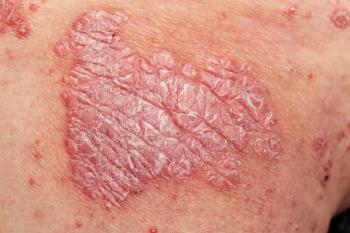
Abrocitinib 100 mg daily was initiated, later increased to 200 mg following a disease flare, resulting in significant improvement with less than 5% body surface area (BSA) involvement. After 7 months of therapy, a new eruption consisting of salmon-colored, scaly, well-demarcated papules and plaques developed, involving approximately 20% BSA. Lesions were morphologically distinct from prior AD and minimally pruritic.
Biopsy demonstrated psoriasiform epidermal hyperplasia, parakeratosis with neutrophils, and dilated capillaries surrounded by a lymphocytic infiltrate—findings consistent with psoriasis. Based on clinical presentation, histopathology, and temporal association with abrocitinib, a diagnosis of drug-induced new-onset psoriasis was made. Resolution of the eruption occurred after dose reduction to 100 mg daily, with no recurrence observed at follow-up.
Clinical Implications