

News|Articles|April 8, 2026
Earlier Acne Onset Tied to Greater Scar Severity in Adults
Listen
0:00 / 0:00
Key Takeaways
- Male sex, earlier onset, and longer acne duration were associated with higher scar prevalence and severity, supporting time-dependent cumulative inflammatory injury as a risk substrate.
- Treatment delay beyond 3 years was markedly enriched among scarred patients, whereas previous topical therapy, systemic treatment, and dermo-cosmetic use were more frequent in scar-free individuals.
A cross-sectional study of 403 acne patients found that higher impulsivity scores were significantly associated with both the presence and severity of acne scars.
Advertisement
A newly published study in the
Study Design and Population
The cross-sectional, case-control study enrolled 403 adult patients with AV (aged 18 to 65) at a single center in Turkey. Acne severity was graded using the Global Evaluation Acne (GEA) Scale, and scar severity was assessed with the Global Scale for Acne Scar Severity (SCAR-S), covering the face, chest, and back. Participants completed validated questionnaires measuring impulsivity (Barratt Impulsivity Scale-11 Short Form, BIS-11-SF), quality of life (Acne Quality of Life Instrument, AQLI), and psychological distress (Depression Anxiety Stress Scale-21, DASS-21). Patients with concurrent psychiatric diagnoses, eating disorders, or significant comorbidities were excluded.
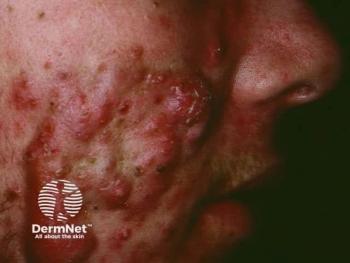
Of the 403 patients, 56% (n=226) had acne scars. Ice pick scars were the most prevalent subtype, present in 93.4% of that group, followed by box scars (76.6%) and rolling scars (69.5%). The cheeks were the most commonly affected site (97%).
Clinical and Demographic Predictors
Sex emerged as a strong independent predictor of scarring — 31.9% of the scar group were men, compared with 13.6% in the scar-free group (p<0.001). Patients with scars also had an earlier mean age of acne onset (15.53 vs. 16.89 years, p<0.001) and a longer mean disease duration (6.78 vs. 6.4 years, p=0.03), with scar severity correlating negatively with age of onset and positively with disease duration.
Oily skin type was significantly more prevalent among those with scars (37.6% vs. 22.6%, p<0.001), as were Fitzpatrick skin types 3 and 4. Pruritus was present in more than half (52.2%) of the scar group versus 15.3% of those without scars, and post-inflammatory hyperpigmentation was documented in 86.3% of scarred patients compared with 39% of non-scarred patients (both p<0.001). The authors note that the link between pruritus, scratching behavior, and scar formation warrants targeted preventive counseling in clinical practice.
Treatment Delay as a Modifiable Risk Factor
One of the most actionable findings relates to treatment timing. Patients with scars were substantially more likely to have waited more than 3 years after acne onset before seeking treatment — 42.9% of the scar group fell into this category, versus just 5.1% of those without scars (p<0.001). Conversely, scar-free patients had higher rates of prior systemic treatment (58.2% vs. 45.1%), topical therapy (90.4% vs. 72.6%), and dermo-cosmetic product use (89.8% vs. 73.9%). The authors highlight doxycycline specifically, suggesting its anti-inflammatory mechanism may confer protective effects against scar formation.
The Impulsivity-Scar Connection
The study's most novel contribution is its documentation of significantly higher impulsivity scores in patients with acne scars. Mean BIS-11-SF scores were 28.42 in the scar group versus 25.86 in controls (p<0.001), and a positive correlation was found between scar severity and impulsivity (r=0.16, p<0.001). The authors posit that impulsive traits may predispose patients to acne excoriation — a well-established trigger for post-inflammatory hyperpigmentation and scarring — and that this association is more likely attributable to the psychosocial burden of scarring than to pharmacological treatment effects, given existing evidence that isotretinoin does not significantly alter impulsivity.
The authors suggest that screening acne patients for elevated impulsivity and referring them for appropriate psychiatric support could serve as a practical preventive strategy.
Psychological Burden of Scarring
Patients with acne scars demonstrated significantly worse outcomes across multiple psychological domains. Total DASS-21 scores were higher in the scar group (18.15 vs. 14.86, p=0.002), driven by elevated depression and stress subscale scores. Quality of life, as measured by AQLI, was also meaningfully lower in this group (18.12 vs. 14.68, p<0.001), with scar severity correlating positively with both QoL impairment and psychological distress indices. Notably, anxiety scores trended higher in the scar group but did not reach statistical significance.
Clinical Implications
The authors conclude that acne scarring, affecting more than half of their cohort, is far from a purely cosmetic concern.2 The convergence of modifiable risk factors — treatment delay, inadequate use of topical and systemic agents, and high impulsivity — points to clear opportunities for earlier and more holistic clinical intervention. Routine psychosocial assessment, particularly in patients with more extensive or longstanding disease, may be warranted. The study's cross-sectional design limits causal inference, and its single-center data may affect generalizability, but the breadth of variables examined offers a useful framework for scar risk stratification in routine dermatology practice.
References
- Yanik Hİ, Acer E, Karaman İGY, et al. Impulsivity, psychological distress, and quality of life among the patients with acne vulgaris: factors related to acne scars. J Cosmet Dermatol. 2026;25(4):e70838. doi:10.1111/jocd.70838
- Zhou C, Vempati A, Tam C, et al. Beyond the surface: a deeper look at the psychosocial impacts of acne scarring. Clin Cosmet Investig Dermatol. 2023;16:731-738. Published 2023 Mar 25. doi:10.2147/CCID.S406235
Advertisement
Related Content
Advertisement




Advertisement
Advertisement
Trending on Dermatology Times
1
Biologic Therapy Linked to Lower 10-Year MACE Risk Across Racial Groups in Psoriasis
2
Former CDC Director Robert Redfield Joins Turn Therapeutics as Chief Scientific Officer
3
Body Weight, Not BMI, Associated With Brodalumab Response Trajectory in Plaque Psoriasis
4
FDA Grants QRX003 Rare Pediatric Disease Designation in Peeling Skin Syndrome
5