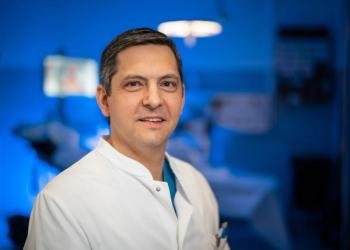
Falk G. Bechara, MD, discusses long-term tunnel control, structural damage, and the evolving role of biologics and surgery in HS care.
As one of California's first derm PAs, Stern discusses the mentorship-driven private practice model that launched her career and its near-disappearance today.
When Valerie Stern, DMSc, MPAS, PA-C, entered dermatology in 1998, patients in Los Angeles didn't always know what a physician assistant (PA) was. Now, she says, the opposite is true.
“I found myself paving the way for PAs today, where now it's not uncommon to see a PA in a dermatology office — in fact, it's probably more uncommon not to see one than it would be to see one.”
Stern practices general and cosmetic dermatology from an integrative standpoint in Los Angeles, holds faculty appointments at the
Stern credits her start to an unusually deep mentorship — trained alongside 6 dermatologists of varied backgrounds for roughly 18 months at her first private practice job. That model, she acknowledges, was exceptional even then. “I can't say that everybody was as lucky as I was. They were of all ages and genders, so I got different perspectives, which was beautiful.”
“I received an education in my first job that was second to none. I'm so incredibly grateful for that. I don't think I would be where I am today without those doctors and everything that they chose to do,” she said.
That practice environment — small, physician-owned, built around close collaboration — has largely given way to something different. Corporate consolidation has changed how new advanced practice providers (APPs) enter the specialty, and Stern is concerned about what's been lost.
PAs and nurse practitioners (NPs) enter dermatology without a residency, and derm represents only a small fraction of what they're tested on. Stern points to a structural reality: the PANCE exam covers dermatology at roughly 4–5% of total content — far less than internal medicine, cardiology, or pulmonology. That means even well-prepared new graduates arrive with limited specialty-specific exposure.
“They need a fair amount of partnership with that superior to kind of guide them and help train them, because this is very new for them,” Stern told Dermatology Times. She also flags a broader trend compounding the challenge: patient volumes in dermatology are rising exponentially, creating even more pressure on practice environments that may already be stretched thin when it comes to training time.
Valerie Stern, DMSc, MPAS, PA-C, is a dermatology PA in private practice in Los Angeles, CA. She serves on faculty at the Keck USC School of Medicine PA program, co-chairs the SDPA Diplomate Fellowship Program, and contributes to Learn Skin, an integrative dermatology education platform.