A retrospective claims analysis of 2897 matched pairs found hazard ratios of 0.48 to 0.67 for new atopic disease with dupilumab vs systemic corticosteroids in children.
Learn more about the in-depth topics covered in the July 2024 supplement of Dermatology Times.
The July
In a series of
Matthew Zirwas, MD, a board-certified dermatologist based at DOCS Dermatology in Bexley, Ohio,
Engaging With Physician Assistants
Zirwas welcomed 12 physician assistants in central Ohio to evaluate AD cases. Their insights and responses impressed him. “Anyone who doubts the quality of care provided by physician assistants hasn’t met these 12 professionals. Their thoughts and questions were phenomenally good,” he remarked.
Case 1: A 63-Year-Old Man With Persistent Itchy Spots
The first case involved a man aged 63 years with intensely itchy spots on his back, proximal arms, and legs. The spots had been intermittent for several years but became constant over the past 3 months. Despite lacking a personal or family history of atopy and having no rashes as a child, the man struggled with severe itching that disrupted his sleep. He had been tested for food allergies and was found to be allergic to corn, but avoiding corn did not improve his condition.
Diagnostic Challenges and Criteria
Zirwas highlighted the initial diagnostic challenges: “Based on his age and presentation, it would be reasonable to diagnose him with nummular eczema or AD at the first visit.” The discussion then shifted to the diagnostic criteria for AD established by the American Academy of Dermatology in 2014, which the FDA has endorsed.
Mona Shahriari, MD, FAAD, an assistant clinical professor of dermatology at Yale University School of Medicine and associate director of clinical trials at Central Connecticut Dermatology Research, hosted a
Case 1: Adolescent Female With Severe Itch Impacting Sleep
The first case concerned a girl aged 12 years with an intensely itchy rash, primarily in the bilateral, antecubital, and popliteal fossae. She had a history of AD since birth; it recently started affecting her sleep and social interactions due to discomfort and visible symptoms. Clinically, she showed patches and plaques on her antecubital and popliteal fossae and buttocks, with excoriation and yellow crusts in some areas, covering about 8% of her body surface area (BSA) with moderate inflammation.
Diagnosis Considerations
Shahriari discussed the importance of keeping a broad differential and considering biopsies when standard treatments are ineffective, especially in skin of color where diseases may manifest differently. The panel noted that postinflammatory pigment changes, like hypopigmentation or hyperpigmentation, can significantly affect quality of life and should be addressed early in treatment planning.
Individualized Treatment
Previous therapies had not fully worked, with some causing adverse events, prompting consideration of newer treatments like ruxolitinib (Jakafi; Incyte). The patient could safely use the cream in other areas and see itch relief in as fast as 15 minutes. The panel discussed some factors noted in caution labels but ultimately decided to move forward, considering supporting research that found no adverse events in patients with similar experiences. Shahriari noted that the panel hoped the drug would soon be approved for patients as young as 2 years.
Robert Posnick, MD, a board-certified medical dermatologist with Nashua Dermatology Associates in Nashua, New Hampshire, hosted a
Case 1: Adolescent Male With Hyperpigmentation Issues
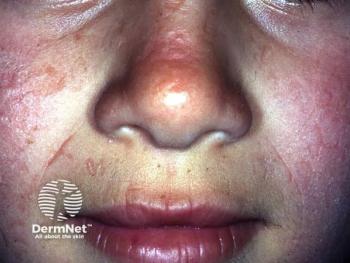
The first case involved a male aged 13 years with Fitzpatrick skin type IV, a skin of color patient with eczema since childhood. His primary complaint was hyperpigmentation in typical areas: the antecubital fossae and behind the knees, neck, and face. His primary care provider had prescribed triamcinolone cream, a common topical steroid, but the patient and his mother were concerned about persistent hyperpigmentation. Additionally, he had white patches on his face, initially misdiagnosed as a fungal infection but correctly identified as pityriasis alba, another manifestation of AD.
Treatment Considerations
To avoid chronic use of topical steroids, particularly on the face, Posnick decided to treat the patient with a topical calcineurin inhibitor. The safety issues of topical steroids vs topical calcineurin inhibitors were discussed, highlighting the risks of hypopigmentation and skin thinning from overuse of topical steroids. Tacrolimus ointment 0.1% was chosen for his treatment. The rare but potential risk of malignancies associated with topical calcineurin inhibitors was also addressed, although studies show this is very unlikely.
Plan Adjustments
The patient initially experienced stinging and burning from the topical calcineurin inhibitor and the PDE4 inhibitor crisaborole, leading him to revert to using topical steroids on his face. Posnick then recommended ruxolitinib cream as the next-best choice. The safety profiles of topical and oral JAK inhibitors were compared, emphasizing that the lymphoma and cancer risks associated with oral JAK inhibitors are not as pronounced with topical applications.