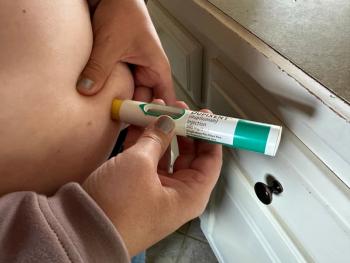
According to data presented at EADV, at week 16 of the phase 2 study, 47.8% to 62.5% of adults receiving tilrekimig achieved EASI 75 across doses, compared with 9.1% to 19.9% with placebo.
Judson Brewer, MD, PhD, discussed how the trigger-behavior-result habit loop model can be applied to itch-scratch cycles in atopic dermatitis.
Judson Brewer, MD, PhD, a psychiatrist and neuroscientist at Brown University's Mindfulness Center, joined the
Brewer explained that habits form around 3 key elements: a trigger, a behavior, and a result. In anxiety, for example, feelings of anxiety can trigger worrying, which may provide a temporary sense of control and reinforce the behavior even though worrying does not resolve the underlying problem.
“So any habit is formed with three key elements: a trigger, a behavior, and a result,” said Brewer.
Patricia Delgado, NP, host of the Skin & Psych podcast, presented the example of a performer experiencing stress before a major event. That anxiety could potentially
He noted that helping patients recognize that they are caught in such a cycle is an important first step. Mapping the process can transform an experience that feels unpredictable into one patients can begin to understand.
Rather than instructing patients simply to suppress an urge, Brewer described bringing nonjudgmental awareness to the behavior and
For worrying, patients may recognize that the behavior does not resolve their anxiety and may actually worsen it. Brewer suggested applying the same process to scratching by encouraging patients to examine what the behavior is actually providing.
“It’s not about judging ourselves and telling ourselves that we shouldn’t worry or we shouldn’t scratch,” said Brewer.
It’s not about judging ourselves and telling ourselves that we shouldn’t worry or we shouldn’t scratch, — Judson Brewer, MD., PhD,
According to Brewer, recognizing that a
In a clinical study involving patients with
Brewer emphasized that curiosity can also help patients experience an urge without immediately responding to it. Over time, patients can begin to recognize that urges arise and subside without necessarily requiring an action to make them disappear.
Brewer also discussed how clinicians can help patients recognize urges earlier, before they reach peak intensity. He recommended practices such as a body scan, performed before sleep or upon waking, to help patients become more familiar with physical sensations rather than distancing themselves from uncomfortable bodily experiences.
Alongside curiosity, Brewer emphasized
“I would say two main categories: curiosity and kindness, and they go really well together,” said Brewer.
For patients who struggle to extend compassion toward themselves, Brewer said he sometimes begins by asking them to recall a small act of kindness they received from another person and notice how that experience felt. From there, patients can consider experiences of showing kindness to others before eventually directing that same attitude inward.
Brewer described the process as a virtuous cycle in which practicing kindness toward oneself can, in turn, support greater kindness toward others.