Madalyn Nguyen discusses testosterone-associated acne, truncal involvement, skin barrier preservation, and interdisciplinary management strategies.
Priyanka Chadha, MBBS, and Andreas Nikolis, MD, PhD, FRCSC, discuss menopausal skin health, aesthetic care, and injectable treatment sequencing.
Hormonal changes associated with perimenopause and menopause can significantly influence skin structure, hydration, elasticity, and overall function. As interest in skin longevity and
In separate written interviews with Dermatology Times, Priyanka Chadha, MBBS, BSc (Hons), DPMSA, MRCS, MSc, FRCS (Plast), plastic surgeon and founder and director of Amer Clinic in London, United Kingdom, and Andreas Nikolis, MD, PhD, FRCSC, board-certified plastic surgeon and associate professor of plastic surgery at McGill University in Montreal, Canada, discussed the evolving landscape of menopausal skin care.
Chadha emphasized individualized patient counseling and realistic treatment expectations, while Nikolis explored emerging clinical evidence surrounding the sequencing of hyaluronic acid (HA) skin boosters and collagen biostimulators in
Together, their perspectives highlight the importance of integrating patient-centered consultations with a growing understanding of menopause-associated skin biology.
For many women, the onset of menopause-associated skin changes can feel unexpectedly rapid, particularly among those who have maintained consistent skin care routines throughout adulthood.
“Women who have maintained excellent skincare routines for years suddenly notice increased dryness, fine lines, loss of elasticity and a change in overall skin quality,” Chadha explained.
Declining estrogen levels contribute to reduced collagen production, altered hydration, and changes in skin barrier function. Patients may also experience increased sensitivity, slower healing, and more pronounced skin laxity, particularly around the lower face, jawline, and neck.
However, patients do not always recognize the relationship between these changes and hormonal transitions. Instead, they may perceive an acceleration in chronological aging, potentially affecting their confidence and influencing their interest in aesthetic interventions.
When patients describe relatively rapid changes in their skin during their 40s or 50s, Chadha encourages clinicians to explore whether they have experienced other
“I think it's important to normalise the conversation around menopause rather than medicalise every aspect of ageing,” she said.
Explaining the physiological mechanisms underlying these changes can help patients understand why previously effective skin care routines may no longer adequately address their concerns. For some patients, this understanding alone can provide reassurance and shift the conversation toward supporting skin health throughout a natural life transition.
Although menopause-focused aesthetic treatments continue to gain attention, Chadha emphasized that consultations should begin with understanding the patient's concerns rather than identifying a particular procedure.
“My starting point is always to ask, ‘What has changed about your skin that bothers you most?’ rather than immediately focusing on a particular treatment,” she explained.
Dryness, pigmentation, textural irregularities, facial volume loss, and skin laxity represent distinct concerns requiring different management approaches.
Chadha considers the timing of these changes, existing skin care routines, medical history, medications, menopausal symptoms, and previous treatments when developing an individualized approach.
Understanding the patient's desired outcome is equally important. Whereas some women may seek visible aesthetic rejuvenation, others may prioritize improved hydration, reduced sensitivity, or greater skin comfort.
“The consultation should be about listening first and treating second,” Chadha said. “Not every patient needs an injectable or device-based procedure, and understanding their expectations is essential to achieving a result that feels right for them.”
Chadha approaches menopausal skin health through a combination of prevention, maintenance, and targeted treatment.
Daily broad-spectrum sunscreen, appropriate moisturizers, and evidence-based active ingredients, including
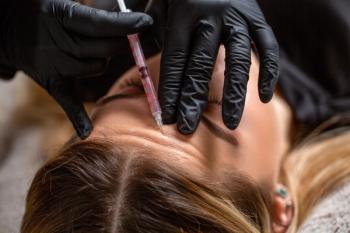
For patients seeking additional aesthetic improvements, injectable treatments and
However, Chadha emphasized that these treatment modalities are not interchangeable.
“A skin booster will not correct significant tissue descent, just as a tightening device cannot replace lost facial volume,” she explained.
Understanding these distinctions becomes particularly important as combination treatment strategies gain popularity. Rather than selecting multiple interventions solely to achieve more substantial aesthetic improvements, clinicians must consider how individual treatments address different components of skin aging and whether their sequencing may influence outcomes.
Emerging research is examining whether the order in which aesthetic injectable treatments are administered may influence improvements in skin quality among menopausal patients.
Nikolis discussed a prospective randomized clinical trial evaluating 2 injectable modalities: HA skin boosters (Restylane Skinboosters; Galderma) and poly-L-lactic acid (PLLA; Sculptra; Galderma), a collagen biostimulator.
The investigators hypothesized that improving skin hydration before administering PLLA could create a more favorable skin microenvironment for subsequent dermal remodeling.
“The premise was that using Restylane Skinboosters, which is known to improve hydration, would improve the microenvironment of the skin leading to a better state of skin health,” Nikolis explained.
Whereas HA skin boosters target aspects of skin quality such as hydration, PLLA stimulates endogenous collagen production, with aesthetic improvements developing gradually over time.
By examining the sequencing of these modalities, the investigators sought to determine whether their complementary mechanisms could influence the timing and magnitude of treatment outcomes.
According to Nikolis, patients who received HA skin boosters before PLLA experienced earlier aesthetic improvements.
Although improvements associated with both treatment modalities were observed by the end of the trial, one finding of particular interest involved changes in skin thickness.
“What was unique was that patients who received Restylane Skinboosters first and consequently Sculptra actually developed a 27.3% increase in skin thickness,” Nikolis said.
He suggested that these findings may reflect complementary effects between the 2 injectable treatments, with initial hydration potentially supporting subsequent collagen stimulation and dermal remodeling.
However, the observed increase in skin thickness does not independently establish a synergistic biological mechanism. Further comparative evidence is needed to determine whether this treatment sequence consistently produces superior outcomes and whether the observed changes translate into clinically meaningful long-term benefits.
The investigators evaluated treatment outcomes using a combination of clinician assessments, objective measurements, and patient-reported outcomes.
Visible aesthetic improvements were assessed using the Global Aesthetic Improvement Scale (GAIS), clinical photography, and blinded assessors who were unaware of treatment group assignments. Additional objective measurements evaluated skin hydration, barrier function, elasticity, surface texture, and skin thickness.
Patient-reported outcomes explored satisfaction with appearance, perceived naturalness of results, emotional responses when looking in the mirror, and willingness to recommend or repeat treatment.
Incorporating these measures alongside clinician assessments may help determine whether objective improvements in skin quality align with outcomes that patients consider meaningful.
Although the study lasted 9 months, Nikolis identified the exclusion of perimenopausal patients as an important limitation.
Restricting enrollment to menopausal patients allowed investigators to examine a more specific population. However, the findings cannot necessarily be extrapolated to women experiencing earlier hormonal transitions.
Additional research is needed to characterize differences in skin biology across perimenopause, menopause, and postmenopause, as well as how these differences may influence treatment response.
Nikolis indicated that ongoing research is also exploring alternative treatment schedules, including administering 1 or 2 initial HA skin booster treatments before transitioning to PLLA and potentially alternating the modalities thereafter.
These approaches remain investigational rather than established treatment protocols.
“Additional evidence in managing aesthetic changes for women at different stages of menopause is certainly much needed,” Nikolis said.
Longer-term studies evaluating treatment durability, safety, optimal sequencing, and patient selection may ultimately support the development of more standardized, evidence-based recommendations for menopause-associated aesthetic care.
As research into combination injectable treatments continues to evolve, Chadha cautioned against conflating improvements in skin appearance with demonstrated changes in the biological aging process.
The growing popularity of
“It shouldn't mean looking 30 when you're 60,” Chadha explained. “For me, it means maintaining healthy, resilient, well-functioning skin for as long as possible.”
She identified perimenopause as an opportunity to establish preventive habits, optimize skin care routines, and address emerging concerns before they become more pronounced.
Although research such as that discussed by Nikolis may help refine future treatment strategies, individualized patient assessment, transparent communication about the limitations of available interventions, and realistic expectations remain central to clinical decision-making.
Ultimately, the evolving landscape of menopausal skin care presents an opportunity to shift the focus from reversing visible signs of aging toward supporting skin health, function, and patient-defined quality of life.
“Menopause is not a cosmetic problem to be fixed,” Chadha concluded. “It is a normal life transition, and our role as clinicians is to help women navigate it with evidence-based advice, realistic expectations and treatments that genuinely benefit them.”
References