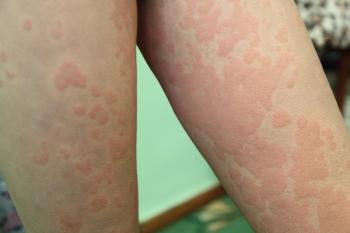
Dietary modification may improve disease activity and quality of life in some patients with chronic idiopathic urticaria.
Explore the potential of dupilumab for treating omalizumab-resistant chronic spontaneous urticaria, offering new hope for affected patients.
Chronic spontaneous urticaria (CSU) is a challenging inflammatory disorder characterized by recurrent wheals and angioedema lasting more than 6 weeks, significantly affecting patient quality of life due to persistent itching and daily functional disruption.1 While second-generation antihistamines remain first-line therapy, biologics are increasingly important for antihistamine-refractory CSU. Omalizumab, a monoclonal antibody targeting free immunoglobulin E (IgE), has been the mainstay of biologic therapy, demonstrating efficacy in approximately 80% of patients after 6 months of treatment.2 However, a subset of patients remains incompletely responsive, prompting consideration of alternative therapeutic strategies.
Dupilumab, an interleukin (IL)-4/13 receptor antagonist, has emerged as a potential option for CSU. Preclinical evidence implicates Th2 cytokines, including IL-4 and IL-13, in mast cell and eosinophil activation, suggesting a rationale for targeting these pathways.3 Clinical trials of dupilumab in CSU patients intolerant or unresponsive to omalizumab have reported mixed results. While primary endpoints, such as the Urticaria Activity Score over 7 days (UAS7) and Urticaria Control Test (UCT), did not achieve statistically significant improvements over placebo, the dupilumab arm demonstrated numerically higher disease control rates.4 This observation motivated an investigation of dupilumab in a real-world cohort of omalizumab-resistant CSU patients.
In a prospective pilot study at Nihon University Itabashi Hospital, 12 CSU patients with persistent UCT scores <12 despite receiving at least four doses of omalizumab were transitioned to dupilumab.5 Patients received an initial 600 mg dose followed by 300 mg biweekly, while continuing high-dose second-generation antihistamines. UCT scores were assessed at baseline (start of dupilumab) and at 1 and 4 months post-switch. Laboratory parameters—including eosinophil and basophil counts, serum IgE, C-reactive protein (CRP), and anti-thyroid peroxidase (TPO) antibodies—were also monitored. No patients received systemic corticosteroids or cyclosporine.
At the time of dupilumab initiation, the mean UCT score was 6.5 ± 2.2, showing a nonsignificant increase from pre-omalizumab baseline (4.9 ± 3.1). Following 1 month of dupilumab therapy, the mean UCT score rose to 8.4 ± 3.0 (P = 0.016), and at 4 months, it remained 8.1 ± 3.9 (P = 0.045). Three patients achieved a UCT score ≥12, meeting the threshold for effective disease control. Notably, 4 patients experienced decreased UCT scores compared with baseline, highlighting the heterogeneity of response. Laboratory markers and clinical characteristics—including baseline IgE, eosinophil and basophil counts, CRP, anti-TPO antibody status, and history of asthma or atopic dermatitis—did not differ significantly between responders and non-responders.
Interestingly, 3 patients who did not respond to dupilumab returned to monthly omalizumab, subsequently achieving UCT scores ≥12 within 1 month, with effects persisting beyond 3 months. This observation suggests that while IL-4/13 blockade may temporarily modify IgE-related pathways, the downstream impact on clinical disease control varies and may allow renewed responsiveness to omalizumab in certain patients.
These findings support the notion that dupilumab can provide modest, short-term symptom relief in a subset of omalizumab-resistant CSU patients. However, the overall improvements were limited, as mean UCT changes did not consistently meet the minimum important difference of 3 points. This variability underscores the need for an endotype-based approach to therapy, tailored to individual pathogenic pathways. Dupilumab may be particularly relevant for patients with comorbid atopic conditions, given its efficacy in atopic dermatitis and asthma.
Limitations of this study include its small, single-center design, short follow-up duration, and absence of UAS7 data. Biomarker evaluation was limited, and cost considerations contributed to therapy discontinuation in some patients. Nevertheless, these real-world data offer valuable insight into treatment sequencing for refractory CSU.
In conclusion, switching from omalizumab to dupilumab shows limited but measurable benefit in select patients with omalizumab-resistant CSU. While some patients achieve meaningful disease control, responses are heterogeneous, and predictors of efficacy remain unclear. Further studies with larger cohorts and integrated biomarker analyses are needed to define the patient subsets most likely to benefit from dupilumab and to optimize individualized treatment strategies in refractory CSU.
References