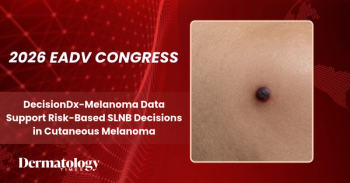
Prospective data suggest DecisionDx-Melanoma may help refine SLNB decisions and identify recurrence risk beyond conventional staging.
Orit Markowitz, MD, shares how a color-focused strategy helps spot early malignancies—even 2-mm lesions—across all skin tones.
At the 2025 Society of Dermatology Physician Associates Summer Dermatology Conference, Orit Markowitz, MD, founder and CEO of
In an interview, Markowitz explained how this approach improves diagnostic precision by keeping clinicians focused on what matters most: early recognition of malignancy, regardless of subtype or size.
“When we’re able to...decide whether something is benign or not, we’re already 10 steps ahead,” Markowitz said.
For many clinicians, particularly those newer to dermoscopy, pattern recognition can quickly become overwhelming. By leading with color assessment, both clinical and dermoscopic, Markowitz’s strategy offers a simplified path to diagnostic clarity. This is especially valuable when evaluating lesions in diverse skin tones, where pigmentation and morphology may vary.
“The other precedent for the color wheel approach was early amelanotic melanomas,” she said. “This is a topic that people are often a little bit anxious about—as they should be—because they’re difficult to diagnose, even on dermoscopy [and] noninvasive devices like confocal.”
Markowitz encourages clinicians to start with broad questions before diving into diagnostic complexity:
“What this enables us to do is catch these lesions very, very early,” she said.
This early catch is critical, particularly for fast-progressing malignancies like amelanotic melanoma or early squamous cell carcinoma. In her lecture, Markowitz emphasized that recognizing certain basic color patterns without needing to precisely subtype the cancer right away can be enough to trigger action.
“Even if it’s 2 mm in diameter, it’s malignant,” she said. “I know it’s early malignant. I need to remove it.”
Instead of overprioritizing exact categorization at the outset, she advocates for a more practical decision-making framework.
“I’m not going to worry too much about what category of benign or malignant. I’m going to focus on the big picture. Does it need to come off?” she said.
That mindset, Markowitz explained, can improve both diagnostic speed and accuracy while minimizing unnecessary biopsies. It also makes the process more inclusive, as clinicians become trained to look at pigment and color more carefully across skin tones.