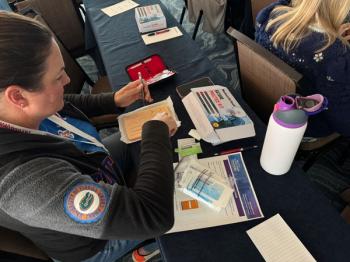
Faculty from the Cutaneous Oncology Workshop answer practical questions spanning skin cancer prevention, diagnosis, treatment, and follow-up.
Andrew Baker, MBA, MPAS, PA-C, discusses new data highlighting both the growing challenges—like burnout and reimbursement cuts—and exciting opportunities in leadership, virtual care, and mentorship for PAs and NPs.
As demand for dermatologic care rises and the roles of advanced practice providers continue to expand, new data from the Point of Care Network (POCN) Group highlights both the challenges and opportunities facing physician’s assistants (PAs) and nurse practitioners (NPs) in the field. In this Q&A, Dermatology Times spoke with Andrew Baker, MBA, MPAS, PA-C, a practicing dermatology PA based in Columbus, Ohio, at DOCS Dermatology and president-elect of the Society of Dermatology Physician Assistants (SDPA). Drawing on recent insights from the POCN Group’s data, he shared his perspective on workforce trends, virtual care, burnout, and the expanding leadership roles of advanced practice providers in dermatology.
DT: Could you highlight some of the most significant findings from POCN Group’s recent data?
Baker: What POCN has really done is they've really carved out the specific niche that PAs and NPs are playing. And in this case, in dermatology, people get into the field because we love patient care. We love dermatology. It excites us. The innovation in this field is really unmatched compared to other specialties. But also, what's happening is we're being asked to see more patients in the same time slots, or smaller time slots, more acuity, more procedures, all things that can just lead to burnout over time. And so really what's happening is as the professions of PAs and NPs have been really getting more years underneath their belts, and there's a lot more programs out there, better education models and better resources for them, we're able to really go into other capacities outside of just practicing clinical medicine, such as leadership roles, pharmaceutical roles, publications. And then really helping go into some areas that have underserved patient populations to help offer care to these patients who would otherwise be left with a very long wait time or drive time to see somebody for their problem. Additionally, the number of PAs and NPs doing non-clinical roles has really increased in recent years, in clinical trials, research publications, and in the pharmaceutical industry. Historically, this was mainly driven by physicians, so it's been nice to see other people be recognized for their knowledge and their skills and being put in some of these roles that historically they were not.
DT: What is the advantage of virtual care platforms, especially for NPs and PAs working in high-volume settings?
Baker: Really, it boils down to access. Improving access to health care that's more amenable to people's lifestyles is going to get them to take even more ownership of their condition. If it's difficult for people to get off of work or drive or get through traffic or whatever it may be, they can do it for the comfort of their own home or their office. It allows them to be much more up to date with their health and compliant with their health care treatments.
DT: What are some of the biggest challenges dermatology NPs and PAs are facing regarding burnout, peer support, and finding opportunities
Baker: Well, reimbursement is constantly being cut, and this is not unique to just PAs and NPs. It's also to physicians as well. But oftentimes, if PAs and NPs are not the practice owners, their salaries might suffer first, but everyone is affected by this for sure. Then you've got to get a little bit more creative with your scheduling and the time involved. Sometimes there's pressure if you want to keep your same income to maybe see more people, learn new procedures, travel more...all things that can be really great and valuable to your career. But for some people can really increase their rate of burnout.
DT: What specific leadership roles and mentorship opportunities are you working to create for NPs and PAs to advance their career path?
Baker: I feel like it's a wonderful opportunity to be working with lots of other like-minded, very smart, motivated people in SDPA and other organizations with PAs and NPs in this space. So it's really been a pleasure and I feel fortunate to do that. But we're trying to just get creative on finding ways to give unique opportunities for people to maximize their career and really just empower them to do that through unique models of education, training, leadership academies - trying to find the people who want to be the leaders and really empower them to grow throughout their career. So I would say my long-term goal is to just see this come to fruition, to see other people growing up through their career, mentoring other people, paying that forward, and ultimately, just helping our peers better care for patients.
DT: As a well-established leader in the field, especially among PAs and NPs, what advice do you have for someone looking to take the next steps in their leadership journey?
Baker: Get involved to some degree. Leadership and volunteerism can be something that can work into your lifestyle initially, just to give you a taste of what it's like to be on the other side of the profession. That's one thing I love about PAs and NPs - their careers are very diverse. It's one of the things that attracted me to it, at least initially. So really, just get involved. You're going to meet other people. The networking that comes from these events is crucial. You're going to learn things you didn't know existed, and that is all part of the excitement of growing professionally and moving on to the next phase of your career.
DT: What is your message to dermatologists and clinicians watching this, especially those who work closely with PAs and NPs?
Baker: Collaboration is key. PAs and NPs are collaborators; we are part of the team. With the physicians we work with, even though we're all trained slightly differently, if we all work together and collectively, we can really do great things together. So just finding a way to utilize the teamwork as a team, knowing your roles within the team, and then maximizing your outputs based on what your role is on the team.
DT: Is there anything else you’d like to share with our audience?
Baker: I definitely wanted to point out a dermatology PA, who won POCN's award for America's Top PA and NP, which is Douglas DiRuggerio, DMSc, MSPAS, PA-C. He is somebody who's done so much for the dermatology field, and I think it's wonderful to see POCN recognize this individual. He's already recognized by the SDPA and other organizations but it's really reassuring to see POCN recognize that as well and elevate him for this award.