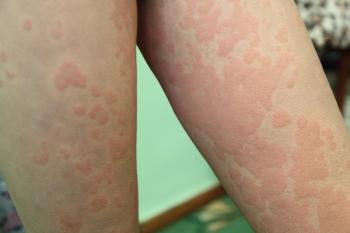
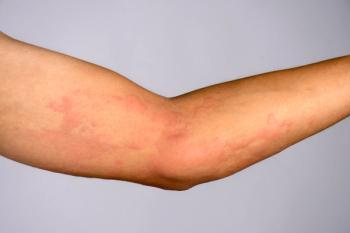
Barzolvolimab (Celldex Therapeutics), an investigational anti-KIT monoclonal antibody, met the primary end point and all key secondary end points in 2 phase 3 trials in chronic spontaneous urticaria (CSU). Topline results from EMBARQ-CSU1 and EMBARQ-CSU2, announced by Celldex on September 22, 2026, included adults whose disease was inadequately controlled by H1 antihistamines. Both dose regimens significantly reduced weekly urticaria activity score (UAS7) vs placebo at week 12, with efficacy sustained or deepened through week 24.1
Barzolvolimab binds the receptor tyrosine kinase KIT, which mast cells require for activation and survival, depleting mast cells directly rather than blocking a single upstream trigger.2 In the phase 2 trial (NCT05368285), 51.1% of patients receiving 150 mg every 4 weeks achieved complete response (UAS7 = 0) at week 12 vs 6.4% with placebo.2 The phase 3 program was designed to confirm these findings in a larger population, including patients with omalizumab-refractory disease.1
EMBARQ-CSU1 (NCT06445023) and EMBARQ-CSU2 (NCT06455202) are randomized, double-blind, placebo-controlled, parallel-group global studies enrolling 1,939 patients (963 and 976, respectively).1 Participants were randomized evenly to barzolvolimab 150 mg every 4 weeks after a 300-mg loading dose, 300 mg every 8 weeks after a 450-mg loading dose, or placebo.1 Patients receiving placebo were re-randomized to active treatment at week 24, and active treatment continues through week 52.1
In EMBARQ-CSU1, least squares (LS) mean UAS7 change from baseline at week 12 was −20.2 with 150 mg every 4 weeks and −20.5 with 300 mg every 8 weeks.1 The placebo arm showed a change of −10.7 (P < .00001 vs placebo for both doses).1 In EMBARQ-CSU2, corresponding LS mean changes were −20.2 and −19.7 vs −11.4 with placebo (P < .00001 for both).1
Frequently Asked Questions
What is barzolvolimab being studied for?
Barzolvolimab is an investigational anti-KIT monoclonal antibody in phase 3 evaluation for adults with chronic spontaneous urticaria inadequately controlled by H1 antihistamines. Celldex plans to submit a Biologics License Application to the FDA in 2027.
How does barzolvolimab work?
Barzolvolimab binds KIT, the receptor mast cells depend on for activation, tissue recruitment, and survival. This depletes mast cells regardless of the upstream pathway driving their activation.
What did the EMBARQ-CSU trials show?
Both trials met the primary end point of UAS7 change from baseline at week 12 with both dose regimens (P < .00001). Complete response rates at week 12 ranged from 42.1% to 45.7% with barzolvolimab vs 9.3% to 12.6% with placebo.
Diane Young, MD, senior vice president and chief medical officer at Celldex, highlighted results in populations with limited options. "Barzolvolimab continued to show unprecedented complete response rates across the overall studies and demonstrated strong differentiation in patient populations underserved by existing therapies, including those with severe disease or angioedema, and those whose disease is refractory to omalizumab," Young said in the news release.1
Complete Response, Angioedema, and Safety Results With Barzolvolimab
Complete response rates at week 12 were 42.4% with 150 mg and 42.1% with 300 mg vs 9.3% with placebo in EMBARQ-CSU1, and 45.7% and 44.0% vs 12.6% in EMBARQ-CSU2 (P < .00001 for all). By week 24, complete response rates rose to 49.0% and 45.1% vs 15.4% in EMBARQ-CSU1 and to 54.0% and 48.4% vs 17.6% in EMBARQ-CSU2.1
Among patients with omalizumab-refractory CSU in EMBARQ-CSU1, week 12 complete response rates were 55.3% with 150 mg (P < .00001) and 44.3% with 300 mg (P = .00017) vs 9.3% with placebo. In EMBARQ-CSU2, rates in this subgroup were 41.7% (P = .0089) and 46.4% (P = .0036) vs 15.1%, respectively.1
Among patients with baseline angioedema (7-day Angioedema Activity Score [AAS7] > 0), complete angioedema resolution (AAS7 = 0) at week 12 occurred in 62.7% and 66.3% of barzolvolimab-treated patients vs 33.8% with placebo in EMBARQ-CSU1. Corresponding rates in EMBARQ-CSU2 were 74.3% and 66.2% vs 33.7% (P < .00001 for all).1
Celldex reported barzolvolimab was well tolerated through the 24-week placebo-controlled period, with a safety profile consistent with prior studies.1 The company has not yet released adverse event rates from the phase 3 program. In the phase 2 trial, the most common treatment-emergent adverse events with barzolvolimab were urticaria (10.3%), hair color changes (9.0%), and neutropenia (7.7%), which was not associated with infections.2
Eligible patients completing either trial may enter an ongoing global phase 3b long-term extension study. Celldex plans to present the full EMBARQ-CSU data at an upcoming medical meeting and to submit a Biologics License Application to the FDA in 2027. The company positions barzolvolimab as a potential first-line advanced therapy for severe CSU or angioedema and as a second-line option after other advanced therapies.1
References
- Celldex announces positive results from phase 3 EMBARQ-CSU1 and EMBARQ-CSU2 studies of barzolvolimab which met primary and all key secondary endpoints. News release. Celldex. September 22, 2026. Accessed September 22, 2026. https://ir.celldex.com/news-releases/news-release-details/celldex-announces-positive-results-phase-3-embarq-csu1-and
- Metz M, Mitha E, Leflein J, et al. Randomized dose-finding study of anti-KIT barzolvolimab in patients with chronic spontaneous urticaria. J Allergy Clin Immunol. Published online February 24, 2026. doi:10.1016/j.jaci.2026.02.018