No skin lesion flares occurred through 16 weeks after patients with an inadequate response to dupilumab switched, and itch flares occurred in 3.6% to 4.8% of evaluable patients.
Multidisciplinary experts rethink advanced cutaneous squamous cell carcinoma care, weighing immunotherapy options, trial data limits, adverse events, and smoother dermatology-oncology referrals.
Cutaneous squamous cell carcinoma (cSCC) is usually treated with surgery or radiation, but when the disease advances beyond curative-intent treatment, management stops being a single specialty’s decision. At 3 recent
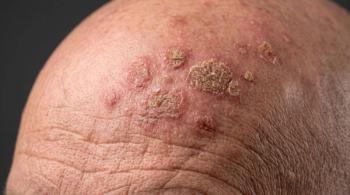
All 3 events reviewed a 72-year-old man with hypertension and hypercholesterolemia, no immunosuppression, and no prior skin cancers who presented with an atrophic plaque and erythematous papulonodules on the left central frontal scalp. CT imaging identified a left parotid-region lymph node measuring 26 mm and concerning for metastasis, and fine needle aspiration confirmed metastatic squamous cell carcinoma. Mohs surgery cleared the tumor in 1 stage, with a final defect of 4.3 by 4.1 cm.
Left parotidectomy found 1 of 18 lymph nodes positive for metastatic disease without extranodal extension, and pathology showed poorly differentiated histology with extensive perineural invasion of nerves 0.2 mm in caliber. The patient went on to adjuvant radiation at 5500 cGy over 20 fractions. Attendees across the 3 events agreed that surgery and radiation alone would not be sufficient.
“Super aggressive case, but radiation alone is not enough for this gentleman,” an attendee at Bhatia’s event said.
One attendee floated downsizing the tumor before further treatment. “You could consider neoadjuvant therapy [to] downsize, and then you do Mohs or follow up with whatever adjuvant or radiation, depending on what you come up with,” the attendee said. Bhatia agreed, prompting discussion of why neoadjuvant systemic therapy is not yet standard thinking for many dermatologists managing high-risk cSCC.
When Rigel asked his group whether they would refer this patient for additional systemic therapy, the answer was consistent across both the dermatology and oncology sides of the table. Every dermatologist in the room indicated they would refer patients with advanced disease rather than initiate systemic therapy themselves. Several emphasized continuing to counsel patients before the handoff. “Being in the community, there is a bigger hospital system which would work up imaging and have a tumor board, which I don’t have in private practice,” an attendee said. “I was the one who referred them for management, which would definitely include systemic therapy, at least historically.”
Three PD-1/PD-L1 checkpoint inhibitors anchored discussion at all 3 events: cemiplimab (Libtayo; Regeneron), pembrolizumab (Keytruda; Merck), and cosibelimab (Unloxcyt; Sun Pharma).1-3 Cemiplimab and pembrolizumab are both anti–PD-1 antibodies that block PD-1 on immune cells, while cosibelimab blocks PD-L1 on tumor cells. Moderators noted cosibelimab may also engage natural killer cells through a secondary pathway, a mechanistic distinction from the shared PD-1 mechanism of the other 2 agents.4,5
When Rigel asked whether this mechanistic difference influenced drug selection, attendees were largely unmoved. “I’m hearing a lot of negative [headshaking] here,” Rigel said. “So really, you care about efficacy primarily, and adverse events.”
Across all 3 events, attendees reviewed data from the pivotal trials for each agent: CK-301-101 (NCT03212404) for cosibelimab, KEYNOTE-629 (NCT03284424) for pembrolizumab, and EMPOWER-CSCC-1 (NCT02760498) for cemiplimab.6-8 In locally advanced disease, objective response rates were 54.8% for cosibelimab, 51.9% for pembrolizumab, and 44.9% for cemiplimab, with complete response rates of 25.8%, 22.2%, and 12.8%, respectively. Response durability was comparable, with a 12-month duration of response above 83% for all 3 agents in this setting.
In the metastatic setting, objective response rates were 50.0% for cosibelimab, 35.2% for pembrolizumab, and 50.8% for cemiplimab at the every-2-week dosing schedule. Complete response rates in this setting ranged from 12.4% to 20.3% across agents. Rigel highlighted a key difference in baseline characteristics across the trials: Patients in the cosibelimab study had notably less prior systemic therapy exposure, 9.0% and 3.2% across the metastatic and locally advanced cohorts, compared with rates as high as 86.7% in the pembrolizumab trial and 33.7% in some cemiplimab arms.
Because the 3 pivotal trials enrolled different populations and were never compared head-to-head, attendees at Singh’s event were disciplined about not overreading cross-trial efficacy rankings. A meaningful share of cemiplimab and pembrolizumab patients had received prior therapy, while cosibelimab’s cohorts were largely treatment naive. One attendee at Bhatia’s event was nonetheless drawn to the numbers.
“Cosibelimab looks like a winner here,” one attendee said, pointing to its locally advanced results. Bhatia agreed that the agent performed somewhat better at 6 months and held up at 12 and 24 months, though he cautioned that the comparison spanned 3 separate trials with different populations.
The question about complete response drew the sharpest exchange at Singh’s event. “If you have metastatic disease, you want to get a [complete response], not a [partial response],” an attendee argued, saying a complete response is more meaningful than stable disease in the metastatic setting. Singh offered a dermatologist’s counterpoint: “The partial response rate, however, that’s what some of my patients want,” describing patients whose goal is stable disease.
This supplement has been produced independently by Dermatology Times and supported through an educational grant by Sun Pharmaceuticals.
Click here to download the full supplement:
Stay tuned for parts 2 and 3 coming later this week!
References
1. Libtayo. Prescribing information. Regeneron Pharmaceuticals; 2025. Accessed July 23, 2026. https://www.regeneron.com/downloads/libtayo_fpi.pdf
2. Keytruda. Prescribing information. Merck; 2026. Accessed July 23, 2026. https://www.merck. com/product/usa/pi_circulars/k/keytruda/keytruda_pi.pdf
3. Unloxcyt. Prescribing information. Sun Pharmaceuticals; 2025. Accessed July 23, 2026. https:// unloxcyt.com/prescribing-information.pdf
4. Moreno-Ramírez D, Silva-Clavería F, Fernández-Orland A, Eiris N, Ruiz de Casas A, Férrandiz L. Surgery for cutaneous squamous cell carcinoma and its limits in advanced disease. Dermatol Pract Concept. 2021;11(suppl 2):e2021167S. doi:10.5826/ dpc.11S2a167S
5. Burshtein J, Schlesinger T. Cosibelimab: a novel therapeutic for advanced cutaneous squamous cell carcinoma. J Clin Aesthet Dermatol. 2025;18(11):21-23.