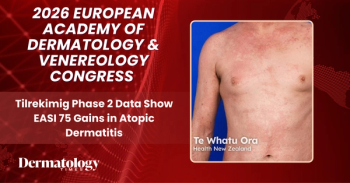
According to data presented at EADV, at week 16 of the phase 2 study, 47.8% to 62.5% of adults receiving tilrekimig achieved EASI 75 across doses, compared with 9.1% to 19.9% with placebo.
In this month's Clinical Considerations, we look at handling the difficult patient, how to improve our diagnostic skills and the latest psoriasis drug approval.
Joe Gorelick, MSNDear Colleagues,
In this month's Clinical Considerations, we look at handling the difficult patient, how to improve our diagnostic skills and the latest psoriasis drug approval.
How many times have you encountered a patient that you knew was going to be 'trouble'? These type of patients can be the bane of our existence and lower the morale of the entire office staff. I always remind my staff to focus on the positive encounters and meaningful exchanges we have with the majority of our patients. Yet it can be challenging not to dwell on negative encounters and difficult interactions.
Do you scrape enough? A topical steroid prescription followed by the worsening of a fungal infection is an embarrassing way to diagnose a fungal infection. We can do better! In addition to our visual diagnostic skills, simple office tests such as KOH preps can help us improve our diagnostic acumen. In this
Brodalumab, a newly approved biologic agent, will soon be available to treat our patients with moderate-to-severe plaque psoriasis. It blocks the receptors for IL-17, as opposed to existing IL-17 agents (Cosentyx and Taltz) which exert their effect as IL-17 antagonists. However, this agent has been tagged with a Black Box warning for suicide or suicidal ideation because suicides occurred in the trials. It is important to note that a causal relationship between Brodalumab and suicide or suicidal ideation has not been established. This warning will be listed on the label and this agent will require an Isotretinoin/Ipledge-like monitoring system to dispense.
Best,
Joe Gorelick, MSN, FNP-C, Dermatology Education Foundation Founder and Chairman