





Atopic Dermatitis
Latest News
Advertisement
Latest Videos




CME Content


Advertisement
More News

Delgocitinib is first-in-class pan-Janus kinase inhibitor.

The results from this 5-year open-label extension trial affirm the safety of dupilumab in adults with moderate to severe AD.

Almost 80% of patients in an extension study maintained clear or almost clear skin, and 90% of patients saw continued improvements in itch.

An expert in dermatology presents the case of a 58-year-old male who has struggled with long-standing atopic dermatitis. The presentation delves into the considerations between topical and systemic treatments and sheds light on the intricacies of managing patients with comorbidities, extensive treatment histories, and the challenges posed by prior authorizations.
Ted Lain, MD & MBA, FAAD, provides an overview of a roundtable discussion centered around a challenging case of a 28-year-old female experiencing recurrent flaring atopic dermatitis. He shares insights from a panel of dermatologists regarding their recommended treatment approach, emphasizing the incorporation of a novel topical treatment to achieve enduring disease remission.

Investigators said that additional, larger studies are needed to assess the safety of live attenuated vaccine administration for pediatric AD patients being treated with dupilumab.

The most common conditions or concerns patients reported having that may influence their selection of a JAK inhibitor included an increased risk of MACE and an age above 65 years.
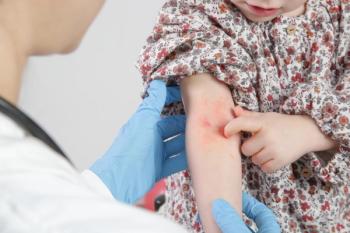
Little is known about the ways primary care physicians should treat or manage atopic dermatitis in their patients, according to the review.

Lisa Sanglay, FNP, and Lauren Miller, PA-C, interviewed a patient at IDS 2023 who used to have debilitating atopic dermatitis before seeing Sanglay for help and who prescribed upadacitinib.

Skin clearance, itch relief, and reduced severity of atopic dermatitis were sustained with monthly maintenance dosing.

With October being National Eczema Awareness Month, there is robust research about the power of the microbiome and eczema.

While blue light irradiation was efficacious in reducing itch and IL-31 levels, it did not reduce any of the objective measures of AD.

The expanded study data correlates with the safety and efficacy of ruxolitinib cream in patients with atopic dermatitis.

Sanofi’s phase 3 program for amlitelimab in atopic dermatitis will start in early 2024.

Almirall presented new data on lebrikizumab at EADV related to clinical improvements and clinically-meaningful treatment responses among patients with atopic dermatitis.

This month's cover feature delves into the new applications and use of AI in dermatology and considers how AI can support clinicians rather than hinder them.

New data from ADORING 1 and ADORING 2 show a rapid reduction in pruritus relief as early as 24 hours after the first application.

Darren West, MPAS, PA-C; and Jayme M. Heim, MSN, FNP-BC, share their approaches to educating patients on use of steroids for dermatologic conditions, highlighting how they approach pediatric patient populations.
Experts in dermatology discuss the benefits of improved topical steroidal vehicle excipients and their impact on treatment duration and response.
Linda F. Stein Gold, MD; Jayme M. Heim, MSN, FNP-BC; and Darren West, MPAS, PA-C, review the adverse effect profiles of steroidal and nonsteroidal treatments, focusing on hypothalamic pituitary adrenal axis suppression.
Darren West, MPAS, PA-C; and Jayme M. Heim, MSN, FNP-BC, comment on how steroids continue to fit into the topical treatment armamentarium.

Dermatologist Diego Ruiz Dasilva, MD, FAAD, and a patient with atopic dermatitis discuss the patient journey from initial symptoms to diagnosis to treatment selection.

The data presents compelling evidence for the sustained efficacy and safety of the oral JAK1 inhibitor in the treatment of moderate to severe atopic dermatitis over an extended 140-week period.

The impact begins in utero, with the diet and health of the mother playing a key role in the potential for a child to develop diseases.

The grant will go toward supporting the group's project, "Atopic Dermatitis is More Than a Skin Disease: Raising Awareness and Improving Care."
Advertisement
Advertisement
Trending on Dermatology Times
1
Beyond the Skin: How Inflammation Connects Dermatologic Disease
2
DermNexus 2026 Day 1 Recap: Emerging Therapies and Clinical Insights
3
Guselkumab in Axial Psoriatic Arthritis: Phase 4 STAR Trial Results
4
Q&A: Where Skin Cancer Prevention Falls Short, With Leigh Ann Pansch, NP
5