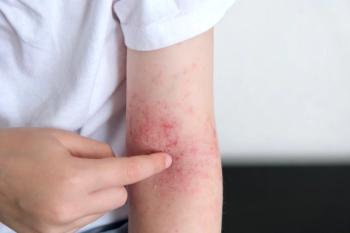
SYX-5219 improved disease severity and itch in a Phase 1b trial of adults with moderate to severe atopic dermatitis.
Learn more about the in-depth topics covered in the November 2023 print issue of Dermatology Times.
The November issue of Dermatology Times includes a collection of thought-provoking articles and topics ranging from age considerations for atopic dermatitis care to investigating the link between cancer and psoriasis management. Be sure to take a look at the highlights from the issue below. Also, don’t miss a moment of Dermatology Times by signing up for our
Understanding the clinical presentations in adult versus pediatric patients is crucial for making an accurate diagnosis and then developing an appropriate treatment regimen. In an interview with Dermatology Times, Raj Chovatiya, MD, PhD, and Lawrence Eichenfield, MD, shared their insights and key treatment pearls. Although certain fundamental characteristics of AD remain consistent across age groups, such as lesions in flexural areas, a history of atopy, and xerosis, there are noteworthy differences. AD is more prevalent in pediatric patients, but Chovatiya explained that there is a better understanding of adult-onset AD.
Access to medical care, including dermatological health care, has been a persistent challenge for individuals within the American Indian/Alaska Native (AIAN) communities. “Despite increasing evidence of health status inequities affecting Indigenous populations, health services often fail to address health and social inequities as routine aspects of health care delivery,” according to authors of a 2016 ethnographic study. Globally, measures of health and well-being of the AIAN community fall significantly behind those of the general population, and life expectancies of AIAN individuals are projected to be dramatically lower than average.
Until recently, there was a lack of internationally agreed-upon guidelines for the treatment of vitiligo. Recently, a significant breakthrough was achieved when 42 international vitiligo experts and 4 patient representatives collaborated and developed a consensus management strategy for vitiligo. Their expert-based clinical practice recommendations encompass the latest evidence on topical and systemic therapies, phototherapies, interventional approaches, and innovative treatments. Managing this condition has been challenging, primarily because there were no international consensus-based guidelines.
Research within the past few decades has elucidated the immune-mediated nature of the psoriasis and the specific elevated levels of chemokines and cytokines that promote inflammation in this disease. Many different cell types are involved, including keratinocytes, natural killer T cells, dermal dendritic cells, and macrophages. Activated dermal dendritic cells secrete IL-12 and IL-23, and both of these cytokines are integral in the cellular cascade of psoriasis pathophysiology. IL-12 causes differentiation of native T cells to Th1 cells (which produce IFN-γ and TNF-α), and IL-23 is important for the proliferation of Th17 cells, which produce IL-17 and IL-22. This pathway allows for the revolutionary use of multiple highly effective biologic therapies for psoriasis that antagonize TNF-α, IL-12, IL-17, and IL-23.
almost 3 years ago
I Was in a Hurry, and I Was Suedalmost 3 years ago
AD Case Study: Topical Steroids Are Not Cutting Italmost 3 years ago
Why Dermatologists Are Not Average Investorsalmost 3 years ago
New International Vitiligo Task Force Recommendationsalmost 3 years ago
Navigating the Complexities of Atopic Dermatitisalmost 3 years ago
Investigating Links Between Cancer and Psoriasis Managementalmost 3 years ago
Key Considerations for Optimal Atopic Dermatitis Care Across All Agesalmost 3 years ago
Understanding Topical Growth Factors and Skin Rejuvenation